


-
If one would like to, at sometime, own an early acoustic L5 before they shuffle off this mortal coil, and in the meantime a nice L12 came along, would that scratch the itch?
Are all L12s, in satisfactory condition, desirable?
Thanks
-
06-13-2024 03:57 PM

-
Sure, they could sound better on a case-by-case basis. Much the same as an L7. An L12, L7, L10 or and L4 can do quite well against an L5 for playing in any practical sense. The problem is that they are simply not L5's. I have to admit I am drawn by the designation, history. and overall mystique of THE L5. If you can skip the baby steps and go with an L5.
l
-
Yes. Yes.
 Originally Posted by garybaldy
-
-
Thanks Mark and Hammer for your thoughts.
I'm looking in the UK. Not quite ready to fund a 30s L5 but there's one over here which is 12k and there's a post war L12 that is open to offers which would be easier on the wallet.
I think I'd be still yearning for an L5 though. It would be ideal to try them both side by side.
-
Post-war 17" carved Gibson archtops are usually quite different than pre-war 17" carved Gibson archtops. Typically, they are all excellent-sounding instruments.
-
Thanks. Originally Posted by Hammertone
Are you saying the post war instruments are as good but different or better ?
-
I had a Loar L5 that I had to sell many years ago. An L12 would definitely fill that void.
-
I would hope Jonathan Stout would chime in.
For me, it may just have been expectations or the lack of them, and that '37 L-7 that found me.
I guess deep down I'd have expected an L-5 from that era to knock me out.
But no way did I expect that L-7 to sound as good as it did. If you want some low end, lay into it, and it's there.
If it's highs you want, they're there too, and can be gotten effortlessly.
I'd probably walk into a store that had both a vintage L-5 and L-7, and ' pretend ' I'm looking for a vintage L-5, but I'd walk right past it and try the L-7 first.
Lots of good luck - - the guitars of this era really are magic !!
-
Thanks Originally Posted by Dennis D
I've read about Jonathan Stout's quests and realise his goal has always been acquiring L5s (I believe an L12 on route). I love his playing and would like to hear his comments.
-
I have played many L7's that were sound wise better than typical L5's. You really have to judge each guitar and its specs individually. 1930'S L5 usually do not ever disappoint. But neither do L7's. The issues sometimes are age and repairs, the collectors don't like some part of the deal. The Rhythm Man can chime in he is a source for sure.
-
I had a 1938 L-10. It was a rare find and started by removing any urge I had to have an L-5. That bird in the hand completely de-mystified the L-5 hunger for me. As I became a better player, I bonded with that instrument and it turned out that I could never find another instrument that could do what that guitar could.
I had a student who had an old L-7. Another once in a lifetime keeper.
Gibson made lots of phenomenal guitars of which the L-5 was just one in those amazing lineups.
I don't know how much the magical name of L-5 means to you but in terms of worthy and superior Gibsons, there are many out there that don't say "5" on them.
Read old reviews of players from that era. Many played instruments that they made their legendary careers on. Only a fraction of them were Gibson L-5's. We have put the L-5 on a pedestal over time especially by Gibson when their line got thinned. Once upon a time there was a large family of amazing instruments and the L-12 was an amazing member of that line up. If it's in good shape, you may have found a gem. Only you will know.
-
I could be wrong but it seems an L7 is talked about as an L5 alternative a lot more than is an L12. In terms of hierarchy I believe it goes, from the top down, L5 - L12 - L7. Originally Posted by deacon Mark
-
From a players' perspective, many times the same luthiers, the same or more modestly figured wood, or the amount of trim (and time it takes to incorporate it) were the determining factours in the heirarchy of an instrument. Originally Posted by garybaldy
My L-10 had a rosewood fingerboard which I felt was more resonant than ebony used in an L-5. It was also not as hard to find so it didn't cost as much to build strictly from a materials standpoint. Contrary to popular indoctrination, there is nothing inferiour about a good rosewood fingerboard but it was cheaper to acquire so instruments built with it could be made with a lower pricetag. Back wood with less spectacular figure, same story. A deeply flamed bookmatch maple back is a great candidate for a blonde finish and a serious price upgrade, but is it better than a more modestly figured back with a dark sunburst (as was the trend back then)? No. I'd take a quartered modest figure over a skew flame back any day but the consumer factour is the determining one. High flame L-5 holds the same prestige even though the L-12 is built with the same care and quality materials.
This is an industry of mystique and aesthetics. Get over that and you may indeed wind up with the better guitar. Could happen.
-
My 63 175 and 2005 L5CES were literally on my doorstep but I will have to travel to try these other instruments. I wouldn't purchase them without trying them. There is a '47 ES300 near me but it's not what I'm after. Originally Posted by Jimmy blue note
-
Thankyou for your insight and wise words. Originally Posted by Jimmy blue note
-
Yes, but entirely depending on the individual instrument and what your ears prefer. Originally Posted by garybaldy
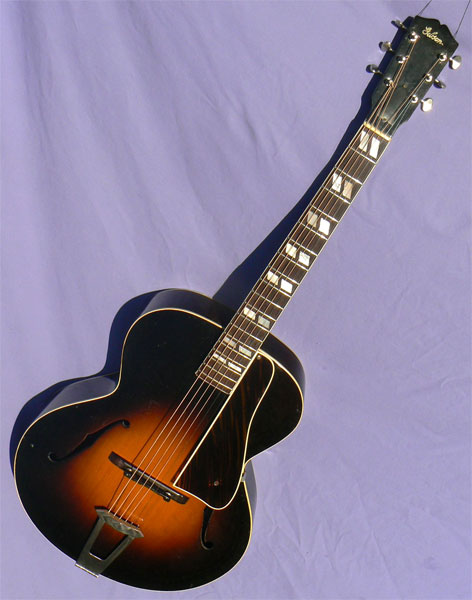
As mentioned, the differences between Gibson's 17" carved archtops are almost entirely cosmetic. However, differences in design are very consequential.There are several periods to consider:
1. Advanced - @1934/5-1938:
-24 3/4" scale;
-x-braced;
-"double hump" top and back carve;
-non-cutaway;
-later introduction of unique, heavier L-5 tailpiece.
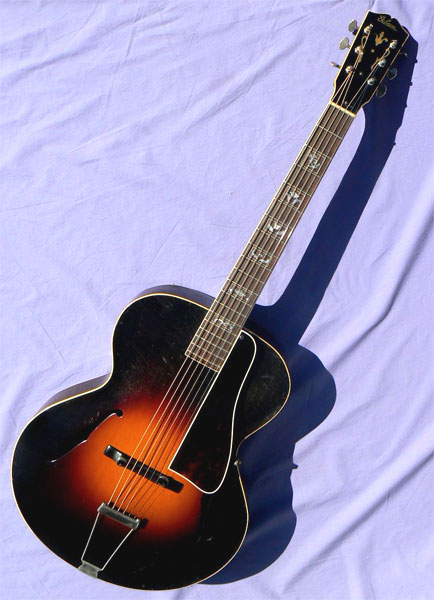
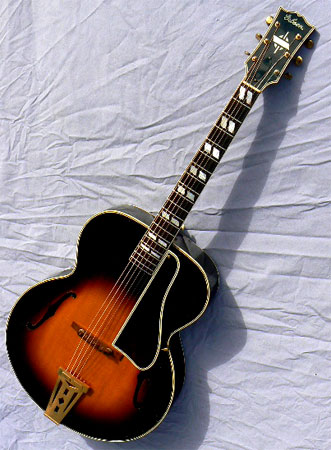
2. Post-Advanced, pre-war - @1938-1941:
-24 3/4" scale or 25 1/2";
-parallel braced;
-"single hump" top and back carve;
-some L-7 models with laminated backs;
-non-cutaway and "Premier" for cutaway;
-L-10 disappears.
During the war, a very small number of 17" carved archtops were made, mostly L-7 "Special" models. Another time for those.
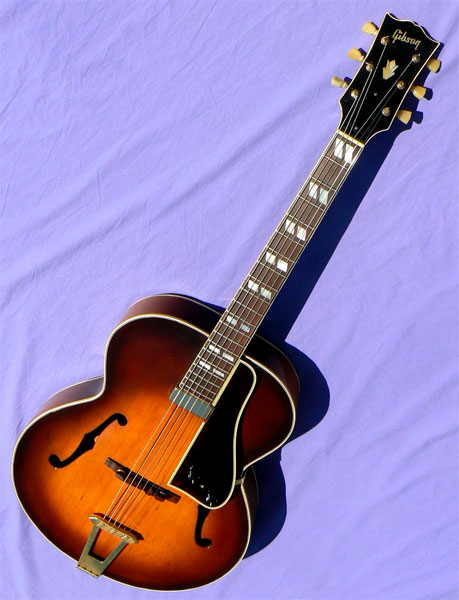
3. Post-war - @1946-@1960:
-25 1/2";
-parallel braced;
-single hump top and back carve;
-some L-7 models with laminated backs;
-non-cutaway, P for Premier cutaway, and then just C for cutaway;
-L-7 and L-12 models become pretty much the same thing, then the L-12 models disappear.
Generally speaking, 17" Gibson short-scale, x-braced, carved archtops sound VERY different from 17" Gibson long-scale, parallel-braced, carved archtops. Within each of these groups, the differences in sound between equivalent L-5, L-12, L-10 and L-7 models are trivial. The heavier L-5 tailpiece and tuners no doubt have an effect.
I have personally observed much more predictability between these guitars in the pre-war era - they generally sound pretty good to me. Post-war versions have less predictability - some amazing ones, some dogs, and a bunch in the middle. After 1960, well, that's yet another era.
-
I’ll just chime in quickly for now. Hammertone and Deacon have covered the bases pretty well. It’s really down to the individual guitar. Which exact species of woods are used (maple vs mahogany necks, ebony vs rosewood fretboards) is less important that the pieces of wood that were used. The best 16” Gibson I’ve played is an L-10. It beats every L-5 I’ve ever played, just as an example. A given L-12 could definitely be more fitting for you than any L-5 you can get your hands on.
Sent from my iPhone using Tapatalk
-
-
-
-
-
-
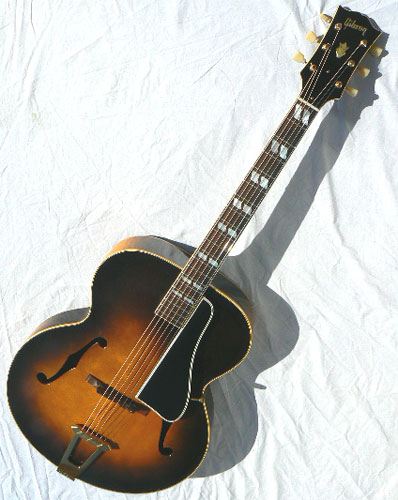
A showcase of how the L12 changed over the period it was in the catalogue.
-
Excellent research. Originally Posted by Jabberwocky
Here's a brief summary of your excellent research in pictures.



 Reply With Quote


Interesting Acoustic-Electric 7-String
Yesterday, 06:32 PM in Guitar, Amps & Gizmos