


-
Which is safer for the guitar?
Seems to me that right angle might be better. In a straight plug, a pull on cable could cause the body of the plug to become a lever, resulting in more pressure on the wood.
Am I analyzing this correctly? Or is the greater possibility that a straight plug would be pulled all the way out (without damage) the bigger issue?
That said, I've been using straight plugs for decades and I haven't destroyed a rim yet.
-
04-20-2022 12:18 AM

-
Hi, rp,
I always wedge the cord gently between the strap and the strap pin, with a few inches of slack between the pin and the jack, so that if I step on the cord the force stops at the pin and does not transfer to the jack. And yes, I often play with a strap when sitting down.
The counterexample to that theory about leverage is that if you step on the cord in a way that is a straight pull, the right-angle plug turns that straight pull into sideways leverage on the jack, instead of pulling the cord straight out.
My own experience is that right-angle plugs seem to go bad more easily than straight plugs. But that's really limited experience because I gave up on right-angle plugs very early on.
$0.02,
SJ
-
Straight plug into my tuner into a patch cable into my amp. But more importantly right angle into side rim jack w the cable pinned to the guitar w the guitar strap.
Real hard to crack the rim that way if cable gets stepped on, but you can still easily crack the rim w a straight plug even if the cable is pinned w the strap, like if the plug contacts something, a chair, amp, etc
-
Right angle is safer (I also tuck it between the strap and the guitar), except for strat style angles jacks.
-
I have been using right angle plugs on the guitar end for years without an issue. You're over-analyzing it--use what you like.
Here's one from 1967:
Danny W.
-
All my cables have a right angle at one side, straight at the other, so depending on the guitar I change what I use.
I don't tuck the cable under the belt despite being practical, cause I've had cables fail that way over the years. I just follow what seems logical for cable strain, straight when they face downwards, angled when facing horizontally.
-
"It depends" on where the jack is; many 335-type guitars have the jack on the face of the guitar, and players use a straight cable there.
[I use RA on all of my guitars, which have the plug on the lower side.]
-
i use Neutrik right angle plugs
they’re very reliable because the design
clamps the cable quite strongly ....
-
Unless you're using a fender, or possibly plugging into an amp or a crowded pedal board, rack gear or something, i don't really see the need to have straight plugs for anything ever.
-
I use Neutrik right-angle silent plugs, when I use a cable. With wireless, I use one of these:
-
I usually play sitting, without a strap. Would you change to straight plugs in that situation?
 Originally Posted by John A.
-
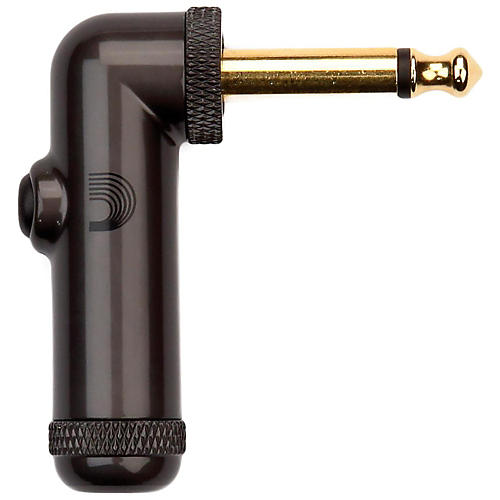
-
My vote for HiCon flathead (right-angled) plugs for cabs. Each TOOB or Metro comes with a short connecting cable with these. Hundreds shipped, not one failure. These are of course a must with the pedalboard patch cables. For guitar cables, I prefer straight Neutrik silent plugs at the guitar end and anything straight at the amp end.
-
A straight plug once hit to a chair or an amp while playing and broke a rim of my guitar.
Neutrik right angle plugs definitely since that. Straight plug in the other end for the amp.
-
Right angle to the guitar and straight to the amp
-
Do you dress left or right? Right-angle plugs when you dress right. Straight plugs when you dress left.
There, I solved it for you.
Right-angle plugs at the guitar end put little leverage on the jack of the guitar should you hit the barrel. Less likely to hit the barrel too since it is tucked 90-degrees away. On the amp end, straight plugs work better.
But we audiophools believe cables have a preferred direction that sounds better!! So, make sure the right end gets the right-angle plug.
-
I do have a preferred direction for my cables. The silent plug doesn't work as well plugged into the amp, because it's not silent when plugged in. So it makes sense to use the silent plug at the guitar, to avoid the loud noise when the plug is inserted or removed. I could put silent plugs on both ends, but that's more expense and trouble than necessary. One silent plug is enough, but necessary for me.
-
angled works better for couch playing...
-
I use straight plugs for solid bodies and right angles for semis and hollow bodies. I also use different amps for both, so it's not too tough to get right consistently

-
I use a strap so that I can hold the guitar in the classical position.
My Sweet 16 archtop has the plug on the end pin. To hold the guitar in the classical position comfortably requires a right-angle plug so I've stuck with that for my other guitars.
Except for my Gibson Le Grand. It's one of the first Le Grands to roll out of the factory in 1994 and the jack is attached under the pickguard. I need a straight plug for that. I think they switched to the end pin jack on the Le Grands very soon after they shipped mine.
-
Right angle is mainly used for pedalboard.
I use this also for my Heritage Sweet 16 with the end pin, otherwise it doesn't sit on the stand !!!!
I'm still looking for a left-angle plug (for my acoustic :-) )
-
I've used these for maybe 40 yrs..no issues and sits very well on your lap or couch or deep chairs etc..1/4" Plug - Switchcraft, flat cable-mount, right-angle | Amplified Parts
Ray
-
Really? That never stopped me: Originally Posted by Bluedawg

Danny W.
-
My Le Grand jack came unglued from the pickguard within the first year or two. Originally Posted by Danny W.
I'm a little paranoid about how much torque I put on the jack when I pull the plug out.
The right angle plugs are harder to get out. Maybe I reglued it too far under the pickguard.
-
The risk of stepping on the cable on stage is real. I've done that more than once... and then bad things could happen; The cable could unplug, the cable could break, the input jack could break (happened to me), the guitar could crack or in worst case the strap could come loose and the guitar drops to the ground.
This is an age old problem that we try to manage one way or another...by far the best solution is not to step on the cable, but sooner or later it's deemed to happen (unless you go wireless).
-What is the best solution? I think it depends on guitar model and the location of the jack.
If you secure the cable behind the strap at the rear button (most common fix) then I strongly advice to use a strap lock at that end, because otherwise tension in the cable could make the strap come loose.
Guitars having the jack on the top (e.g ES-335) benefits from using angled plugs or the jack becomes a fulcrum that causes cables and the jack itself to wear prematurely.
Solid body guitars having the jack on the rim (e.g Les Paul) benefits from using angled plugs and cable pinned to the strap. The rim won't break, but the jack could break. With an angled plug the risk of general damage is reduced.
Hollow bodies with the jack on the rim (e.g ES-175) benefit from a straight plug, because on the large body, the plug is out of the way. If the cable gets caught, chances are the plug will just pull straight out...unless you pin it behind the strap, then you may prefer an angled plug.
YMMW, but it's really important to develop some general safety practices in this regard, because disasters do happen. (Whatever you do, always unplug the cable from the guitar before putting the guitar on a stand)


 Reply With Quote


Interesting Acoustic-Electric 7-String
Today, 06:32 PM in Guitar, Amps & Gizmos