


-
The archtop guitar seems to have been invented as a gut strung instrument in Paris around 1820 by Francesco Molino who was a player rather than a maker. He had the guitars made for him by Mauchant of Mirecourt. Molino's intention was to give the guitar a louder voice. The design was not patented at the time and was copied by other makers. Unfortunately, it was not successful in the market perhaps because of musical conservatism or perhaps it was simply before its time.
The guitar has an arched top with two parallel braces as can be seen from the X Ray picture. The back is not arched and is braced side to side. The bridge is movable although the strings are anchored to the soundboard. The fingerboard is curved. The body length is 450mm, the width 305mm and the depth 90mm. Some of the instruments had a lyre shaped peghead and others a single sided style, rather like the one Fender subsequently adopted.
An example of this guitar can be seen in the Forderer collection on YouTube starting at 6min 11sec
The explanation there refers only to the Mirecourt luthiers, omitting to mention Molino as the actual inventor and claims an earlier date.
-
08-18-2020 01:27 PM

-
Thank you for posting this.....so much to learn and its quite an interesting instrument.
Being a guitar and flute player I gathered a bunch of CD's quite some time ago that were relevant to both interests.
So when you referred to Francesco Molino I was reminded of a disc with his guitar and flute duos and trios for guitar, flute and viola.
So thats on tonight's playlist.
I doubt the guitarist is using an instrument like that one but I'll have my ears open anyway!
-
Countless efforts were made in the first half of the 19th century to give the delicate guitar, then still a gut string instrument for the parlor, more volume and projection.
I didn't read the full article by Panagiotis Poulopoulos (impact of Francois Chanot’s experimental violins on the development of the earliest guitar with an arched soundboard by Francesco Molino in the 1820s | Early Music | Oxford Academic , A Pioneering Guitar Design by Francesco Molino – The Consortium for Guitar Research ), but I know about some principles that Francois Chanot, a fascinating unorthodox luthier, applied in his violins since 1817 (Chanot: Uber die Geigenbauer-Familie der franzosischen Schule in England | Meister-Portraits | Bibliothek | Corilon violins ).
Heck, it might even have been Chanot who had invented the "teardrop" body! (Chanot Ergonomic Violin — Google Arts & Culture ).
I might talk to Mr. Poulopoulos personally to clarify whether Chanot or Molino-Mauchant were the first to use the principles known in the violin world as Chanot's ones, but it could be moot.
Similar to Chanot's instruments, the pictured Molino-Mauchant guitar shows an unusual flat-arched belly without recurve, so some may be tempted to inspect them a bit closer and see, if the top was really carved and graduated. Also, the ladder-bracing is not what we would expect on a carved guitar, neither the "stop-tail" in the heart of the soundboard - though all these features together could be balanced out, and somehow work out.
Francesco Molino, born near Torino, was a well-known and hard-working violinist, guitarist and composer in Italy, Spain and France. It's not known where he had learned guitar playing; maybe he was an autodidact like Paganini. Hard to imagine that such folks had much time to tinker with entirely new instrument classes, though not impossible, of course.
Authentic moving reports exist about Paganini who went through hell when he had to bring his Guarneri for a check to Mirecourt-born luthier Jean-Baptiste Vuillaume (1789 - 1875) in Paris, another violin maker never afraid of breaking new ground. The third man of wonderful French violin tinkerers, after Chanot and the successful Vuillaume, was Felix Savart (1791 - 1841), a friend of Vuillaume.
-
Not sure if I got trough with the gist of the Francois Chanot violin principle, or the Molino-Mauvant guitar above:
Chanot's thesis was that the largest possible number of undamaged wood fibers is necessary for a optimal vibration pattern of the top, so he demanded that the wood grain lines should be uncut, without run-out, as long as possible. This is the thinking of all flat-top guitar makers or, in the archtop realm, of the solid_pressed_top supporters. This is one reason why these Chanot and Molino-Mauvant instruments show a relatively flat-arched belly.
Conventional violin makers think differently: they take the enormous effort of carving a thick spruce plate to compensate a bit for the excessive stiffness the higher arching provides to the soundboard. Not to talk here of other compensations, like the elongated f-soundholes, the thickness and graduation pattern of the plates, the type of bracing, etc..
To accomplish this goal, the makers of carved stringed instruments have to cut many wood grains of the top by intention - only this way the soundboard can get the best-possible compromise of stiffness-mass-vibration. Such an archtop construction can provide the necessary stiffness to withstand thicker steel strings for a lifetime, and, at the same time, deliver the acoustic sound, balance and projection that many are after. That's what Lloyd Loar, and some other men before him (I think I dropped some names here) did, when they translated conventional violin principles to the archtop guitar.
It's a bit different (and bigger) world though, when it comes to additional electric amplification.
-
There seems to be no doubt that the top is carved, even though the arch is not very deep. The top is not ladder braced. It has two parallel tone bars running along its length. The cross braces in the X-Ray are on the back of the guitar. I have a Levin model 335 from 1964 that has exactly the same construction but with F holes.
 Originally Posted by Ol' Fret
The article by Panagiotis Poulopoulos describes another example of this guitar that is inscribed
"FMolino inventeur // fabrique de Moitessier fils"
-
Originally Posted by aquin43
Ah, thanks for this! X-ray as a summation image is always a bit tricky to read without additional visual inspection or examination.
There is no doubt that Francois Chanot and Molino/Mauchant/Moitessier were open-minded and up to something new, at least something different to the main stream. After all, Chanot was a teacher of Vuillaume; the latter was one of the most influential violin makers of his period. Of the trio Chanot - Savart - Vuillaume was only Vuillaume commercially successful; now we have to add Francesco Molino.
So why had Chanot-style instruments almost no impact on the players' scene? What are the downsides of that design? Does Poulopoulos give answers in his article? Or was it simply the usual wretched conservativism of many stringed archtop instrument players, that we still find today?
-
Poulopoulos points out three things. Musical conservatism, the fact that the design was not patented and so could be easily copied, spreading the initial profits too thinly and also the probable price of the instruments which he estimates as costing up to four times as much as a top grade flat top guitar at the time.
-
Thanks, aquin43!
Patent law has always been tricky. The modern French patent system was created during the Revolution in 1791. Patents were granted without examination since inventor's right was considered as a natural one, and patent costs were very high (from 500 to 1500 francs). Though the French patent law was revised in 1844 - patent cost was lowered and importation patents were abolished, it didn't seem to have changed much, if you follow the almost lifelong disputes that Adolphe Sax, who patented his invention of the saxophone in 1846, had to suffer.
Yes, the cost of making a carved archtop vs. a flat-top guitar are high - it wasn't a big problem for Loar and the Gibson business men at the right moment ... Eddie Lang, Maybelle Carter, and others.
The guitar evolution moved up a gear after country, western and folk music got popular ... C. F. Martin, the steel string guitar...
The real thing started at the beginning of the 20th century, in North America with the upcoming of Minstrel shows, blues, early jazz music; in Europe with Vaudeville and the Wandervogel movement. Til today the majority of classical guitarists sticks to flat-top guitars and nylon strings.
-
Very pleased to see and read all the discussion above, especially as two days ago I bought this:
It was on eBay for over a thousand pounds, but I offered £800 to which the seller agreed. It is thought to have been made in Mirecourt c. 1890-1910. The bizarre bridge is not original - there is evidence of there having been a tailpiece (three small holes around what is now a strap button), though on the bottom side - not on the soundboard as per the Molino - and the tuners are probably from the 1950s. Plus there is evidence a pickup of sorts might have been attached around the sound hole:
It might also have been refretted around that time. The rest is original: Choice Brazilian rosewood back, sides, neck and headstock, and an excellent-quality spruce soundboard. It also has genuine ivory binding. It sounds strong and beautifully mellow.
Now, the seller claimed it might be evidence of an early archtop, and knowing of Molino's archtop from c.1820, I got excited. I was disappointed to discover there is no arch, just a little doming around the bridge. I almost filed for a return and refund, but for £800 it's a nice guitar. But after reading the above posts, perhaps not all Molino guitars were arched.
I tried photographing the inside of the guitar, rather unsuccessfully, and will try again, but it doesn't look carved, and there appear to be five mostly parallel braces - not all five are visible in the photos, but I could feel them:
I've been in discussion with the highly-regarded 19th-century guitar researcher (who once owned an original Molino), Dr James Westbrook. We both find my Mirecourt guitar curious to say the least. I also personally know Panagiotis Poulopoulos (I'm mentioned in his Doctoral Thesis on the 18th-century wire-strung 'guittar'), but we haven't been in touch for years. I might write to him soon.
This guitar has stories to tell regarding its origins and history of changes. I would like to make the following changes: new tuning machines - the 1950s ones are not good at all - and maybe a compensated bridge, as the intonation drops from the 12th fret to 7th on the lower four strings - I don't want the fingerboard planed and new frets installed, though that might have to happen. Talking of frets, I'm not convinced they are original. I get the feeling the guitar was used in the 1950s when the tuners and bridge were changed, possibly the frets too, and a pickup was installed (?).
Today I played a mixture of classical and jazz on it, and it sounded great either way. Before that I restrung it in gut trebles and real silk-core basses from Aquila.
Your thoughts, gentlemen...
-
My thought is that you are a very cool dude. Your love of the instrument and the kinds of music it creates knows no bounds. Thanks for sharing it as you always do. Originally Posted by Rob MacKillop
-
Thank you, my friend!
Last edited by Rob MacKillop; 02-20-2026 at 02:58 AM.
-
More photos:
-
Congrats Rob! May she inspire your playing for many years to come. I would opine that this guitar has found the right owner. Beautiful rosewood on that one.
-
Nice find Rob. Enjoy my friend.
-
Thanks, gentlemen!
-
Congrats to your new/old guitar, Originally Posted by Rob MacKillop
It's had a long life, a pickup was added and then removed. At some point in time it got a trapeze tailpiece that was later removed, but do you think that was the original tailpiece? The flat top could possibly suggest that the original bridge was glued on to the top and that the current bridge is an attempt to restore the guitar to its original state.
It's of interest in the context of the OP, because there's possibly some confusion here about the definition of an "archtop" guitar.
The denotation "archtop" suggests that the top is arched, OK, but that alone won't make it an archtop guitar, do you think? Nor is the existence of f-holes sufficient to conclude that a guitar falls into the archtop category.
One could argue that unless the guitar got a Trapeze tailpiece, it's not an archtop. Note that the logic behind the arch is to provide support for the bridge when strings are anchored by a Trapeze tailpiece (violin style).
Also note that the driving force behind the development of the archtop guitar was the introduction of steel strings. The traditional flat top guitars of the 19th century were not strong enough to support steel strings until C.F Martin found a way. In other words one could argue, that unless the guitar is purposed for steel strings it's not an archtop (regardless if it got an arched top or not).
Words like "archtop" and "flat top" have become synonyms to two different instrument categories, each defined by a range of common construction elements. The Molino guitar in the OP got more in common with a traditional flat top guitar, as a matter of fact.
-
Thanks, JC. There’s a lot to unravel there while I’m having breakfast. I’ll just say for now that viols were always gut strung through the Renaissance and up to the late 17th century, and they mostly always had an arched top, either carved or steam bent, and a tailpiece. Sometimes the arch was very minor, sometimes more pronounced. They didn’t have to wait for steel strings to come along. The same can be said for many early violins.
The arched Molino guitars had a floating bridge, with the strings anchored on the soundboard, as in the OP, again no tailpiece.
Here’s a vihuela de Mano played by one of the Borgias. No steel strings here, but definitely arched, though presumably no tailpiece.
I have more on pre-Gibson archtops in Europe on my archtop website Earliest Non-Gibson Archtop Guitars – ArchtopGuitar.net with much information from a contributor to JJG.
Back to me breakfast!
-
Thanks for this information, Originally Posted by Rob MacKillop
First enjoy your breakfast, then your thoughts about the original tailpiece of your guitar?
According to your understanding, -what was the purpose of combining a floating bridge with a tailpiece glued on to the top (like the Molina guitar in the OP)?
-
I've no idea why Molino did that. It might have something to do with the break angle over the bridge? Looks similar to what we see on a Les Paul, no?
There's about 80 years between Molino's guitar and mine, and although they both come from the same factory - Luthiers-Mirecourt, Cognier, Terrier, violin,viola, cello, bow, making, repar. - there was bound to be some development, structurally or stylistically. In short, I've no idea what my guitar was like originally.
Here is one possible reading:
1. My guitar was exactly like Molino's, with the floating bridge and the glued-on-the-top tailpiece. There might have been some catastrophe, where the tailpiece was ripped off, causing structural damage to the top.
2. The owner kept the floating bridge but shifted the tailpiece to the bottom, but leaving an unsightly mess after patching up the soundboard.
3. The owner - or next owner - decided on what we see now, to cover up and give structural integrity to the soundboard, which is why the whole bridge design is so big. And along with this change came a new bridge with holes to thread the strings through.
But all of that might be fantasy on my part, bearing no relation to the truth.
-
Excellent, enjoy the adventure of owning a Historical instrument.

And, there was I thinking that Henry Ford invented the Automobile, Thomas Edison invented electricity and Orville Gibson invented the Guitar.................
-
Here's an original:
And here's mine:
Mine seems more domed than arched, don't you think?
-
There's often the sense that some Americans don't like Europeans saying things were invented in Europe first, but, ffs, we are all humanity, it's a collective effort, and ultimately it's what you do with it that matters. X-bracing is another debatable point, one that tends to get Martin-ites hot under the collar. But that's another story... Originally Posted by GuyBoden

-
On the left my 'Molino', on the right my Roudhloff Brothers 'Melophonic' x-braced guitar, London c.1840. The latter is the best classical guitar I've ever played, including a Panormo with Fernando Sor's signature on the label, and a 1st generation C. F. Martin.
-
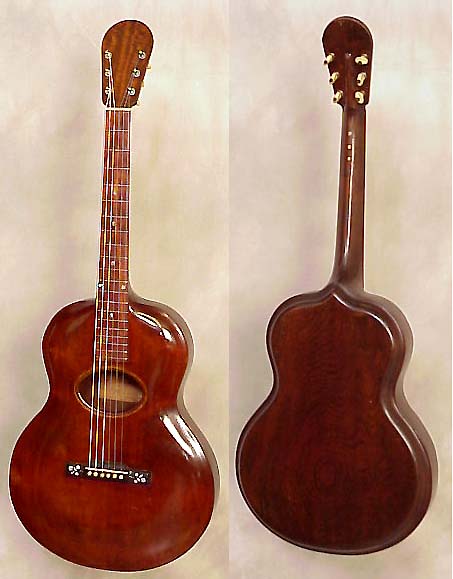
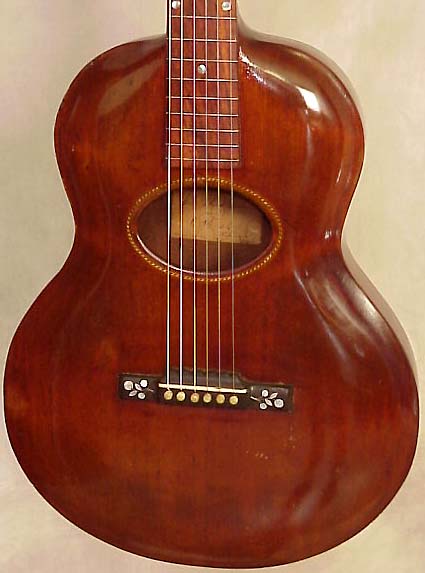
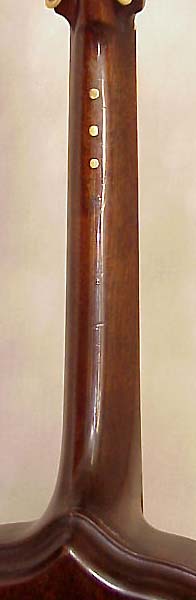
Orville Gibson's first attempts were not very "Arched". Originally Posted by Rob MacKillop
Below Orville Gibson guitar 1897.
Featured Inventory Archives 1999-2012 | Gruhn Guitars
-
Interesting!


 Reply With Quote


Interesting Acoustic-Electric 7-String
Today, 06:32 PM in Guitar, Amps & Gizmos