
-
I don't see a Golden Age tuner that has a metal button, so you'd be better off going with the Grover Sta-Tights or the Waverly, unless you deliberately want to put plastic button tuners on there.
As far as "aging", I went with the aged nickel Waverly for my 1937 ES-150, and I wouldn't go as far as saying I regret it, I would say that the "aged" tuners are by far the most aged metal on the guitar.
The aged tuners (whether Golden Age or Waverly) would be significantly darker than the tailpiece you've got on there now.
That said, you might be able to find a luthier who could age some new finish tuners with ammonia (or whatever) for you, or how to do it yourself.
-
-
>> Do all archtops have arch backs? I never got an answer... I still don't know.... sigh, well... do they? :-) <<
No answer? A shame - I'd never stop asking fundamental questions!
My next topic would be: Why is the back plate commonly arched?To carve an arch into a back plate you need more raw material and more hours of work. Moreover, the string tension puts the back into longitudinal tension, and the stiffest back shape in that direction would be a straight section with no longitudinal arching.
So why arched back plates? The answer would be:
- Nicer aesthetics
- An increased air volume of the body (bringing down the main air resonance - if that's what you're aiming at)
- Building in fexibility. Putting in curve gives flexibility both in the long and cross arch, though it is arguable if archtop guitar making is supposed to be designing for flexibility or stiffness.
Can you deduce selective sound reasons pleading for a flat back (or a flattish arched back or even front)?
Well, they give quite a punchy sound, if kept thick and stiff enough. To compensate for too much punch of flattish arched guitars good luthiers often use(d) a thicker graduation.
Really not easy to submit facts in behalf of arched back plates - which once more proves that we often unknowingly love just what we see or what is considered to be 'traditional'.
Wait a second - there's one more essential advantage of arched backs, at least in the long run: they're much less to prone to cracking compared to flat backs with cross bracing! That's why we don't come across old violins or Cellos, and just some old double basses, with flat backs that don't show heavy repair work on the backs.
Good timing for thinking about laminated constructions...
Last edited by Ol' Fret; 08-06-2017 at 05:08 PM.
-
As best I can tell, guitar archtop construction was derived from violins and mandolins. The arched back and front were better able to withstand string stresses, and more stable.
Of course, classical guitars with thin braced tops had been around for centuries, but were prone to cracks and warping and more importantly (at the time) weren't as loud as arched instruments. They also had less middle range.
So there's a tradeoff between loudness and stability and sweetness of tone, where the archtop guitar, like fine violins and cellos, fits in.
The Violin Shop: Arching. Great Curves!
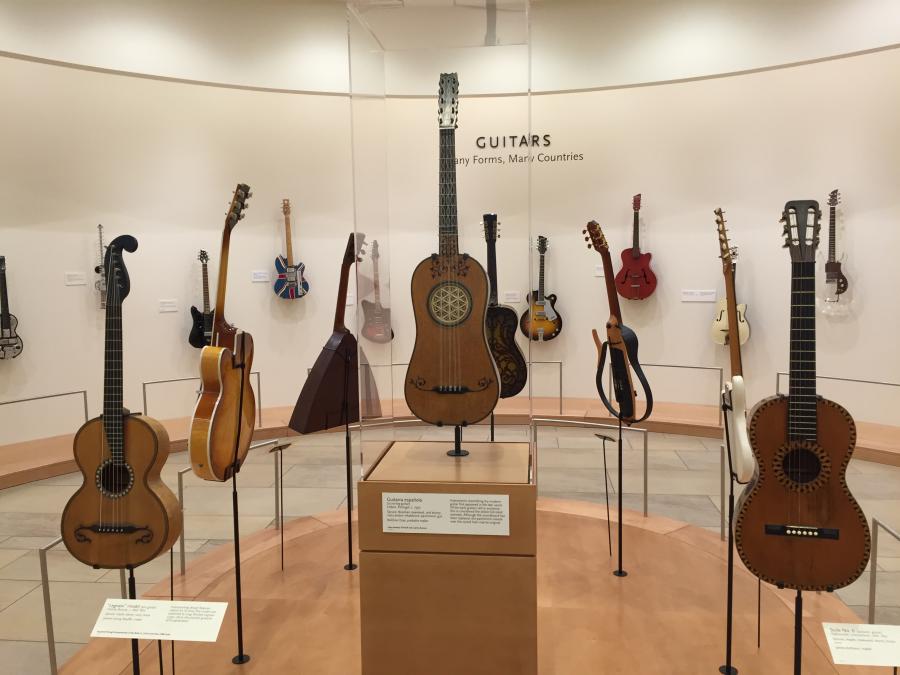
BTW, in the center is the world's oldest playable guitar, built in 1590. It's at the Musical Instrument Museum in Phoenix. WELL WORTH a visit if you're in the area, in fact even if you're not in the area.






 Reply With Quote


Got some picking exercises?
Today, 01:17 PM in Guitar Technique