


-
Just stuck my camera phone inside an F hole to have a look around.
A quick word about the guitar. It is a script logo, so 1946-47. The guitar has a newer pickguard, replaced tuners, and the neck has almost certainly been shaved and repainted at some time; the profile is Gibson circa 1960, not 1947. Otherwise, the guitar is pretty immaculate. There is no sign whatsoever that there has been a jack plate repair; the wood grain is continuous all along the rim.
So I am a little curious about the wood patch inside the guitar around the jack, and that gray piece to the left of it. Original with Gibson? Or has the top been off the guitar?
-
05-28-2017 01:12 PM

-
I have a '46, but I can't get to it for a couple of days. I'll take a look for comparison when I get the chance.
-
That would be great.Thanks. Cell phones do everything these days.
-
now that's interesting!...based on the "outside" pic, i dont see how those interior "patches" could have been done...unless
1. they were there before bending the sides
or
2. the back of that guitar was off at some point..and a major reconstruction was done...
is back the same mahogany?
love the size of that big green tone cap!! a cornell dubilier maybe
cheers
-
All my Gibson archtops (5 dating from 1961 to a recent VOS ES-175) have those black pieces on the rims. They feel like thin wood, no idea their function. The interior reinforcement at the jack point is a good idea, shame Gibson stopped doing it, would have probably prevented a lot of guitars having cracks in that area.
the cap is a blue Solar, probably tin foil and waxed paper. Solar were the USA manf. Company. Gibson and others used them into the 50's.
-
The back and sides are identical in grain and color. The top and bottom binding are identical, yellowed to the same color.
-
The mysterious grey/black piece must be the super secret source of the elusive Gibson Mojo !

-
Gibson has used reinforcement fabric and or thin veneers inside the rims of guitars for a _very_ long time.
Last edited by Greentone; 05-29-2017 at 01:15 PM.
-
No such piece of wood around the jack in my 1946 ES-300.
Edit: Wait! I think it is there, but my phone wants to focus on the pots and it's kind of blurry and the extra layer of wood seems to be a really good color match. I'm going to see if I can get a better pic.

Last edited by ThatRhythmMan; 05-30-2017 at 06:58 AM.
-
Inside a younger sibling 1952 ES-150:
-
This is inside my ES-125 (either a '48 or a '50, not sure, FON has faded):

The input-jack patch is there (but it is broken, the input jack has been repaired with a metal plate from the outside). Also present the cloth reinforcement strips on the sides. You can also see the complete absence of the top braces, which is what made placing a sound post (just visible at the far left) necessary.
-
I got a better angle on it. No extra strip oh wood that I can see after all.

-
This 1949 ES-150 has it though.

-
The grey black material looks like vulcanized cellulose otherwise known as fiber veneer. It is difficult to identify with only a photo to go by. It would make sense to use fiber as reinforcement. It glues well and is very strong and thin. Fiber does not crack or split and is more resistant to tearing than cloth reinforcement. I for one am curious to find out what the grey stuff is.
-
I am not a Gibson historian, but guitars of that period, and older, often had strips of linen saturated with hide glue. They are meant as insurance against cracks forming and spreading on the sides. This is not an issue with plywood laminated sides, because the plys are insurance enough. I use them when I bend solid sides for the same reason and, honestly, as a nod to those classic guitars.
As far as building up the area where the jack is, that's just good sense. I use thin "aircraft" plywood I can get from Amazon, but sourcing of that kind of stuff might have been hit or miss in the 40's.
I also think that construction of factory guitars from those golden years of the 40's and 50's were less standardized and assembly line than now. The individual luthiers had a little more freedom to build the guitar as they see fit.
Sent from my iPhone using Tapatalk
-
The 1946 I show above without the strip is supposedly one of the very first post-war laminate archtops Gibson made. If true, that may also account for that difference.
 Originally Posted by rlrhett
-
Matt nailed it: these grey-black patches are very likely made of fiber veneer.
>> i dont see how those interior "patches" could have been done...unless
1. they were there before bending the sides
or
2. the back of that guitar was off at some point..and a major reconstruction was done... <<
It is not too difficult to provide such repair patches later.
Don't know about the Gibsons, but the Roger guitars from the same period originally show internal wooden output jack reinforcements - a far-seeing procedure at a time when German boxes did not find regular use for such jacks at all!
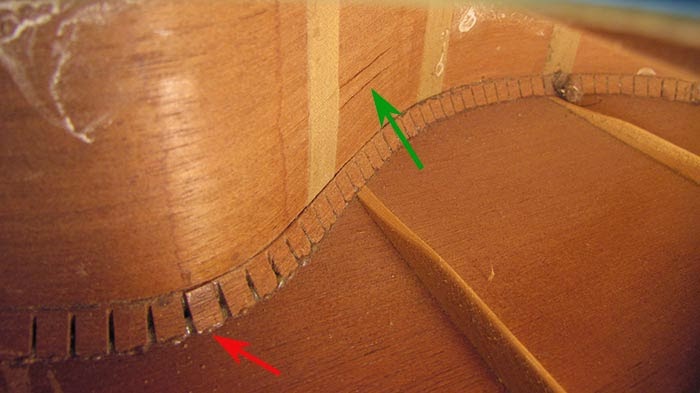
On this photo of a Roger Luxus #648 (ca. late 1948) some clueless person missed the original reinforcement patch when placing the jack subsequently... geez!
Good to have folks around here taking a look inside their guitars - with time a very worthwile investment!
Last edited by Ol' Fret; 05-30-2017 at 01:29 PM.


 Reply With Quote




Interesting Acoustic-Electric 7-String
Yesterday, 06:32 PM in Guitar, Amps & Gizmos