


-
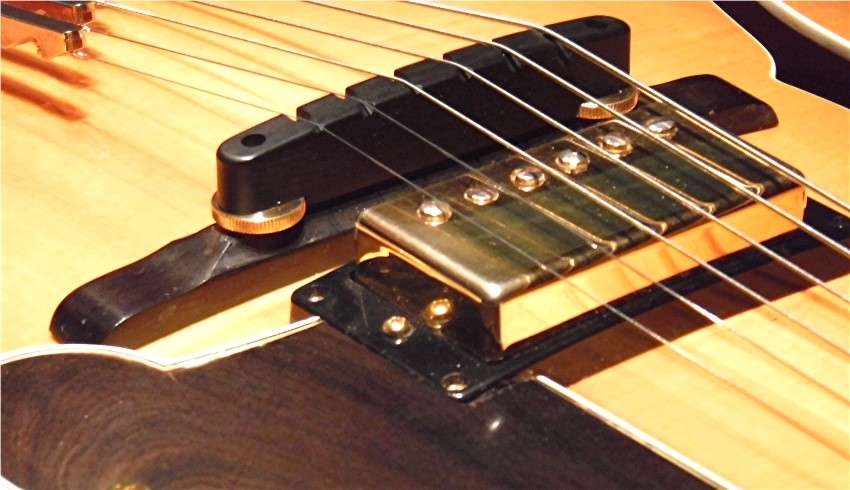
The Stew-Mac compensated (ebony) guitar bridge has a 330.20mm (13") saddle radius and the guitar it would be destined for (PM2) has a neck radius of 305mm. Any problems here? Would I need to sand it down or something?
Cheers
-
05-05-2017 08:10 AM

-
It's not that much of a difference. I probably wouldn't radius the bridge for slight mismatch, but your mileage may vary.
On the other hand, I just had a new bridge prepared for one of my old Epiphones that have very rounded fingerboard radius (around 7"-8" radius). That bridge needed some work because the difference between the new bridge and the guitar radius was so pronounced that the strings were significantly imbalanced.
-
That shouldnt be a problem as the difference is minor and can easily be made up when cutting the slots in the bridge. Get the Stewmac or other brand under string radius gauge and cut the slots to the 305mm profile. Bob
-
The flatter radius on the bridge is to help to compensate for the varying diameter between the plain and the wound strings. With some saddles a 15" radius is used for a 12" radius fingerboard.
Last edited by Matt Cushman; 05-05-2017 at 09:52 AM.
-
If you are contemplating the compensated bridge like those used on Westerly Guilds, they are a sort of cartoon-ish exaggeration of relative string compensation and far less accurate than a simple slanted bridge such as Benedetto use.
-
Archtop Guitar Bridge | stewmac.com
I mean these. The relative slope of the Low E through G then the excessive step back on the B really does not match the most common relative compensations of string sets.
Fortunately these bridges can have a bit taken off the top and the individual saddles can be moved a bit by re-shaping the saddle tops.Last edited by ptchristopher3; 05-05-2017 at 12:00 PM.
-
Look at the Sadowsky compensated bridges for the sort of relative positions that are VERY close to what most string sets will work best. And even these (the lower one is the plain G bridge) are slightly farther from a simple slant than is best for many sets of strings.
-
Maybe I got lucky, but the Sadowsky True-Tone bridge intonates better than any fixed bridge I've used:
 Originally Posted by ptchristopher3
-
with any non adjustable saddle bridge (compensated or otherwise), acceptable intonation is really the luck of the draw...even using the exact same strings everytime (ex.- chrome 12's) is no guarantee that intonation will remain exactly the same...
the most obvious issue is the wound/unwound g...but that low e also has its quirks!! haha
setting up a guitar is a science...but one that leaves plenty of room for magic!
cheers
-
OK, I get the point regarding "mismatched" radii not necessarily being an issue, thanks.
Hi ptchristopher3. Thanks for the time you took to reply but, damn, the user reviews for that particular Stew-Mac item are, in general, nothing short of glowing. "Cartoonish" is maybe not really helping here, y'know?
I am, by the way, looking at a wooden bridge simply because I'm getting too much zing when using roundwound strings on an Ibanez PM2 with the stock TOM bridge. I'm also (probably vainly) hoping it will attenuate finger noise somewhat. As it is, it works just fine with flatwounds.
-
getting as much pencil lead/graphite into a tom's saddle slots will help with that zing/ping....
can also replace the tom saddles with non metal saddles ie nylon, graphite etc
cheers
-
Another consideration is that with string spacing at the bridge wider than at the nut, anything other than a dead flat fretboard has a string set geometry that describes a "section of a cone" when string height is uniform. Originally Posted by Matt Cushman
So the bridge radius is naturally larger. If your bridge radius matched the fretboard radius, and you set action to be ideal at first and sixth string, you could be compromising the third & fourth strings height (too high.)
But we don't often use uniform string height, it's typically greater toward the bass side. The result is the ideal bridge gets flatter yet, and no longer follows a set radius exactly, but generally more like an increasing radius curve.
John
-
I definitely understand. So maybe best to consider my one opinion as not terribly compelling vs. a large number of glowing reviews - plus the thousands and thousands of guitars out there from Guild with this exact bridge design on there. Originally Posted by Peter C
**************
Helios, I think the Sadowsky bridges are superb designs, and great for almost all string sets. In my opinion a set like the T-I JS-112 would have the saddles often sightly closer to a straight (albeit slanted) line than the Sadowsky bridge - but we are really talking minuscule differences now.
-
I have guitars with both straight and compensated bridges, and I find that there really isn't much difference. The compensated saddles are just like straight saddles except for the B string. The bridge is seldom perpendicular to the nut. With the D'Addario .012 pure nickel strings that I mostly use, on both types of bridge the bass side is usually slightly closer to the nut with best intonation. The slant is almost always too much, and should be almost straight vs the slant it has. But this is for one string set. It's not the same for all. A Benedetto style saddle works well enough, but the compensated type tends to intonate slightly better for the B string, for most sets. I'm not sure it's enough to be worth getting excited about, though.
-
So much for fretboard/bridge radius, almost everyone wants to blather about intonation...
-
Seems to me that between Matt and John-A radius was very well covered with simple geometry. I guess we could more specifically agree with them in some detail, but for at least two specific reasons they opine that the bridge radius is best slightly larger than the radius of the FB. Originally Posted by cosmic gumbo
-
Reading back here, I hadn't considered individual graphite saddles. I fitted those to a LP once, but mainly because of string breakage, and I don't recall a big difference in string response - maybe less ping?
Interesting to read that intonation can be a kind of hit-and-miss affair, with few advantages of compensated/cartoonish vis-à-vis slanted/Benedetto type bridges. Come to think of it, my old Suzuki dreadnought (with standard slanted saddle) never had any intonation issues worth mentioning.
-
To try to keep this clear. The Sadowsky compensated bridges are very good and would almost always represent an improvement in bridge compensation vs. a straight (and slanted) bridge.
But often this improvement will be very slight.
In my opinion there is nothing at all "wrong" with a straight bridge.
The Stewmac bridge in question is absurdly over compensated, with the string positions along the saddle at an exaggerated deviation from a straight line to the point that almost all (wound G) string sets will require a considerable compromise - most notably between a sharp G and a flat B.
Again, anyone using such a bridge may quite possibly be very pleased, as are the glowing reviewers of this component. Nothing wrong with being happy with one's guitar.
Chris
-
better to "blather about intonation" than to play out of tune.."close enough for rock & roll" may work for some, but is certainly not ideal
to hear a good player hit sour (tuning & intonation) notes makes me wince
guitar set up is holistic..every detail counts..radius is part of the intonation process
cheers
-
ptchristopher, you are a hard man to ignore! I'm going to take heed of your advice and try my little experiment with a cheap and cheerful straight bridge - any idea where I could get one here in Europe? Allparts.uk (yes, the Uk is still in Europe) I think had only a cartoon one available
Those Sadowsky bridges look really good, but I'm not paying 100(+) bucks yet for something that may not be of use.
Another question: could an ebony bridge help to reduce string squeak?
-
To answer my own questions, there appear to be very cheap straight or slanted bridges on ebay, and little little else. I did see a GB10 (style) ebony item, but those are compensated. Aha!
Also, I'm realizing that a wooden bridge saddle could actually increase string noise! Duh. I'll stick to flatwounds.
Thanks
-
Hallo Peter, Originally Posted by Peter C
I know exactly your concern, as I have the same PM2 TOM that needed improvement.
In my case, the TOM itself was the source of a buzz, and I also wanted to try the sound of a different bridge.
Same as you, I first found a compensated wood bridge similar to the Stew Mac (in that it was cartoonish in the compensation attempt) but this was the "Tyler Mountain" German brand. It sounded better than stock, but was not going to be accurate enough wrt intonation, and the base was not really able to get flat enough to fit the PM2 soundboard well.
Next step was to to make my own, which is a work in progress still (but I am using it already.)
Recently, I had purchased another Ibanez model that was near-new, and had an unused TOM with the case candy. I decided to make a new base from Gabon ebony, and fit the posts to be able to use that new Ibanez TOM. After I get the TOM dialed in for intonation, I can use it as a guide to make my own Sadowsky tru tone copy with the Ibanez post spread. The difference between the stock PM2 base/TOM and my homemade base/TOM is very noticeable, and I'm encouraged. Once I get around to making the new top to replace the TOM, I should be in good shape.
Pics below:
First shows the underside of the stock PM2 base, with the crappy stain Ibanez had applied to the whole piece.
Second pic is stock PM2 after burnishing off the crap stain on its top side (3M Polishing Papers.)
Third is the cartoon compensation (Tyler Mtn) fitted for trial.
Fourth and fifth are the new base I made, mostly done on my router table after making plywood templates so I can knock out more in a hurry. That's the new Ibanez TOM (no rattle like the the PM2 old TOM) and this combination sounds pretty good. I'm convinced the fitting of the base is very much responsible for tone, and the PM2 laminated top is unusually flat where the bridge sits, to where none of the availale replacement bridges have enough meat to cut them to a flat enough radius to work.
I've got enough ebony to experiment, and plan to try a few base designs. Working on the plan to make a Sadowsky inspired top piece, and maybe a 4-2 slant with split between G and B.
John
-
Yeah, I'm not experiencing any particular problems with flatwounds on the stock TOM. You have great dedication and skills to make that bridge yourself!
-
I've been trying to make the best of an old Hofner Congress and attempted my first fret dress. (the neck is surprisingly straight!). It's worked out OK so far but I still have a bit of choking on the D string around the 14th fret. Just by looking, I can tell the fb radius is less than the bridge, ie the fb is more curved. I was going to match the bridge radius to the fb as in the linked Stewmac video (at 1.08). That may be just enough to stop the choking and maintain the current good action on the two E strings. The consensus here seems to suggest that that is not what should be done. Some years ago, without having done any research, I did the same to a Chinese 'ES125 copy' and it work out very well. Is the Stewmac video wrong?


 Reply With Quote


Interesting Acoustic-Electric 7-String
Today, 06:32 PM in Guitar, Amps & Gizmos