


-
Yeah, isn't that what the VERY FIRST Boogie was... a heavily-modded Princeton??
Me, I like 10's, in a Princeton. Alot of excellent 10" speakers out there these days.
And while the new 68 CPR is "silverface", if I'm not mistaken, it doesn't SOUND like a traditional SF PR, does it? Between the circuit changes and speaker change, it's got more mids and less headroom... I dare say like a .....6G2
Now THERE'S an amp Fender needs to "reissue" : the 6G2. As long as they don't charge as much for it as the vintage ones are going for today...
-
01-03-2018 05:18 PM

-
I thinks you are right on the Boogies. I am slightly too young (59) for the true origin of Mesa Boogie amps.
As for headroom now vs. then I have no idea. In 1979 I was a power trio I-IV-V moron. I had no idea what clean headroom could have possibly meant.
Now in my II-V-I dotage (relatively speaking), it matters very much.
I think the “65” and “68” PRRI amps sound fairly accurate relative to each other. The “65” is all scoopy (until you add the midrange control), and the “68” is bright, and maybe more midrange raspy than punchy. I think Fender did a great job on these.
I am sure a real amp nut can identify all sorts of ways in which he will find the PRRI amps to fall short of either his distant memory, or the current state of some vintage amp. Neither of which strikes me as the ultimate metric.
Speaker size is funny. My 10” Weber booms just fine. Hell my THR1O with these tiny (maybe 2”?) speakers drives VERY solid bass at living room volumes from a clean chord-melody line.
-
One more....
65 PR TWEED w/12" Cannabis Rex LOL
-
I think it's fair to say that the very first Boogies weren't actually Princeton amps -- they were more of a hot-rodded Bassman crammed into a Princeton chassis and cabinet.
 Originally Posted by ruger9
-
There's been a lot of good advice given in this thread. I think that maybe some of it can be clarified with a picture or two. Here are a couple of photos that I've borrowed from Rob Robinette's web site on the page entitled "How to Voice an Amplifier."
Amp Voicing
If you scroll down the page to find the section on the tone stack, he uses Duncan's Tone Stack Calculator to provide graphical illustrations of the types of midrange changes we're talking about here. Sometimes it's easier to understand how much change you'll get from a resistor swap if you look at the tonestack's frequency response curve.
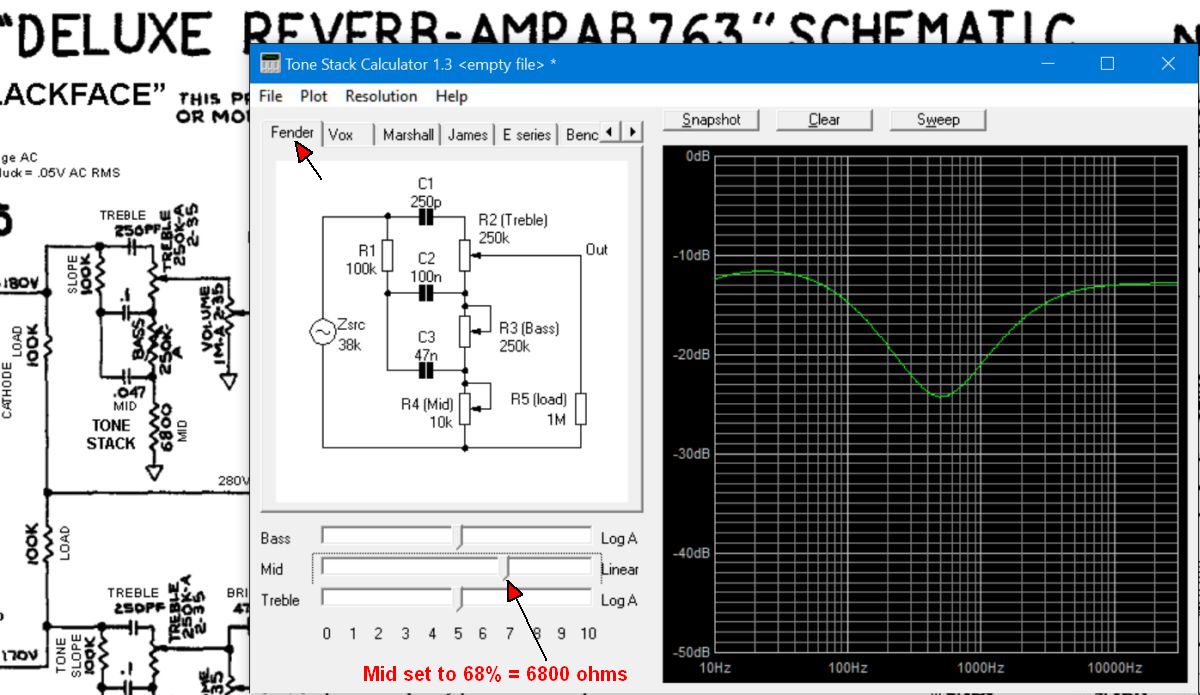
Here is what the midrange looks like with a stock 6k8 resistor (acutally a 10k pot set to 6k8):
.
.
.
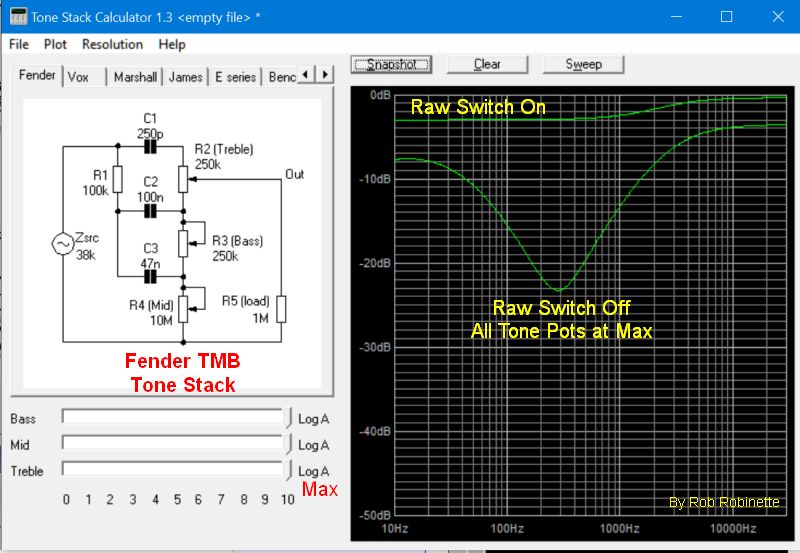
And this is what the response plot looks like if you interrupt the grounding of the mid resistor/pot resistor with a switch that "lifts" the tone stack:
.
.
.
.
.
The basic principle is that the smaller 6k8 resistor provides quite a bit of "scoop" in the midrange, and that midrange scoop goes away as you increase the resistance between the bottom of the stack and ground. first it brings up the midrange, and when resistance gets high enough it ends up lifting gain at all frequencies by effectively bypassing the tonestack.
If you are capable of running Windows software I definitely recommend installing Duncan's Tonestack Calculator. It'll allow you to do interactive modeling to get a visual idea of how the different midrange pot/resistor values will sound.
-
Boy, I've never gotten that kind of tone with the Gold in my PRRI. Originally Posted by ruger9
-
Is it possible to add a 2 or 3 way switch on a Princeton and be able to select among say the stock 6.8K and 10K (also perhaps a 15K) mid resistors easily? Ideally the mod should be completely reversible. Has anybody done this? Is it worth it?
I'm wondering if switching to higher valued resistor would bring a blackface Princeton closer to a tweed sound?
-
Sure, would be possible. But if you’re going to add wires to a hole in the chassis to put a switch, why not just put a 25k potmeter instead? Then you have all the values betweeon 0-25k...... Originally Posted by Tal_175
-
As Jay says, sure, but a pot is the decades old classic solution. Originally Posted by Tal_175
Put a 25K pot in the external speaker jack hole and you are ready to go. This is completely reversible, of course.
It has been done countless times from my teens to my comparatively ancient status today. There is a reason for its success as a classic mod.
Read earlier in this thread for recommended values and alternate solutions.
-
To make it reversible you’d need to free up an existing chassis hole such as the external speaker jack. But why not put a pot there instead?
A tweed amp has many other differences. But the higher value mid resistor will give you a flatter midrange frequency response and more gain (less attenuation).
-
That makes sense to me. But I've been reading people saying that a variable pot would have an impact on the the amp's sound in more complex ways than just being a mid knob. I don't really know how the tone stack works and interacts with the rest of the amp. I was thinking having a switch for different resister values that includes the original resistor will give an option to switch back to the completely unchanged original Princeton when/if needed. Originally Posted by Little Jay
-
Yeah, that is based on primitive fantasy. Look at the schematic. It is hard to be a more isolated component than the drain to ground on the tone stack, which this resistor or pot (wired as a rheostat) is. Originally Posted by Tal_175
-
I was thinking with the switch one can use the volume (or any other) knob with dual function by pulling up to different values. Originally Posted by KirkP
-
Well if I knew amp internals well enough to deduce such things from looking at the schematic I happily would. Originally Posted by ptchristopher3
-
I understand. I am sure that you can get the results you wish to have. I hope my opinions here do not make that more difficult.
-
Surprised nobody has suggested this:
My PRRI was initially a little bright for jazz even with the amp's two tone controls set all the way down. I knew from experience with my other Fender tube amps that swapping the stock first preamp tube (12AX7) for a 12AT7 would reduce the gain a little but make a noticeable shift from bright to a more deep midrange. Worked for me, and I use a Strat, and I prefer a definitely not scooped not bright tone.
Before you warm up the soldering iron or buy a replacement speaker, try using a 12AT7 for V1 and see if that doesn't sound like what you are wanting to hear.
-
10kohm resistor and a Weber 10A150 made this the perfect clean jazz amp. I have zero desire whatsoever to mess with the mid value now that the 10k is in there. Try that first, then see if you still want to go higher or lower. I had tried 15k but found it to be way too much. You may find, like me, that a potentiometer is a nice to have, but once you have the mid frequency response you like, you won't want to mess with it.
-
How much gain/volume loss do you experience with this tube swap? Originally Posted by pauln
John
-
It always pays off to experiment with different brands and (interchangeable) types of preamp tubes. I like to hunt auction sites and ebay for old 12ax/t/y7s and try them out in my amps. Sometimes there’s a dudd and V1 needs a real quite tube without hiss and noise, but the results can be remarkable. I like old German tubes. You don’t need to spend a lot of money unless you absolutely want old RCA blackplates.... (good tubes, but a bit of a hype imho).
-
But if you really want more mids than a 25k pot instead if the fixed 6k8 resistor is the way to go!
-
It seems like the consensus is 25k pot doesn't adversely affect the natural tone of the amp and it's the best way to go. I'm convinced.
-
After playing with the Duncan Tone Stack Calculator I came to think of the Fender circuit this way:
When the treble and bass controls are set to the minimum, the frequency response of the tone stack becomes nearly flat, and the mid resistor (or pot) acts as an attenuator (or gain control).
As the treble and bass controls are are turned up, they let more of the high or low frequencies “leak” past that attenuator.
As the resistance of the mid resistor (or pot) is increased, the attenuation decreases (gain increases), so there is less excess signal to “leak” around it. This makes treble and volume controls less effective.
If the mid resistor is set to a very large value (or removed entirely) the circuit no longer attenuates the signal at all, and the treble and bass controls no longer have a significant effect. The tone stack has basically been bypassed, even though most of the components are still connected. Doing so will greatly increase the gain of the amp, but the frequency response will be nearly flat with no ability to adjust treble or bass.
Bottom line — If you prefer the tone of Fender amps with the treble and bass controls set very low and the mid control near maximum, increasing the mid resistor value might work for you. But if you usually set the bass and treble controls above 5 or so, increasing the mid resistor might work against you.
-
My Princeton eq typically is Bass:1 Treble:3. I cut the treble from the guitar when I need to. So the mid pot should serve me well.
It also seems like mid pot would allow less attenuation of the original signal for the same volume level. I mean turning bass and treble down to get a flat response effectively means grounding a lot of the signal coming from the pre-amp. Same flat eq achieved using the mid pot would mean less filtered signal. Does that make any sense?
-
Yes, it makes sense. It will not necessarily translate into a better sound, or less noise. But yes, makes complete sense. Originally Posted by Tal_175
**************
While I would use different knob positions and mid resistor values than Kirk did in his example, his principle is fundamantally solid in my opinion.
-
I’ll quibble with this statement a little. If you increase the mid resistor and want to play at the same volume level, you’ll need to add some attenuation somewhere else in the signal chain: e.g., turning down the volume control on the amp or on the guitar, plugging into the #2 jack on the amp, turning down the amp’s master volume (if it has one) or using a volume pedal. All those options “filter the signal” a bit, especially the volume pot on the guitar. Originally Posted by Tal_175
My usual preference for playing jazz with Fender amps is to distribute the attenuation about equally between the available options. I plug in jack #2, and set all volume and MV knobs around 6-8 depending on how loud I need to be and what guitar I’m using. It’s just a trial & error process to figure out which combination most pleases me.



 Reply With Quote


Got some picking exercises?
Today, 01:17 PM in Guitar Technique