


-
I don't know what got him to decide to try out the hollow bridge, but he probably compared it to a non-hollow bridge and followed his ears. Wenzel was a commercially-minded guy interested in production efficiencies, so my guess is that he was willing to add some labour cost to his production process because he believed that it improved his instruments.
 Originally Posted by Patrick2
-
07-02-2015 12:42 AM

-
yes sure. Sounded pretty nice right. Although apparently strings were last changed approx 1973 Originally Posted by ArchtopHeaven
 For me though, I miscalculated a bit on the extra costs. The fee, tax, and percentage for the intermediate, all added up nicely. And then the seller doesnt ship, so I had to pay someone to pick it up in person, pack, and send. All in all the additional costs were higher that the price I paid for the guitar.... So it is really no use to buy there for me, again.
-
Dangelico was of the idea that a lighter weight bridge would improve sound, his 1930 s bridges are so small thin and hollowed out that they were really fragile. He stepped of the idea mostly for practical considerations. Daquisto was of the opposite idea, and made very large bridges with especially wide base. He made a different width to the treble and bass side of the bridge foot in an attempt to improve the overall balance. Roger (and in the US, Vega) kept the width of the bridge base the same but cut off one side of the foot to achieve the same. Then if you read the Benedetto book (p180) it sais that Benedetto ideally has the bridge symmetrical, but wants to have the bridge as light as possible. I guess neither of the people made an especially bad instrument, so all in all it must be just one of the factors in the whole equation which you can do right in multiple ways. Originally Posted by Patrick2
-
Originally Posted by fws6
I haven't bought from there in the 5 that I've been too. Prices re too high, guitars generally have issues (yours doesn't) and it costs me £50 to go there and view.
Its mostly a dumping ground, all auctions are.
You could always try contacting me nearer the next one, I'm just a bit bad at responding to emails apparently (my bad mate).
Anyway enjoy :-)
-
We don't know what Wenzel Rossmeisl thought when decreasing the weight of the ROGER archtop guitar bridges. Besides being one of the best jazz guitar players in the jazz-denying and -persecuting German Third Reich, he was driven to construct, build and sell guitars - and a master of production rationalization.
In Germany we consider Wenzel to be the "Leo Fender" of the archtop guitar (yes, ROGER German carve guitars are also archtop guitars!), and it is a strange twist of fate that Wenzel's son Roger worked for Leo in the 1960s. Roger was, besides other factors, too late, and definitely at the wrong place from the viewpoint of the US customer, with making archtop guitars for Fender.
If Wenzel considered additional working steps to be necessary for making his "Superton" bridges, it could only have done with tonal necessities. Despite his rationalization efforts he never built guitars below a certain quality level. In-house precision routing of brittle rosewood or ebony was not as easy to accomplish for a small scale builder as it is today with CNC machinery.
Due to the flat center (or heart) area of German carve ROGERs, the bridges have to be quite tall. In the Mittenwald period (1955 - 60) their average tallness was a. 40mm; later, after 1960, he slightly decreased it by changing the neck angle and some other changes.
Many ROGER guitars are built like a tank, but a 40mm tall, fully solid bridge gets quite heavy - too heavy for guitars that were intended for primary acoustic playing. Effects of giving special shapes to bridges are well-known in the violin world since centuries, but not so in the archtop guitar niche.
Btw., Wenzel used almost exclusively rosewood for the bridges and fretboards in the 50s, since it was not as brittle (and as expensive) as ebony. For the top end models (Super and Luxus Ultra) he selected darker looking RW blanks. In the 60s the ROGER sale number declined rapidly; this is why Wenzel had to water down his rationalization principles and use ebony parts in some cases. Or neck bindings even for the bread-and-butter "Junior" models (export version, mainly for Boosey & Hawkes). Or pressed and cello-arched plates on a few models, like the one above.
Wenzel adored the acoustic archtop guitar more than any other guitar types, though he also sold much Fender import gear in his Munich shop in the 1960s.
As another side note: excavating the base and upper part of wooden bridges improves the tonal properties of any archtop guitar, acoustic archtop, that is - as long as the necessary stiffness of the bridge is not compromised. And due to the remaining small rims of the bridge base, the spherical bridge-soundboard-linkage can be made perfect in the longitudinal direction of any conventional cello-arched body.Last edited by Ol' Fret; 07-19-2015 at 05:35 PM.
-
I was wondering if anyone has info on what size tool or wrench is used
to adjust truss rod in neck on these old Roger guitars.
I've included a picture but would like to make note that I'm a Rickenbacker
lover and thought this guitar was the 'prototype' for the Rickenbacker 760J (Jazzbo)
so I added the Rick truss rod cover.
Anyone with info please let me know.
Thanks, Tony
-
Truss rod adustment? Er, ah….
It would be great if you could post a few more pix of the guitar - back, heel, neck joint, tuners, rims, and so forth. What you have is a lovely fully carved East German archtop guitar. This particular style of guitar has a very interesting story attached to it, which is part of the Roger guitar saga. After the war, Wenzel Rossmeisl, whose shop was in Berlin, went down to Markneukirchen, purchased the shop of Peter Harlan, and hired a few folks to build Roger archtops. His intention was to build in Markneukirchen, using the local skilled labour and historic instrument-building infrastructure, then sell the guitars from Berlin.
Unfortunately, the architects of the Workers' Paradise had other ideas, and Wenzel ended up as an honoured guest of the state, courtesy of the Stasi (as mentioned on the previous page of this thread). They graciously relieved him of the stress of owning the facility in Markneukirchen by expropriating it and all of its contents, including a variety of archtop guitars that were in the process of being prepared for sale. Shortly thereafter, it became MUSIMA.
Things get a little murky here - there were guitars, parts of guitars, workers who had been trained to make these guitars, and so forth, but …no Roger brand. And no Wenzel to oversee production, maintain consistency, quality control and that kind of thing. What has emerged from this fog are various guitars that look sort of like Roger "Super" archtops, with differences that range from major to minor. They have the "German carve" as well as the distinctive cat's-eye soundholes that Gertsch had previously copied from Roger. Some are a bit shallower, a bit smaller, have the soundholes a bit closer together, and have larger recarve areas around their perimeters. Some of them are excellent instruments, but are they Rogers made from the material in the Roger shop, or are they copies based on the original design? Are they Post-Roger Rogers? Pre-Musima Musimas?
One thing is for sure. You will not find an adjustable truss rod on any of them.Last edited by Hammertone; 04-25-2017 at 01:54 PM.
-
Here's a fun picture of three Roger Super guitars, again:
The one on the left (with replaced hardware) was built in Markneukirchen.
The one in the middle was built in Berlin.
The one on the right is a bona fide Non-Roger Roger, built by Klaus Andrees using Roger parts, after Roger fled Berlin and the company was shut down, and before Wenzel was released from prison.
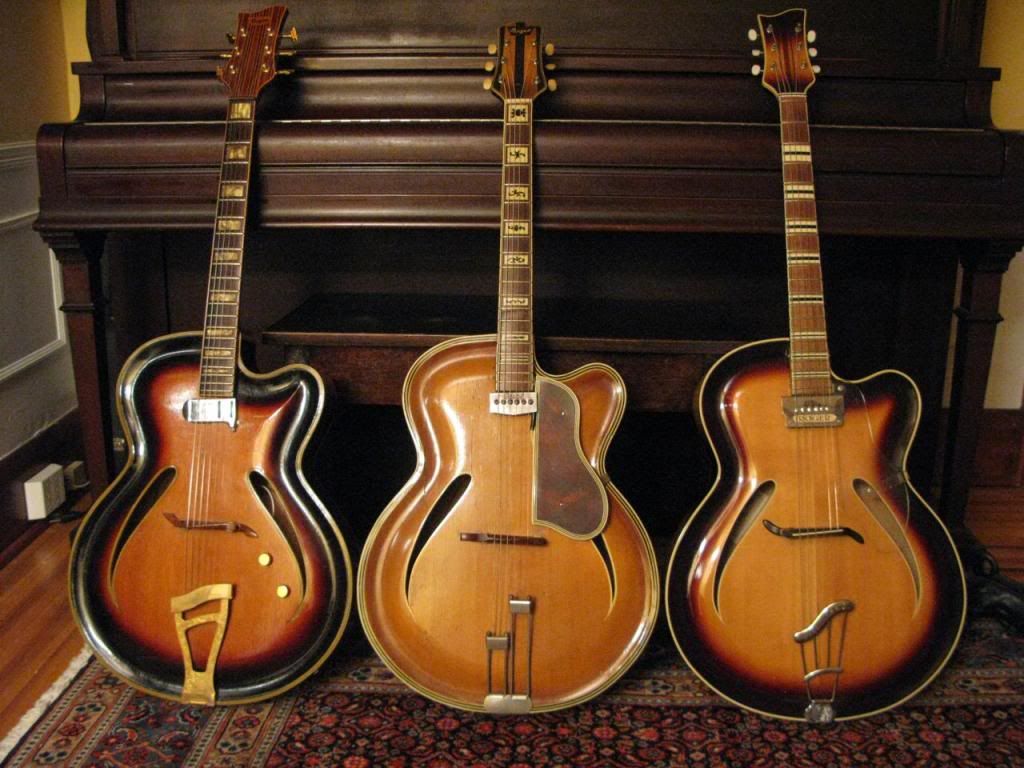
Last edited by Hammertone; 04-25-2017 at 01:56 PM.
-
Hammertone,
Thank you for your info!
Here are some additional pics.
I had the tuners replaced plus put Rick Truss cover on.
I had a "Johnny Smith neck pickup" installed with 'Old Fender Volume knob"
The guitar had a warppage by the back strap button which I had fixed
and also rebounded and installed new strap buttons.
I wanted to put 'Checkerboard binding' ala the '760J Jazzbo Rick' but
it was challenging for the luthier and also too expensive for me.
Neck is fat like a baseball bat so i was wondering what tool can adjust
the truss nut. ~Tony
-
The hardware you see at the guitar heel is a screw that attaches the neck to the body - yes, the neck is simply bolted to the body with one screw. No glue required. It can be turned with a clock key that has the right diameter (they come in different sizes). The screw can also be used to adjust the neck angle.
Sets of these keys as well as individual keys come up for sale regularly on ebay.de. They are not expensive. Or simply visit a clock repair shop with the guitar to find the right size clock key.
This is not a Roger design feature (Roger necks are glued in for the most part) but is very typical of East German archtop guitar construction.Last edited by Hammertone; 04-24-2017 at 10:32 PM.
-
This is a cool thread - I know nothing about these kinds of guitars so it is all very interesting to read.
What is the "German carve" exactly?
Sent from my iPhone using Tapatalk Pro
-
Flat plate raised above the rims with all the carving around the perimeter of the guitar. Originally Posted by rio
Sometimes not completely flat, but Roger guitars did keep the center section flat.
This is the German carve:


Last edited by Hammertone; 04-25-2017 at 02:46 AM.
-
Congratulations on a great-looking guitar! And welcome to the Roger 'club' - in which I include near relatives, even those without the Roger brand (as Hammertone explained the unusual family lineage).
-
Hammertone,
So are you saying my box may be one of those built
with Roger parts but not by Rossmeisl? But by (Musima)?
I see the three guitars you pictured and the non Roger
has the missing 1st fret inlay as does mine which may be another
clue along with the non gluing of the neck. I bought this Roger on eBay for $360
but have put $$ into making it my own.
Also, the neck nut that you said could be adjusted with a Clock Key
will only loosen or tighten neck but not adjust the straightness correct?
Thank you for all of your helpful info! ~Tony
-
A nice 'stolen Roger'!
Like Hammertone pointed out, Wenzel Rossmeisl had reason to establish a larger workshop in Markneukirchen (the Soviet occupation zone) in 1948:
- The local skilled labour and historic instrument-building infrastructure was on hand in Markneukirchen.
- The stock of aged tonewoods that he acquired from the former workshop owner Peter Harlan was invaluable after the war. After all, it was this immense lack of appropriate tonewoods in Germany why Wenzel had been concerned to develop German carve guitars in 1946/47.
Btw., the German carve routing technology - like most wooden technology around stringed instruments - was developed in the (industrial) violin world at least several decades prior to the Rossmeisls, probably first in Schönbach and later refined in Markneukirchen ( http://erlebniswelt-musikinstrumente...__S._22-25.pdf ):
- The exchange rate between the Deutsche Mark and the East German mark was ca. 1 : 4. So Wenzel must have bootlegged like crazy between the Soviet zone and West-Berlin (the sales outlet) after 1948. In spring 1951 the Roger workshop in Markneukirchen had been stocking many Roger guitars ready for shipping, plus prefabricated parts. Eyewitnesses talked of ca. 200 guitars in total.
- The marriage of Wenzel with his first wife, the mother of Roger, and the family living in Berlin was already broken before the war.
It's not an easy task to tell from pics if a stolen Roger is entirely made of left-over original Roger parts, or is a mix of Roger and Musima made parts, or is entirely Musima made. My guess is that this guitar belongs to the last group, what I call 'Pre-Musima-Label' guitars. IMO, both the neck and the body show signs of the Musima manufacturing. Parts resemble the full-hollowbody Musima (labeled) 'Record' and 'Spezial' models that were made in the mid and late 1950s.
So the neck here is a 'louisville slugger'? That's typical for the early Musima production. Most Markneukirchen made Roger guitars (1948 - spring 1951) feature surprisingly modern and right feeling, not at all fat necks. The reason for this was the special Kaurit glue lamination procedure that required a costly (consider these times in Germany!) heat and high pressure device, resulting in quite stiff and dimensionally stable necks without using metal reinforcements. I don't know why the Musima responsibles didn't make use of that press later. My guess is that it broke and the Soviet economy of scarcity didn't bother about.
After spring 1951, when Roger Rossmeisl had to run the Roger workshop in Berlin, he didn't have access to such a press. If the (unreinforced) necks of the Rogers made between 1951 and 53 were relatively slim and comfortable too, this must have been the result of a careful wood selection and carving. Roger's best employee then, Olga Adelmann, the very first female violin master maker in the world, had a way with making guitars... Btw., with the exception of some prototypes, these 1951 - 53 guitars are the sole Roger guitars that were actually made in Berlin.
The Mittenwald Roger guitar necks, made by Wenzel between 1955 and 1959, of which most show no reinforcement, generally show the most Teutonic dimensions. However, these were made right: the laminated blanks were left in the open air for some season changes - consider that Mittenwald is a skiing resort! These well aged necks would come through any bar fight today... After that time, most Roger necks got a metal reinforcement and became slimmer again. And it is known that some 57/58 examples show as frequently a metal rod as there are post 59 examples without such a rod.
Sorry for digressing!
Musima was officially founded in 1952, but came to start with their own production very slowly. In the meantime, the former Roger employees were allowed to assemble the stocked guitar parts, respective to build new parts when they ran out of something - parts that were slightly altered in comparison to the original Roger parts, or simply had to match somehow the new VEB's (nationally owned enterprises) and their five-year-plans. Hence, many of these early Musima guitars did not bear the 'Musima' or any other label. Some of the Roger parts were also (inofficially) given to companioned guitar makers who had never been related to the Roger workshop - makers who in turn added some of their own ideas. A confusing picture.Last edited by Ol' Fret; 04-26-2017 at 08:31 AM.
-
>> What is the "German carve" exactly? <<
Some info here: http://www.schlaggitarren.de/uploaded/ROGER.pdf (pages 14ff.)
Some pics may also be helpful: here a Mittenwald model
After the rough routing process of the plate above and below the transitions between the recurve and the completely flat center (the latter is typical for the Roger German carve as such) was done by hand by trained luthiers with gouges and scrapers. As you can see in the second pic this particular Roger top underbelly experienced almost none or just little traces of a gouge or scraper at the transition edge. The spent manual labor, the variables of these plates concerning the thickness and the manner of processing at the sound sensitive transition between the recurve and the center, can make a difference. Despite the preceding cost-effective routing procedure all Roger plates and guitars are unique.Last edited by Ol' Fret; 04-25-2017 at 04:30 PM.
-
I knew the good doctor would illuminate the darkness while I was typing the following: Originally Posted by Tshooto
Maybe using some of the parts, maybe using some rough-carved plates. Maybe built in the same place at a later date by former Roger employees, using the same machines, before the Musima Record brand was agreed upon. Maybe built independently of all of that, using the design features of that kind of guitar. "A confusing picture" indeed.
There was a specific devolution of Roger-designed features over time, to be seen on these instruments (just as one sees a specific evolution when comparing Mittenwald-labelled Roger archtops to Berlin-labelled Roger archtops). These include rim depth, plate width recarve width, distance between the soundholes (and, necessarily, the bracing), cutaway shape, neck laminations, neck shapes and so forth. And in addition to the factors mentioned above, there is a history of specialist makers providing parts that would be assembled into finished instruments, so one sees similar necks and bodies on instruments that came from different suppliers.
Correct. Originally Posted by Tshooto
Last edited by Hammertone; 04-25-2017 at 10:49 AM.
-
Thanks to Hammertone and Ol' Fret for the info.
I'm just going to play this thing, I made it into
something different anyway. It's a Frankenroger-Rickenbackerstein!!
Roger Rossmeisl (the son) 'did' use this same
design for the early Rickenbacker 360 and 760J.
Tony
-
Originally Posted by Tshooto
Yeah, have fun with your "Frankenroger-Rickenbackerstein"! But if you ever find a nice and rare Berlin Roger guitar - please, keep that one a Roger!
The early Rickenbacker 360? I think this was a semiacoustic electric guitar intended for playing 'Jangle Pop'. Not comparable to the full-hollowbody, acoustically constructed Roger guitars.
The Rickenbacker 760J - was that a short-lived reproduction of the also short-lived, but legendary 390 'Jazzbo' designed by Roger Rossmeisl in 1957? I know quite a few folks here in Europe who would vote for the 390 prototypes as one of the most beautiful archtops ever made. The 390s are construction-wise, probably also soundwise, as closely related to the 1940/50 German carve Roger guitars as are the Gibson Citation contenders made by Fender, the LTD's: Fender Ltd & Montego | Vintage Guitar(R) magazine . It looks like Roger Rossmeisl's best designs, based on his father's designs, never made much of an impact in the USA... which is a good thing in Europe because here the (original) Roger guitars can still be found quite reasonably priced.
Despite Roger Jr's possible flaws as a human... he was a fine and universally talented guitar maker. His situations were: Gibson (must have been a crude experience after which he kept on standing by the German carve construction), Rickenbacker, Fender, then briefly self-employment in California. And Roger was a fan and owner of the most expensive American sports cars, available back then.Last edited by Ol' Fret; 04-25-2017 at 06:07 PM.
-
So weird to see my name on a guitar, I guess that's why I thought the OP was wishing a happy NGD to someone named Roger.
Always fun popping in here and learning something new lol.
-
This is definerely a very nice early Musima. They later on became the Rekord model.i just saw exactly the same guitar for sale in Germany. Should have bought it. Check Schlaggitarren.de for more info on Musima Roger Saga. Enjoy.
Thomas
Originally Posted by Tshooto
-
These are pretty decent archtops. Here's another one, by Karl Keller:


Last edited by Hammertone; 10-11-2020 at 06:31 AM.
-
Serious clips of Roger German carve guitars are hard to find in the web.
This recent one on YT could illustrate how Wenzel Rossmeisl originally intended these guitars to sound. It's a late "Standard" model with a "toaster" pickup (unknown to me).
That's what I like to communicate: if a guitar sounds already convincing acoustically, you'll always have a winner, even if your pickup may not be not among the creme de la creme:
(no affiliation with the seller)



 Reply With Quote


Interesting Acoustic-Electric 7-String
Today, 06:32 PM in Guitar, Amps & Gizmos