


-
03-06-2015, 01:08 PM #1Dutchbopper Guest
With all the disdain for laminate guitars and Gibson on display here let me show you guys a clip of how one of the cheapest laminate archtops ever made by Gibson, the ES 125, an entry or student level guitar at best at the time, sounds in the hand of a master. I recorded this clip right in front of MVI´s amp, a Fender Hotrod.
Nothing custom, fancy or boutique, neither in the guitar, nor the amp. Just run of the mill factory stuff. Very humble gear really. No modifications. Yes, the guitar is vintage but can still be had under 2k. I sold one for 1300 bucks a few years ago.
Still, one of the best archtop sounds ever.
-
03-06-2015 01:08 PM

-
I just read the half sentence blurb in the news feed and I knew this was gonna be MVI.
He really does have it all, as a player. Chops, taste, tone.
-
masterfull ....
really swingin....
the no cutaway doesn't seem a problem
for him
maybe he tried out the guitar and liked it so
much .....
or
maybe he doesn't like the look of a cutawayLast edited by pingu; 03-06-2015 at 03:29 PM.
-
To me that is a perfect guitar sound. Gorgeous.
-
Thanks, Dutchbopper. For those working on a strict budget, a timely reminder that they need nothing more fancy. I have the slightly more fancy 17" bigger brother of the ES-125, a 1953 ES-150 with a single P90 that I got from William Imperial in New York. Sweet.
Not to be scoffed at. What a sound.
-
Matt Munisteri of Butler Bernstein and Hot 9 was playing one the other week:
http://mattmunisteri.com/wp-content/...img_9371_0.jpg
-
I approve of this thread!
Here is my beloved ES-125. It is the CD version: full depth, cutaway and dual pickup.


-
This thread is a very very good idea
Thanks for that Dutchbopper !
9:30 of pure happiness !
Nice sound, but so nice playing !
I'm unfortunately far very far from being able to the tenth of that
A '59 thinline.
ES125er, yours is a beauty !
-
On paper, aside from the floating fingerboard extension on the 175, the 125 and 175 are very similar. The 175 has additional cosmetic changes which are negligible, BUT you will find that the quality control on the 125was much lower. You'll see more guitars with neck angles that really wouldn't fly with a professional instrument like the 175. In other words, there are a lot more dog 125 then 175. If you find a good one, maybe replace the tuners but otherwise youare good to go right out of the box IF you like P 90s
I have a mid 90s 165 that is a much better electric guitar then my 125. But the 125 is just a joy to play and sounds wonderful and I can't seem to bring myself to let go of it. An additional warning, yes they are affordable vintage guitars but the ever present cloud of Brazilian Rosewood restrictions will apply to this guitar is well. Get them while you can!
-
I have owned dozens of expensive archtops over the years, but my current "go to" is its big brother, the ES-150. Hope it isn't too OT to lump in the ES-150, but the things that make these guitars great are the same.
They are laminates, but they are thin laminates, and have a lively resonant tone that modern thicker laminates (and some carve tops) don't have. So you play them more than guitars that don't sound good unplugged, because you don't have to plug them in.
They have the neck P90. Not sure that a better pickup has been made.
I actually prefer a noncut. I think they sound better (more internal volume), especially at the low end.
The necks are plain, but that doesn't necessarily impact playability.
A P90 ES-175 is for practical purposes just about the same guitar as an ES-125, and a P90 ES-350 has the same relationship to an ES-150. Same great laminate body, same electronics. The differences are mostly cosmetic. They are all light weight, great sounding, vintage Gibsons.
This is not true of the acoustics from the same era. I would in no way compare an L-50 with an L-4 from that era.
The ES-125/ES-150 line reminds me of the telecasters of the same era. You can spend more, but you don't get better sound or playability.
-
I have the exact same guitar. Also a 1953. I love it.
 Originally Posted by Jabberwocky
-
I had an ES 150 for a few days. It had been damaged in shipping and I couldn't decide whether to keep it or the ES 125. Since I was going to take a hit on the value because the damage I decided to keep the one $.25 in most other respect they were very very similar. Not so interesting factoid about the ES 150, it was the first Gibson to have crown fingerboard inlays
-
Martijn is the bomb!
I'm working on Darn That Dream and I'm stealing a lot of stuff from this one:
His 125 sounds excellent here I think.
-
i played an es 150 from the late forties for a while - after a string of modern 175s that hardly worked. it was a joy. very contained and focused woody sound - and really excellent feedback resistance. and of course - the 150 is 17'' and 25.5'' scale, which make a big difference to the way it handles. the 125 is very close to the 175.
these clips have more clarity - better articulation - than the joe pass clips and the clips from forum members on the other thread everyone is referring to here. that's largely because of the p90 i suppose.
but it does sound a bit closed-off - at least in the first clip. it has that nasal quality that i don't find very musical. after 16 bars of eighths it starts to wear on me. no singing side to it - or at least the singing side is very well hidden behind the thunky/thuddy side. he shows in the second clip that the instrument really can sing.
-
I remember you and your ES125 clips from years ago and I was always impressed as hell with the tone. Originally Posted by Dutchbopper
-
My Dad bought me a used es-125 in 1963 in perfect condition. He paid $40. for it. I so fell in love with it that I made a career out of playing the guitar. I have other guitars, older Gibson electrics and an acoustic. I have had other brands, but the older hollow body Gibsons simply feel very close to my heart.
-
Here's my 1963 ES-125C without it's pickguard. It's the single pickup, full thickness cutaway model. There were approximately 400 of these made. Bridge is non-original. Originally Posted by John Leduc
I don't play it any longer & I'm going to put it on the market soon.
-
There was a guitar identical to yours here in Montreal available last year. It just wasn't the right time for me even though I could've gotten rid of my 165 and 125 and one clean swoop. I'm sure your guitar will go very quickly. Originally Posted by zdub
-
I liked playing it, and I loved the tone, but my biggest issue was always feedback. I recall that players sometimes stuffed their 175 f-holes with foam to try & remedy this. I assume that the problem is probably more correctable these days with some DI boxes. Even so, I'd rather have the proceeds and use it for a nice acoustic!
-
Great thread (and clip), DB.
That guitar does sound great.(The playing is incredible, of course.) Never played an electric without a cutaway but I'd love to give that one a go!
-
a thinline with a bound neck and some split parallelograms (or possibly blocks) would be the handsomest configuration for me. there is something perverse about the lack of a cutaway on an electric that makes me want to try.

what was the cheaper epiphone version of this, the cordoba? and i think heritage has something similar in their current line up, no? and i suppose a casino could get you close to that, save the full depth.
-
I love my full-depth 125. A cutaway would be great, but in the meantime this rig works well in smaller venues.
-
This was a nice thread and I see it's lacking a pic of my ES-125, so I'll revive it ;-)
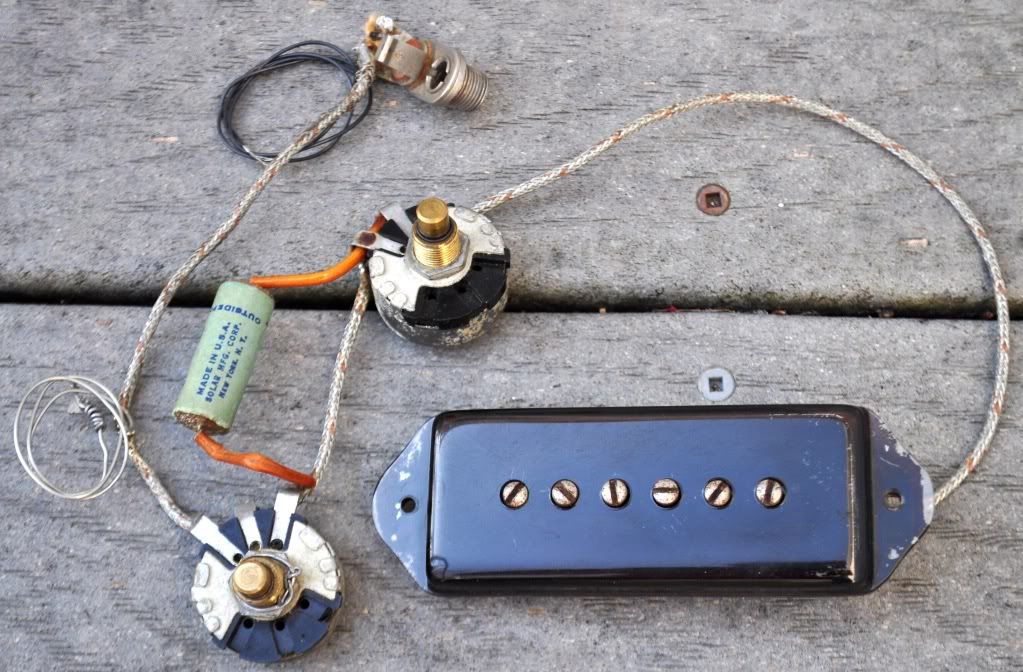
According to it's FON 3428, mine's either a '48 or a '50, but the features (flat back, tapered headstock, un-numbered perspex knobs) suggest '48 rather than '50. It was converted to a humbucker guitar at some point, but I put back a '47 P90 with original wiring harness (thanks to forum-member Sam Sherry!). The early models did not yet come with the 'raised diamond' tailpiece. She came with an incorrect German tailpiece (probably Höfner) that just looked off. Luckily I found this old Waverly tailpiece for little money on ebay. I think it looks a lot better. The guitars is very light.
Scratchplate and the perspex barrel-knobs appear to be original. Tuners are newer Kluson 3-on-plate (open tuners would have been more 'historically correct' but who cares, they work like a charm).
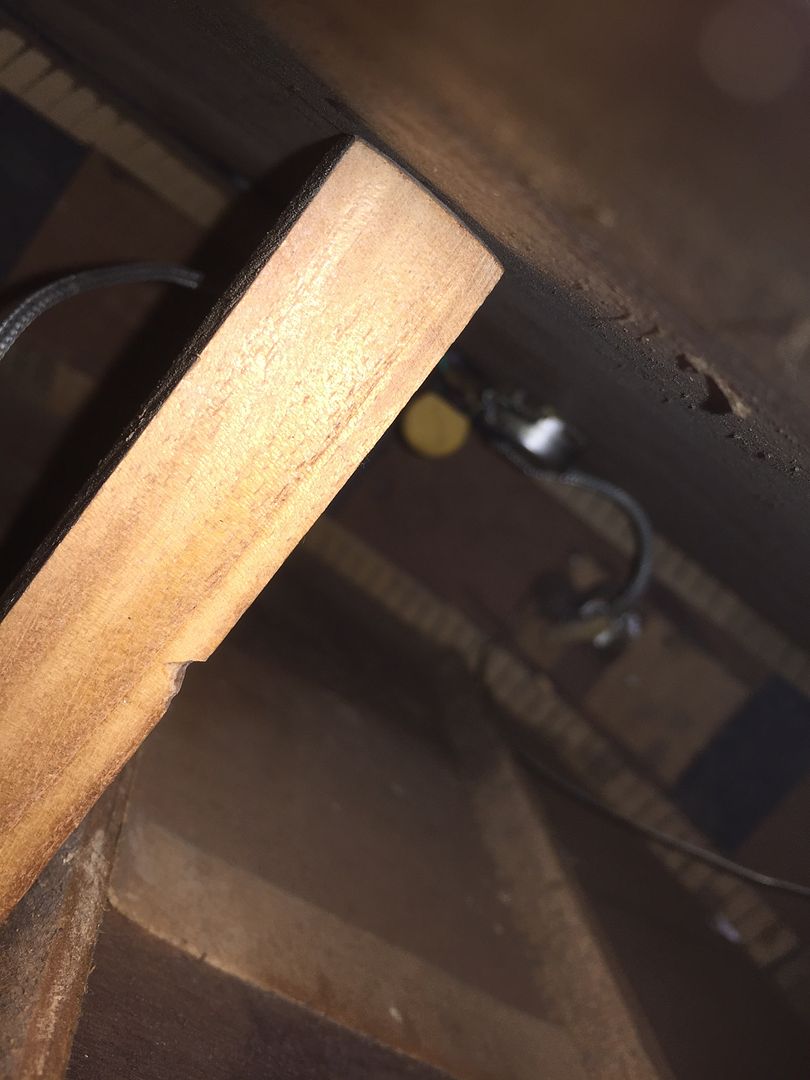
The parallel braces are completely missing from the top! It seems to have been like that for a long time without any negative consequences (no sinking top) but for my own peace of mind I put a staple or sound post under the bridge.
It's a great sounding and playing guitar! Love that old P90 in this guitar. Lot's of play-wear, scratches and dings, but it's supposed to be a player, not a collector's item.


-
That is interesting. My L50 was missing brace #2 on the back. Odd no glue or notches in the kerfing. It was never there from the start and would not have been able to come out the f-hole. Do you think your guitar never had them? Originally Posted by Little Jay
-
No, after examination with a mirror I concluded that they must have been there at some point. But how and when they came loose and how somebody can decide to take them out completely is beyond me! (I think you would have to break them to get them out, aargh!) Originally Posted by icr
If you look at this pic of the inside (picture of the staple) you can distinguish some traces of the old glue:

 Reply With Quote


Interesting Acoustic-Electric 7-String
Yesterday, 06:32 PM in Guitar, Amps & Gizmos