


-
>>> I knew that "over & out stuff wasn't you.
Yeah, that was precipitous.
But then Four00 comes in with what in my opinion is an actual thumb-in-the-eyeball challenge to my thinking based on an (inconvenient for me) solid basis.
Chris
-
07-27-2014 06:51 PM

-
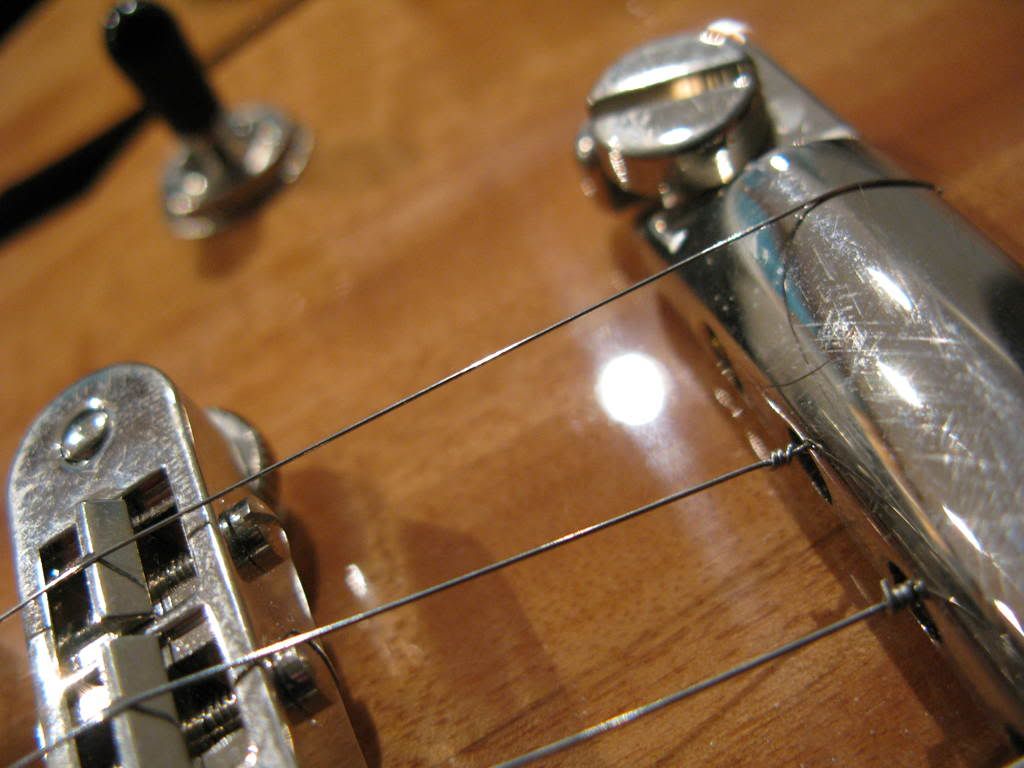
We may never know for sure. I remain convinced, so I top-wrap my Les Paul and my 335. Yes they look funny that way. No offense intended toward oldane or Chris, just an alternate viewpoint. Raising the stop tailpiece is easy enough to try, so all you kids watching ... DO try this at home.
-
String break angle behind the saddle does make an impact on the tone of a string!
There, I've said it!
But only on the extreme.
And a pictures to prove it....
J200 copy
Bridge trying to do its job
And desperately in need of a neck reset and with a warped top. Uneconomical repair.
Break angle non existent on the top E, practically flat angle & sounded thin.
Synopsis? Fine musical instrument? No. Wall art? Yes.
-
Yeah . . . SuperFour00 got game. I like his contributions. But, don't tell him I said so. I really don't want people to start thinking I'm a softie.
 Originally Posted by PTChristopher2
-
I'm with you on that - as far as we are dealing with acoustic guitars. IMHO, that's because a changed break angle changes the downward pressure on the top. That is where those adjustable archtop tailpieces can have an effect though the effect is minute due to the limited variance in break angle the adjustmens allow for. Still IMHO, it has nothing to do with string tension and bending resistance, which is unchanged. Originally Posted by jazzbow
-
'I tossed the lore and the-lore won, I tossed the lore and - (A G F#m D)........' Originally Posted by PTChristopher2
-
When you scale things up to the size of a bass it's easy to see the effect that the string break angle has on the instrument's response. On an upright bass the height of the saddle determines that break angle, all other things being equal. On an archtop guitar set up in a similar way this part is the small piece of bone where the tailwire rides over the top.
On a bass an increase in the height of the saddle by one inch makes a noticeable effect as that angle is reduced. The decreased force on the top can give the PERCEPTION of less string tension and allow the bass to speak more easily. This high saddle is typically employed when the bridge ends up being very tall for some reason, or when the top is thin and fragile. Or you might try a high saddle simply to try and give the instrument a "softer" feel.
I think that's it's likely the case that a system like an archtop guitar is not sensitive enough to be noticeably affected by a change in the string break angle, at least with the sort of neck angle and bridge height were used to. And I know that the feel of a thick plywood GB 10 doesn't change when that tailpiece moves in height from top to bottom. But on a carved bass the effect is very real.Last edited by vejesse; 07-28-2014 at 10:16 PM.
-
Why? What leads you to believe "an archtop guitar is not sensitive enough"? Duane Allman clearly thought a solid body Les Paul was sensitive enough to benefit from a more shallow break angle, as does Billy Gibbons. Does Joe Bonamassa do that, too? What experiences have you had with any guitar that leads you to believe that a shallow break angle of the strings changes the feel on an acoustic Bass violin, but not on a guitar? Originally Posted by vejesse
-
Which reminds me - from one of my Hofners:
-
Yes, but wouldn't that torque change when the break angle is changed, though maybe in a more complex way than with the simple downward pressure of an archtop? Originally Posted by PTChristopher2
I agree that flattops and archtops are really very different instruments which only happens to be tuned the same way (well, sometimes)...... :-)
BTW this tension discussion has been going on at least since Epiphones introduction of the frequensator tailpiece and there's no reason it can't continue for decades to come with each of us sticking to our firm beliefs about the matter.Last edited by oldane; 07-29-2014 at 01:47 AM.
-
Thanks! I've just spat coffee over me laptop (!euphemism?)! Originally Posted by PTChristopher2
Besides, the higher one is on the social scale the more likely one has a lacquey to cater for those needs.
I, however, tall in stature but low in breeding, can only dream of troddling the toaster....!
Lol.
-
You're right in that there has to be some sort of effect however small with the guitar, some change in the response. And we all know that the human body is very sensitive and some people may actually be able to sense a difference from a tiny change. What I'm saying is that it's much harder to notice the change with a guitar. If you decrease the break angle to just about zero with a top wrapped bridge (your example) I guess you might see a more pronounced effect there! But that's taking things to the limit of your adjustment.
With an instrument like the bass it's easy to notice the change in the feel of the instrument when you change the break over angle just a couple degrees, with all other things unchanged. The bridge on a bass is typically 6 3/4" tall so there's the possibility of wider adjustment in that break angle just from the increased dimensions alone. Plus the sustain that the bow allows gives you the ability to truly evaluate the instrument. There are so many options at your disposal when setting up a bass it's probably not even worth comparing it to the guitar, but I just bring up the break angle for the purpose of discussion.
-
I'm having trouble reconciling "there has to be some sort of effect" and "some people may actually be able to sense a difference from a tiny change" with "it's probably not even worth comparing it to the guitar". You're quite the politician. Originally Posted by vejesse
-
Maybe that's not a bad thing, given the way this thread has developed Originally Posted by SuperFour00
-
Top wrap the strings on a Gibson style Tune o matic bridge and stop tailpiece setup and the virtual ZERO string break over angle is going to feel different than normal. Rather, just crank the stop tailpiece up a couple turns and you won't feel much difference at all. Am I off here? What's your beef?
-
No beef. Originally Posted by vejesse
I agree with:
"there has to be some sort of effect" and "some people may actually be able to sense a difference from a tiny change"
I disagree with:
"it's probably not even worth comparing it to the guitar"
Whoever ventures the opinion that because they can't tell a difference, then there is no difference is ignoring the reality that not everyone has the same capacity for sensing minute variations. Some people are far more sensitive to subtleties. Some of us are denying that fact. Much like saying that, since one man can't feel the tumblers in a lock through the combination knob, therefore, safecracking is impossible.
-
I'm not sure where you're coming from on this. The bass is a huge instrument compared to the guitar. If you disregard all other setup concerns and just compare your ability to change the string break over angle between the upright bass and guitar you find that with the bass it's much easier to tell that your adjustment has made a difference. That's the direct comparison and it's valid. In reality it's not a great comparison because the bass produces sound in a different way and there are some other factors at work (i.e. soundpost placement, bass design and execution, string construction, voodoo, etc.) even if the basics of string height and fingerboard relief setup are common to the two instruments. I thought that the idea of "scaling up" the size would give people a simplified idea of why the effect is much smaller on a guitar and much harder to notice.
Sound reasonable?Last edited by vejesse; 07-29-2014 at 05:25 PM.
-
"I'm not sure where you're coming from on this."
Simply, that I'm making a distinction between "there is no difference" and "I can't feel a difference".
Or, more precisely, "There may be a difference, but no one could sense it" vs. "There may be a difference that's worth considering, because some people may readily notice that difference."
-
Furthermore, the "Varitone tension adjuster tailpiece" was invented presumably by a player, designed by engineers and tooled up and built by machinists (someone thought tailpiece height affected the feel of the action).
This guitar has one: Gibson L 5 (#996) 1939 Sunburst Guitar For Sale Fretted Americana
I've seen them on L-5s and Super 400s.
-
Ah, the "Varitone Top-cracking Device." Originally Posted by SuperFour00
One of Gibson's less-than-brilliant moments.
-
My friend reminded me that he once owned a Johnny Smith L-5 with that adjustable tailpiece. (He never adjusted it, so no data there.) Originally Posted by Hammertone
Still, Gibson apparently was convinced that variations in the break angle over an archtop's bridge significantly changed the feel of the strings. I think I'll rest my case. Thank you ... thank you very much.


 Reply With Quote


Interesting Acoustic-Electric 7-String
Today, 06:32 PM in Guitar, Amps & Gizmos