


-
Sheesh, just get one of these (they're still cheap):
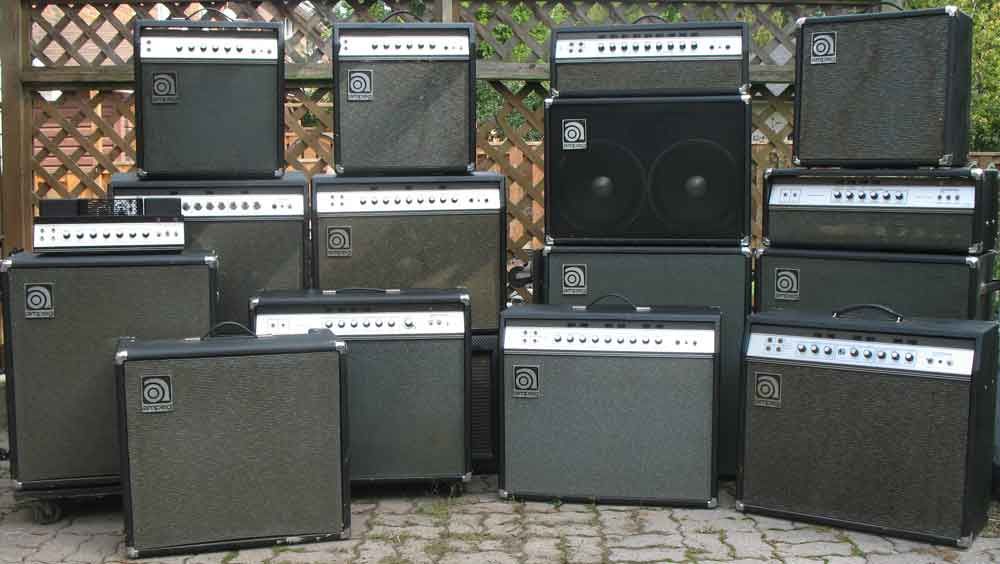
B-15S / VT-40 / VT-22 / GV-22 / GV-15 / G-20 / G-12 / V-4 / GU-12 (OK, two of them) / J-42X / Reverb-o-Jet / VT-22 cab / V-4 cabs. The black grill cloth on the VT-22 cab is not original.Last edited by Hammertone; 10-29-2013 at 11:25 PM.
-
10-29-2013 09:09 PM

-
Are those Ampeg guitar amps? I thought they only made Bass guitar amps.
Are they a hidden treasure for Jazz guitar?
-
Yes, guitar amps as well as bass amps.
Yes, a hidden treasure, along with Sunn tube amps from the same era (like the 190B [Sonaro, Sorado]; 190L/200S [Septre, Solarus]; 2000S, 1200S, 1220S).
I see you're in Texas - most of the old Ampegs were more of an East Coast thing throughout the '50s and '60s, favoured by many jazz players. Everything in the picture above was built between 1968 and 1974, during Ampeg's "helmethead" era (1968 - 1978). I pay very little attention to post-'68 Ampeg-branded amps, since the trademark has been kicked around since then.
Prior to 1968, there were plenty of excellent jazz-oriented tube combos for guitar. 1950s ones are rare and fairly obscure. Here's a pile of 1960s Ampeg guitar combos, (including a couple from 1959):
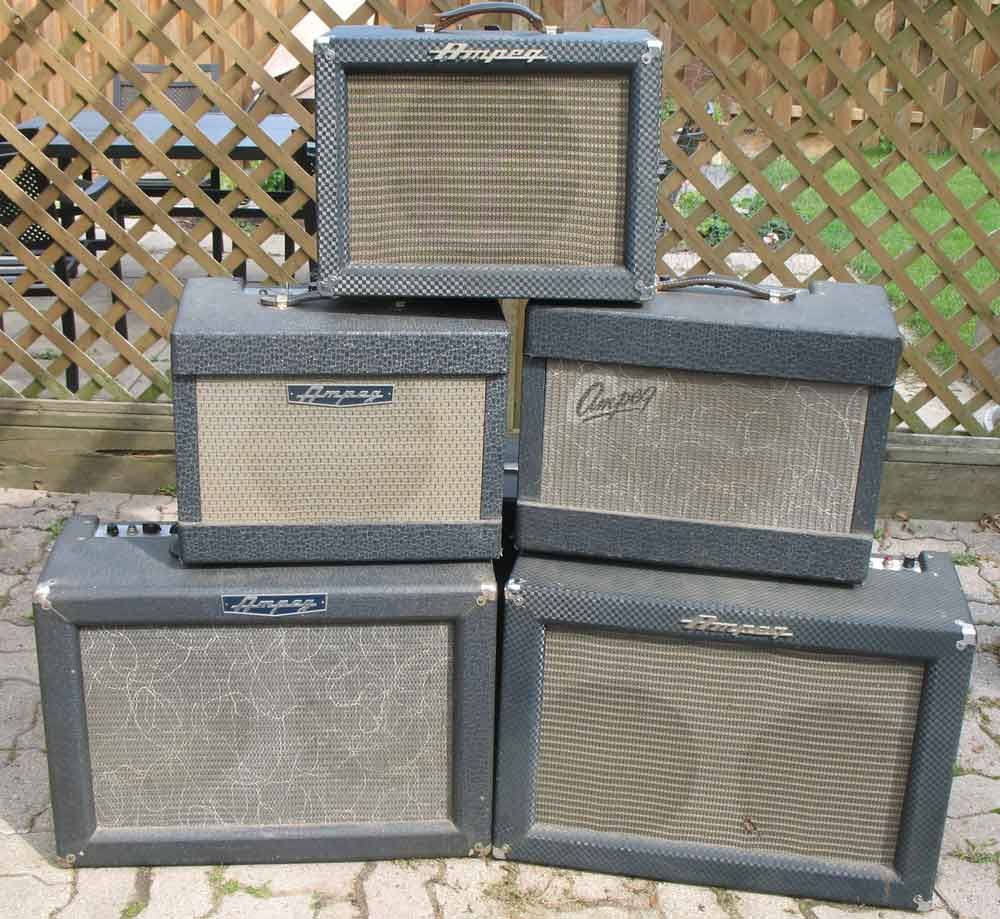
Echo Jet / Jet / Rocket / Rhapody "Special" / Super Echo TwinLast edited by Hammertone; 10-29-2013 at 11:27 PM.
-
Nice stack of Ampegs, Hammertone!
I've probably spent more money on buying modestly priced vintage amps and having them made to work properly, than I'll ever expect to get back.....but I'm very happy with what I've ended up with. I've got quirky tastes anyway.
Investments for resale though? Never seem to think of them that way.
I've got a several 40's and 50's Gibson amps that are quite pleasing for jazz and pretty much everything else as far as I'm concerned.
I do have a 1960 "La Prima" which is an Ampeg R-12 Rocket rebadged for an accordion distributor/maker.
Its got great clean tone at lower volumes but tends to break up very early (much too early for my needs), even with a more robust speaker with higher power handling abilities. I'm hoping its got more than that, but it may be all there is.
It probably could use a good going over by my amp guy.
ziz
-
 Originally Posted by Hammertone
Ampeg. I remember the days when they made good bass amps. B15N.
Thought they had gone the way of the Ford Edsel...good designed car, but with a horse collar around it,
it wasn't too popular. Good to see that marque still around these days.but I'm puzzled by the same
model names for both Ampeg VT40 and Vox VT40....were they made in the same chinese factory or
did somebody copy somebody because of it's popularity? Inquiring minds want to know.
Attachment 9262Attachment 9263 Vox VT40 +40W 12x10 guitar combo
-
Those Gibson amps are to die for! Do you KNOW what you have there? These amps were designed by Seth Lover Originally Posted by zizala
(we all bow down as we are not worthy), the father of the Humbucker.
In my book , Gibson Guitars, it was mentioned that Ted McCarty, CEO of Gibson during their glory days, mentioned that he didn't like Leo's amps because they sounded "loud and raucous" and an amp should produce mellow tones that sounded real nice, when Johnny Smith played "Moonlight in Vermont"..so he told Seth and Walter Fuller to make them sound 'sweeter" as in jazz.
some of their amp models: GA8T (G= Gibson; A = Amp T=Tremelo R=Reverb)
Discoverer 8 watt practice amp
GA2RT Maestro deluxe reverb-echo
Maestro 30 stereo amp
Maestro standard
Maestro 15RV
Maestro Viscount
GA-100 Bass amp
GA1T reverb-echo
GA79RV Stereo-reverb amp with that neat side angled stereo speakers (L +R)
GA77RV Vanguard
GA30RV Invader
GA90 High Fidelity 6 speakers
GA77 Two Channel with a high gain (lead channel)
GA55V High gain Twin Twelve
GA70 (the new Country and Western amP
GA40 Les Paul amp with tremelo
GA30 Dual speaker (wide angle dispersion)
McCarty cites the Les Paul guitar as his greatest achievement, but... on the other end, he was never able to compete with Leo Fender. "To help us build amps, I brought in Seth Lover from Chicago (CMI),and I always blamed him for not being able to beat Leo's amps. I told him (laughing) "it's your fault!"
"I gave him a lab, put him in charge.He was top dog in amplifiers. We built what we thought were damn good amps and today you hear people say these are very fine amps, but of course, our amps would not go into these real raucous tones".
In 1966 Gibson cancelled their amp production when sales dropped off considerably. Seth Lover retired as chief project engineer at Gibson, moved to Garden Grove Ca, where he worked for Fender Musical Instruments, where he worked on amplifier design and Fender pickups until his death.
Isn't it funny that in the music world..what goes around comes around?
"Gibson players wanted that mellow sound while Fender players wanted that harsh-raucous sound".
but when Fender amp sales left Gibson in the dust (1960s) Gibson sales told Ted,"We'd like to have some of that so called "harsh Fender" kind of sound."
I think that the Maestro amps were the economy models. Gibson discontinued amp production in 1966.Last edited by Daniel Kuryliak; 10-30-2013 at 08:03 AM.
-
I think Gibson amps varied A LOT in their circuit and some people even complain their schematics don't match their circuit... but I think they were similar to fender tweeds (and the ones I tried did sound similar to tweed amps).
People tend to associate Gibson amps with Johnny Smith and Jim Hall BUT
1) Smith's amp was one of a kind and based on his ampeg, so I assume baxandall eq and flat frequency response
http://www.chipstern.com/chip_sound_jsfy.htm
2) Hall's early sound might be the stock amp but later he had it modified (quite a bit I think) by Harry Kolbe.
Gibson reissued these amps in the 90s - again with not much success. A friend of mine has one and it sounds VERY good (his L-5 and playing help a lot too).Last edited by jorgemg1984; 10-30-2013 at 08:16 AM.
-
Valves being equal (more or less), except for specific tube brands , and what they call soft overload on some preamp (12ax7)/ 6L6/EL34 power tubes..it boils down to unique design within the preamp circuit, type of coupling caps used between tube stages and the output transformer. Originally Posted by jorgemg1984
The eq section (treble/mid/bass) is a big variant, and also makes the amp sound unique, and desirable over another brand. Fender users like the raw power at high levels and some distortion.
Also , a contributing factor to the tone of the early amps was ALNICO magnets on the early speakers,
like Fender using Jenson. Gibson also used Alnico magnets on their speakers, but they either made their own Alnico magnets, or had a supplier make them and slap a Gibson label on the speaker.
Gibson jazz players didn't like some types of Fender amps. I was at the gate of the Gibson"Hallowed
factory" ground in Kalamazoo in 1967, to tour the factory, but they were on strike for the first time in their history, I believe, and I don't think that McCarty or Seth Lover were still there at the point
in the summer of 1967.
McCarty left in '66 after a falling out with the son of CMI founder, Arnie Berlin. McCarty's and Arnie Berlin's management style were directly opposite vectors. Gibson overall production took a big dive
starting in 1966.
McCarty had negotiated with Paul Bigsby and bought the small company off Paul. He was busy with production of it, as well as some kind of "flashlight" (Flex-lite) The management at the time told me they didn't want any trouble from the union and wouldn't allow me to cross the picket lines although the picket line said they would be ok with me going in being one of their dealers from Canada. ..
So I missed my one and only opportunity ,due to bad timing. Had they told me to see McCarty at Flex-lite/Bigsby I would have gone over to meet him.
Many of the jazz greats of the 60s/early 70s either used one brand or another (Montgomery used Fender for a while (I read somewhere) until he switched Standel and from there on..it provided his characteristic 'octave" sound.
A lot of jazz players prefer the clean and not too much eq sound.Last edited by Daniel Kuryliak; 10-30-2013 at 09:41 AM.
-
I was just noting your example (Johnny Smith) was not a good one because his amp was custom made for him so not comparable with other Gibsons.
I was also saying that I believe most Gibson amps offered a tone stack very similar to Fender Tweed and a lot were also low-powered and know for their overdrive sounds (again, like tweed amps). So not a big alternative to Fenders.
Plenty of jazzers love fenders (both tweed and blackface). I believe the main alternative to Fenders was Ampeg.. and that kind of sound (flat frequency) is still the main alternative to fender sounds (in most ss "jazz amps").
Not all Fender user enjoy raw sound - Twin Reverbs or Pro Reverbs or even a Super Reverb or some high powered tweeds are hard to get that sound at club levels (and also other Fender amps). Fender clean sounds are actually pretty much legendary on lots of styles, including jazz.
Wes octave sound was already pretty much done before he used a Standel (which I also believe has a Fender style preamp adapted to solid state technology).
-
I played in a jazz club in my early days with a friend of mine, who had a Gibson Archtop, forget the model, but Originally Posted by jorgemg1984
it was not a 175 nor an L5, but full body thickness. He found a Tweed Champ and that is what we used.
Little 5 watt amp..but the sound was so sweet and enough volume that the sax/trumpet/keyboard player
didn't overwhelm us. I looked around for a vintage one many years later, but they are as scarce as hen's teeth
and any available fetch big bucks..a simple class A with an 8 inch Alnico speaker..but with a jazz box at
"normal" levels..a tone..this side of Heaven (IMO of course.
Yes, you are right there. I don't know what he used when he played with his brothers (Monk and Buddy) butWes octave sound was already pretty much done before he used a Standel (which I also believe has a Fender style preamp adapted to solid state technology).
it would be interesting to know what equipment he was using. I also have seen pictures of him playing
an ES-175 in his early jazz years, based on the FB parallelogram markers.
-
Johnny Smith's custom amp was built later. His "Moonlight In Vermont" was recorded with a Gibson GA-75 borrowed from his friend (and killer player in his own right) John Collins and his DeArmond equipped D'Angelico. The Sound Of The Johnny Smith Guitar album I believe was recorded direct or at least from what I've gathered from interviews. Gibson amps are very cool. They generally used older topologies than Fenders of the same age. For example Gibson stuck with grid leak biased octal preamps while Fender had already moved to cathode biased noval tubes. In fact the GA-75 most likely still had a field coil speaker in it.
-
Cool Jason. Love to hear that there are electronics guys on here as well. Yes,I am familar with grid leak bias vs Originally Posted by jasonc
cathode bias and the reasons. Did some experimentation in my early days and built a few... transistor amps..
excuse me..akk!
This link gives some insight to the different tube biasing schemes; cathode bias being simple and economical,
and of course Leo would approve.
http://electriciantraining.tpub.com/...s/14178_45.htm
Grid leak bias advantage of being directly related to the amplitude of the input signal. If the amplitude increases, biasing increases in step with it. The main limiting factor is the amount of distortion that you may be willing to tolerate. Distortion occurs during the positive alternation when the grid draws current. Current drawn from the electron stream by the grid never reaches the plate; therefore the negative-going output is not a faithful reproduction of the input, while the positive-going output (during the negative input cycle) will be a faithful reproduction of the input.
I guess Seth Lover was "old school".
-
I wouldn't go so far as to say I'm an electronics guy. I really know just enough to cause trouble. I've built a handful of tube amps. Mainly because I wanted a GA-75 but they were either too expensive or too rare. Being a tinkerer I thought I'd just build one. So I did. My main amp right now has the front end and tone stack from the GA-75 and the power section and phase inverter from a Fender 5C5 Pro all built into a little tweed Deluxe sized cabinet with a single 12. So it's an all octal (6SL7GT's, cathode biased 6L6's and a 5U4) vintage jazz tone machine! The only reason I went with the Fender power section is just because it had a lower parts count and was a bit easier for me to figure out. Great little amp and it's even easier to haul around than my Henriksen 112. Plus it's always cool to be out on a gig playing a complete rig you built yourself!
-
IMO, a '60 Rocket is way underpowered for anything other than kickass grit and distortion (at which my Rocket excels). Originally Posted by zizala
For a small, clean, 1x12 combo for jazz, I recommend a later 1960s Reverbrocket II - still pretty light.
Better yet, a helmethead G-12 or GU-12 - even cheaper because they don't have the aura of blue-check grooviness.
All with plenty of headroom and reverb.
All dead simple and easy to repair, with widely available schematics.
For increased headroom, one can find old 12" AlNiCo speakers like the Altec 417, JBL D/K-120 or EV-SRO all day long. For 15", there's the AlNiCo Altec 418 or JBL D/K-130. These speakers are heavy but worth the weight IMO.Last edited by Hammertone; 10-30-2013 at 03:54 PM.
-
I believe most Standel's used the Baxandall tone stack..... Not at all Fendery . Originally Posted by jorgemg1984
-
If so I am sorry for the mistake.
-
Originally Posted by jorgemg1984
oh, what a surprise!
Here is a 1958 Gibson GA-8 Gibsonette with an ES-225 from the same year. I got them separately but they only work together now. Like they were made for each other. Originally Posted by Daniel Kuryliak

This GA-8 is pretty comparable to a Tweed Fender Harvard (model between the Tweed Princeton and Deluxe) in terms of tone and size.

-
Originally Posted by jasonc
Yes, I hear you. I do know a bit about tube theory and of course can read tube/transistor schematics if I need
to repair an amp, which I have in the past. I almost went for one of those Fender amp kits that TubeDepot sell,
but decided to go for a used Peavey Valveking and upgraded the tubes and speaker to a vintage Celestion.
I don't know where you live, Jason, but up here in "Canuck land", getting any parts to build a tube amp from
scratch is next to impossible..especially power and output transformers. The tubes, I could get on line, and I
can punch out/drill a metal chassis..but by the time I invest the hours of labour + parts..I'm better off to
just get a kit. Yes, there is nostalgia in finding an old Fender amp from the 60s/70s, but everyone thinks that
just because these vintage amps are 40 year old, they can charge an arm and a leg for them.
Most of the time the power electrolytics are dried up after all these years and need changing, although with
tube voltages the 120 cycle rectifier ripple is not as critical.
-
[QUOTE=Eddie Lang;373472]oh, what a surprise!
Here is a 1958 Gibson GA-8 Gibsonette with an ES-225 from the same year. I got them separately but they only work together now. Like they were made for each other.
This GA-8 is pretty comparable to a Tweed Fender Harvard (model between the Tweed Princeton and Deluxe) in terms of tone and size.
[/QUOT
That's a sweet combo.
For jazz you don't need hundreds of watts and stacked Marshalls, just a small amp that has a good
mellow sound. We'll leave the stacked Marshalls for the rockers.
-
Hammeton..yo is da man! Originally Posted by Hammertone
Headroom is very important and for those non-initiated in the electronic arts, its an expression of how much
the signal can be amplified before the onset of distortion/clipping.
I used to work in a recording studio in my younger days as chief engineer and we were always concerned about
headroom in the recording consoles. I remember the days of JBL 15 inch studio monitors and Altec-Lansing
studio speakers..sweet..but of course at professional audio prices.
intage Pair Altec Lansing Model 19 Studio Monitors - $1050 (Colleyville/Hurst)
Rowfff! I remember tuning a couple new recording studios with pink noise and a digital audio spectrum analyzer
to eq the room acoustics to the speaker SPL and rolloffs with these!
Altec-Lansing Model 19 Studio monitors (from a Craiglist ad)
----------------------------------------------
These circa '78 studio monitors sound like you are in a symphony hall. Clear sound. They have their share of scratches and minor blemishes. I've tried to take blemish pictures so you can see what you'll get. One of the woofers had a little tear and was professionally repaired - that (I'm told) was about 20 years ago. Again they are the best sounding speakers I've ever owned. Serial numbers are only 65 apart.
These are big boys. Each weigh in at 166 pounds. 37" tall 30" wide 21"deep. So bring your truck (they fit in our minivan too)
Other specs:
Low Frequency: 15" bass driver (416-8B)
High Frequency: radial phase plug driver mounted to 811B sectoral horn
Nominal Impedence: 8 ohms
Crossover Frequency: 1200 Hz
Enclosure Type: Vented
Sensitivity: 99 dB SPL 102dB SPL (Measurd at 4 feet, 1 watt input, using pink noise which has been limited to a bandwidth of 500 Hz to 3kHz
Frequency Response: 30 Hz to 20kHz
Amplifier Output Range: 10 watts to 350 watts (PLEASE do not mistake this with speaker power capacity)
Long Term Broad Band Maximum Power: 65 watts (Measured with a source of pink noise limited to the frequency response bandwidth of the system over an extended period of time)
-
I had a VT-22 when I was a young man. I still get a sentimental twinge in my back when I think about it. Originally Posted by Hammertone
-
I get that hauling my 35lb Peavey Valveking up the stairs. Originally Posted by Jonathan0996
-
"Hold their value" is a relative term. If you buy a new amp today, you're out of luck if you expect it to retain its purchase price.
Generally I'd have to say that amps will depreciate in value from new for some time to some $ point and if you're lucky stay there. If you happen to buy an amp that goes out of production that is "rare" and it becomes desirable you're in luck, but prognosticating which one is which is likely impossible.
Lots of people don't or won't buy used, but if you find one at a store used that you can check out, buying used is as you saw on Ebay the way to go.
-
Like I said, this has been a very eye-opening thread.
My apologies to any salesmen on the forum, but when I can, I try to buy used or second hand - or even blemished.
I have so far had very good luck with three guitars and two amps - all used.
And I am very happy to see that an amp I have coveted (but won't buy unless I start performing) can be easily had at 70 percent of the value.
But, as always, let the buyer beware.
A Fender Jazzmaster Ultralight that I bought from Guitar Center had a cracked receptacle on the head. It does not seem to have affected the tone at all and the amp sound great.
I ordered it from a Guitar Center in Canton Township and the salesman failed to tell me about the defect when I spoke with them to order it.
Let the buyer beware....as they say.



 Reply With Quote


Interesting Acoustic-Electric 7-String
Yesterday, 06:32 PM in Guitar, Amps & Gizmos