


-
Assuming a 50s es125...
Same pickup.
Same materials
Different body size
Different scale length.
I have a 60s ES125 I never bonded with. I am thinking a 50s es150 (after seeing the one posted for sale a couple of months ago) but am I barking up the same tree? The 125 wasnt bad.. just not .. it.
Thoughts
-
08-30-2011 12:14 PM

-
^ I'm a fan of long-scale guitars; I'd go for the 150. Pretty different from the 125.
-
I would probably start at trying to figure out what made ES125 not "it" and guitar specs that contribute to those qualities
-
I got to play an ES 125 from the 60's for about a year (it was my brother's). The name on the head stock looked impressive. Everyone could see the name "Gibson" on it so it would seem as though it should've been a great guitar... but it was not. It was a dog! Perhaps the laminated top was too stiff to produce a decent tone. Plugged in didn't sound too good either.
In short, I don't recommend the ES 125 guitar.
-
It depends on the specific guitar in hand imo. I used to own a fantastic 125 that blew away far more expensive guitars in terms of sound and playability. On the other hand I took a lesson from a well-known player who had a 125 that didn't impress me at all.
 Originally Posted by caravan
Martijn Van Iterson I believe uses one as his main guitar.
-
Does anyone know how they changed over the years, or why a 50s model might be better? I have watched several YouTubes of single pickup ES125s from various years and that's all I have to go on- they all look the same to me. But as far as I can tell from the videos, these guitars consistently sound gorgeous. Of course there may be lemons out there, but there are several players on YouTube with several ES125s and I am really impressed with these. Judging by the videos, I prefer the sound of the cheaper ES125 over the ES175 which I think sounds disappointingly tubby in comparison. As for ES150s- one reason I play Gibsons is because I don't like long scale necks regardless of how they sound.
-
The ones I've seen have had different pickup locations. Some have the P-90 right next to the neck and others have it halfway between the neck and bridge. I've never played them A against B but just on GP I'd prefer the pickup near the neck. Also, on those older ones some of the P-90's were very mellow and some were screamers. Think George Thorougood and the Delaware Destroyers. Originally Posted by moderato assai
-
All ES125s look like mine, with the pup by the neck. The only major difference over the years was the slimming of the neck in the later models. If the pickup is halfway between the neck and the bridge, it's an ES-225. Originally Posted by mongrel
I think mine sounds great in an appropriate setting and with the right amplification. I prefer it to the 150 because of the 16" body and shorter scale, but like any other vintage guitar some are going to be better than others.
-
Did Gibson not change their laminating process? The thickness of their laminate certainly changed in the 70's and I think that started back in the 60's due to profit margins. Hollow jazz guitars were popular until the beat boom, surf sound and instrumentals vis a vis solid bodied guitars became popular due to larger venues and louder sound systems. So less interest in hollow jazz guitars, less cash coming in so cutbacks and redesigns.
-
Originally Posted by AlohaJoe
+1 .. never seen a mid position ES125 ... maybe some older L50s that have had someone put a P90 in them.
One thing I dont like about my 64 is the slimmer neck.. not LP slim.. but I like something beefier.
-
Originally Posted by jazzbow
They changed the materials for the laminates.. older laminates (50s and I thought 60s as well) were maple/basswood/maple and they later switched to maple/poplar/maple. I dont know when.
-
I think the quality control suffered in the mid 60's and eventually Norlin bought the company and imposed cutbacks, notably dropping the ES125. In retrospect I think the laminate issue was as you said from the 70's.
The issue with production line instruments is whether it's a player or not.
-
I play a 1952 es 150 and it plays like a dream, I wouldn't think they sound too different, but they definitely feel different
-
well.. specs arent hard to come by (I have a few books that talk about the 50s ES150s)... but first hand experience and opinions do count for something..
Sometimes it isnt so much taking things with a grain of salt as it is separating the wheat from the chaff. Other times, being honest with yourself and not just listing to the comments that say what you want to hear...
-
I own a 1947 ES 125 and I appreciate it for what it is. The P-90 pup has non-adjustable pins (I believe the adjustable ones were produced on the '49 or '50 ES 125's). The guitar originally sold for about $150 and was produced as a student guitar....hence made to play comfortably with a short neck and 16" bout. IMHO the sound is classic and unique for that era and projects a very rustic open tone, which can be adjusted by the tone knob....smooth to barking is the versatility of the pup. I have never played the ES's from the 50's or 60's so I don't know how they compare.
-
thread is 10 years old, but anyways
Originally Posted by NEWCITY
so do I, how about sharing a pic of yours ?
here's mine, from 1947, non-adjustable pick-up as well, it is a dream guitar, that can do next to anything.
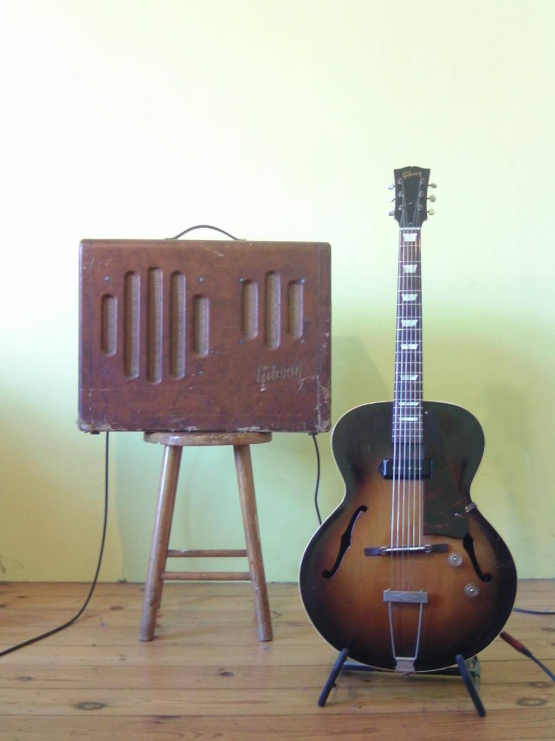
-
I would love to share a photo of my ES, but I don't know how to post it on this site...it ,must be because I am almost as old as the as the '47...LOL If you let me know how to do it I will try to post it.
Great photo of your ES and the Gibson amp. How is the sound from that amp it must compliment the P-90 a lot. I have a Fender Blues , Jr. (modified significantly for jazz... 30W). and its my favorite tone set up for the ES.
-
I posted about an ES-125 that I bought a couple of years ago. To the best of my abilities, I've narrowed it to 1947. It has a flat back, fixed lug p-90's, and the knobs show no numbers and are clear.
Gibson ES-125 evaluation fun
Here's a couple more pics:
The only thing non-original are the tuners, and pickguard. The old buttons rotted off. I have the machines, and plan to restore them with antiqued (off-white) buttons.
-
Gibson did not use serial numbers on the economy models like the ES 125's. They only stamped an FON number on the internal back piece. Based upon the FON nos. 1168 the guitar was made in 1948. It was number 33 or 39 (difficult to read) in the batch off the production line. The volume and tone knobs had no numbers until they were changed to numbered knobs with a metal indicator on or about '49 -'51. From the pictures it looks like your tailpiece may have also been replaced as I have not seen that on any model. The tailpiece with a diamond on it replaced the simple contoured tailpiece around the '50's. Hope this helps.
-
Thanks. It's really hard to accurately date some of these old Gibsons. The tall, clear speed knobs, flat back, and slug P90's put it in that time frame. Certainly sounds and plays great.



 Reply With Quote


Interesting Acoustic-Electric 7-String
Yesterday, 06:32 PM in Guitar, Amps & Gizmos