


-
I wanted to give a short write-up on my 1964 Gibson 175.
As some of you know, I've had close to 12 175s as well as a couple 165s.
I'd had them from almost every era, 1964, 1968, 1971, 1974, 1989(4), 2005, 2012
As time went on, gibson made the build heavier and heavier in an attempt to save money on warranty repairs. They also briefly flirted with 3pc mahogany and 3pc maple necks to avoid warpage. Tops also got thicker and glues were changed. Originally hide and then PVA. I have heard that the modern 175s used epoxy for the plates but I'm not sure.
In 2012, gibson was "caught" using laminated fingerboards so it's possible the 175 from that era also fell victim.
I haven't played a real '59 and only briefly played a '59 reissue so I can't tell you much about them.
This '64 is remarkable in that there is almost no top sinkage. By contrast, when you get up to the '80s 175s, they almost all have significant top sinkage. One of the first things I do when I look at a 175 is look at how many threads are visible above the base. On the late '80s models, you often see 1/4" to 3/8" of threads visible. On my 64, there is less than 1/8. Of course this can vary based on the hight of the base/bridge itself. I'm talking the standard base and bridge, including tuneamatic.
IMO, the '88/'89 guitars were the last era that had a light enough build that you actually got some acoustic resonance when you played electrically. Sadly, the 88/89 guitars also suffer from extreme top sinkage. I've heard that Gibson flirted with kerfed bracing but I cannot confirm which eras had this.
My 64 has a couple screw holes in the top which apparently were from a bigsby. It also has replaced pickups (patent # pickups). Tuners, tailpiece are also replaced. It weighs slightly more than 6lb compared to the 7.5lb of the 2012 I recently sold.
Earlier ones have a much more resonant vibe to them than the modern ones. Each decade generally brought heavier builds and had different characteristics, progressively worse build quality/younger woods and subsceptibility to top sinkage, warping, etc.
Will write more later and accompany with a sound demo.
-
05-04-2026 09:10 AM

-
I have owned the following years:
1963
1967 (single pickup)
1970
1977
1982
1997 (still have it)
2008
2017 (Still have it)
2017 59RI (Still have it)
I have a bandmate that has a single pickup 1952 and I have used that on a couple of gigs.
My experience is that in general, they did get heavier over time with a period in the 90's where they got lighter. My 97 weighs 7 pounds which is about the same as my 60's examples weighed. My 2017 Figured weighs 7.5 pounds which is about the same as my 70's and 80's examples weighed. My 59RI weighs 6.5 pounds which is about the same as most late 50's 175's that I have played weighs. My bandmate's 52 weighs just over 6 pounds, and is very acoustic. But my 67 single pickup was also very acoustic, so I think the single pickup models are a bit more acoustic in that there is less metal sitting on the top.
I don't think that counting threads on the bridge base is necessarily dispositive of top shrinkage. If a guitar needs a neck reset, the bridge height will often be lowered as much as possible to compensate (this was the case with my 63). And that guitar could have a top that has sunk or not. But for the most part, I agree that if there are a lot of threads showing, it is indicative of a top that has sunk.
There is a lot of weight variation in the same eras as well. I have heard about 8 and even 9 pound 175's (mostly from the 70's and 80's) though I have never had one of those in my hands.
When I first got my 2017 Figured, the weight was a turnoff and I thought that I would sell it. But after playing it for awhile, I found that it sustained better than any 175 I had ever owned so I kept it. Today I keep that one set up with a metal bridge and roundwounds and my 97 is set up with a wooden bridge and flatwounds. The 97 nails the Joe Pass sound and the 2017 gets a more modern, cutting sound which I like for Gypsy jazz (I will only play a Gypsy guitar if I have to as the 26.25 scale hampers my playing). My 59RI has a more acoustic sound (like the 175's of the late 50's) and I sometimes choose that one. I have heard that many of the 59 RI 175's had quality control issues, so it seems that I got lucky.
Neck profiles are all over the place on these guitars. With older models, there may be some luthier work needed and parts may have been swapped out particularly valuable PAF pickups). If they were not so valuable and I could find one that didn't need a ton of work, a 1960-1964 175 would be my first choice as I love the neck profile (wide and thin). The 90's models can be had for considerable less, often need less work and they also have a nice neck profile (some taper). I generally recommend that cats look for 175's from this era.
I have played some terrible examples from all eras so buyer beware! The only terrible example I owned was my 2008. The neck had a bit of a twist that prevented the action from going as low as I like. I bought it sight unseen and resold it for what I had into it, so it ended well for me and the buyer loved it.
@JZ It sounds like the 64 is a winner for you? Perhaps you should keep that one?
-
i was hoping you'd chime in. You're the only other person in the forum who has had as many 175s as I have. (maybe more).
And yeah, i should keep this one, lol.
Check out the conversation about lam tops I posted.
 Originally Posted by Stringswinger
-
It is good to see Steve Holst's comments. When I think about old wood, I am reminded that when Joe Pass recorded the Joy Spring album, his 175 was not very old. The same applies with Johnny Smith's DA. Some guitars are just great and some guitarists are even greater (Joe and Johnny sure prove that). Originally Posted by jzucker
When I was younger, I had to sell a guitar to get a guitar so my first couple of 175's went away for monetary reasons. Since then, I have sold some of them because I didn't love them (with regrets about my 77. I did not love the color which is kind of a stupid reason to sell a great guitar, but like everyone, at times, I can be downright stupid). I have three at present which is really more than I need, but if I could have my 70, 77 and 82 back, assuming they are in great shape, I would consider it.
As much as I have loved Strats, Lesters, L-5's and Super 400's, for me the 175 is simply the right electric guitar for playing jazz. And like you, JZ, I kept trying stuff, just to see what is out there. But in the end, the 175 is the winner. I am glad i bought the ones I have before they got stupid crazy in price.
Congrats on the 64! May she inspire your playing for many years to come. I know that most cats think the late 50's examples are the best, but I think the 60-64 examples are the best.
-
I like the '50s 175s but I can't deal with the hum and the brighter sound of the P90s just doesn't fit with the sound I hear in my head. Originally Posted by Stringswinger
When I bought my Tal Farlow, it had Duncan Phat Cat pickups with the dummy coil underneath the pickup for hum cancelation. I ended up putting the classic '57s back in and now it just sounds like "home".
Also, the '50s 175s i've played have had huge necks. That probably contributes to the tone but never felt as comfortable.
-
@jzucker what about the ES-165, own any of those? How did they compare?
I'm looking at a first year ES-165 or a '89 ES-175 to compliment my '54.
-
The only Gibson ES-175 I've ever played is my 2005. I played an old Ibanez copy about 35 years ago, too far back to make a comparison. I remember thinking "nice guitar."
As I've said a few times, the various copies may or may not sound like an ES-175, but depending on your reference point a Gibson ES-175 may not sound like one either. If your yardstick is Howard Roberts's/Jim Hall's '54- which didn't sound the same in their respective hands- then my 2005 doesn't sound like that. Or Pat Metheny's '58, which doesn't sound like Jim's nor mine. Etc. The ES-175 sound is a range of sounds rather than a specific sound, IMHO.
-
I have worked on many but none from the 1950's. To me it just depends on the guitar itself but eras matter. That said I remember setting up a late 1970's Norlin Blond with no real figure, but it sounded wonderful. It was like Joe Pass to the max and I even had a polytone Mini Brute 4 at the time. I think getting the Jim Hall sound almost requires one that is softer playing and lighter but maybe I am wrong. Pass and Hall of course sounded very different on them which tells you about a 175.
The telling is that if you get a nice 175 that lights your hands and ears, be very careful parting with it and make sure you are through playing the guitar period, not just the 175.
-
I had an '88 or '89 165 which was really great. I don't remember it being mahogany back and sides though. But quality control was iffy. The tailpiece slots were cut too big for daddario chrome ball ends which would slip through. I had to run a heavy piece of wire through all the holes in the ball ends to fix that problem. Originally Posted by trailmixer
-
^^I have an ‘88. Wonderful guitar.
There are some minor cosmetic issues such as cracking of the fingerboard binding and minor checking of the finish. Not unexpected for an almost 40 y/o guitar. But feels good and sounds great. Love the Shaw pickups.
I haven‘t weighed it, but it feels light. No top collapse.
-
I think that's the year I want. I don't like T-Tops and I do like the glossy finish and 'heavy' electric sound of the 80s units. But man the asking prices are UP THERE. $6k for a '88 seems a bit crazy after I spent $4k for a '54. Originally Posted by Doctor Jeff
-
Another fan of the late '80's ES-175's. Maybe it's the combination of the Shaw pickups and the Mahogany back/sides, but I love the sonic beauty of this era. A few years ago I was fortunate to score a very nice example, with no issues.
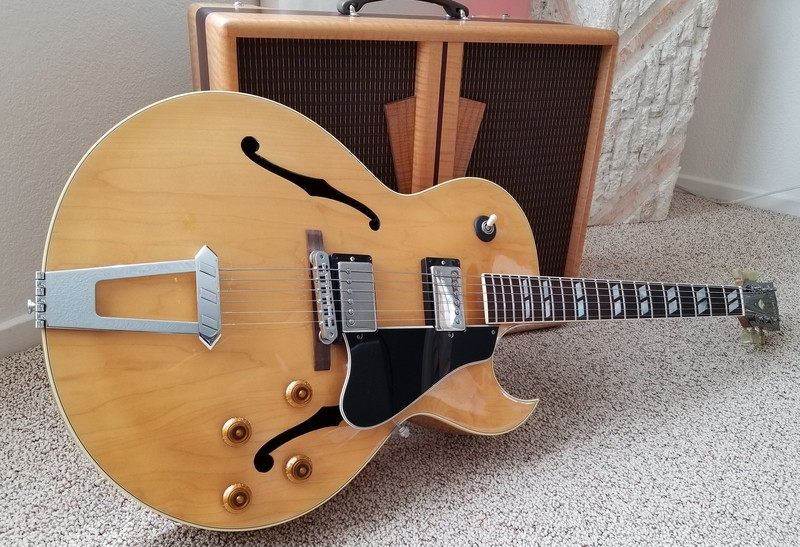
Here's my '89...
-
Was there ES165s in ’80s? I have always thought that it was introduced in 1991. Originally Posted by jzucker
-
Correct. -Phil Originally Posted by Herbie
-
Mine is a '96. It's the only one I've ever owned although I couldn't keep track of all the ones I've played over the years. When I was a teenager in the 70s I wanted one in the worst way, I figured any guitar good enough for Jim Hall, Kenny Burrell *and* Steve Howe had to be the one. But there was no way I could afford it, so I ended up with a 335 and that ended up being a great choice for me, ideal really. I could make a list longer than Jack's of 335 years and variations I've gone through. I've never been without at least one 335 in over 50 years now.
I love having a 175 but I rarely take it to gigs or teaching. I love playing it around the house though. Teenage me feels validated!
Last edited by KRosser; 05-13-2026 at 10:37 PM.



 Reply With Quote


Interesting Acoustic-Electric 7-String
Today, 06:32 PM in Guitar, Amps & Gizmos