


-
"16's?!" Aren't those bass strings?!
 Originally Posted by kris


Sounds great, Kris!!
-
03-14-2026 10:31 AM

-
The compliance of the top plate in an archtop, or even a thinline ES, absorbs some of the pick impulse, and spreads the attack out. I've considered developing a bridge for solid body bass that has something springy under the E side. This would emulate the setup of an upright bass, which has a yielding top under the E, but the unmoving soundpost under the G. (The soundpost serves to translate the sideways bowed-string vibration to an up-and-down motion of the bass foot as the bridge pivots.)
My guess for spring rate is in the range of 50lb/in, although only a couple of millimeters of motion is needed. It might be enough to put a slice of solid rubber, like from a tire or rubber stopper, under a P-bass bridge.
the main difference between upright and solid-body bass is the attack envelope. The thump of the acoustic drives the groove in a way electric can't. And the upright's difference in response from E to G string is important. The lower pitches thump well, while the upper range can sing for solos.
My semi-hollow electric mandolin has a singing attack like, or better than an ES 335, even with a slab back. It's the reactive vibration of the top's large thin area that spreads the pick impulse. Its maple neck preserves sustain after the attack,
A Tele could benefit from a sprung bridge. It has the maple neck of Gibson-style semi-and full hollow guitars.
-
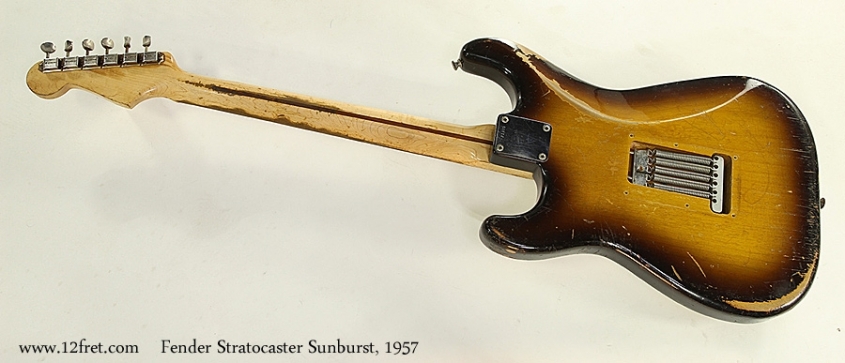
The springs on the back of a whammy bar Strat add something to the sound too: Originally Posted by twtunes
-
While the instrument and its construction are very important to its sound and feel. Ultimately it’s the magician behind it!
I.E. Joe Pass playing a Fender Jaguar with flat wounds probably?
-
Actually I think it's all in my attitude. When I pick up a telecaster, I start playing telecaster music. Same with a strat. Or an LP. Originally Posted by Cunamara
I play a 335 as well with .010's, and my touch on that guitar is fine for extracting some jazz stuff. But then all of a sudden I'm playing Larry Carlton licks....
Since I play in a variety of styles, and needed to adapt in various session scenarios, I found that I just used what each guitar was good at, unless I only had one guitar on a gig, then I just made it work.
Sure, jazz can be played on any guitar, especially modern jazz. I just prefer the arch tops for my version.
-
Can't argue with someone's preferences- those are subjective and personal. It's a different domain than objectivity. I'll not deny that there is a romance to the archtop guitar with its sinuous shape and compound curves and other factors (e.g., that many of our heroes used them) that change the experience of playing music on one versus a Telecaster. I feel it too. But these days I'm liking the sound I get with my TSO for its own sake as well as for the practical issues.
-
Originally Posted by bluejaybill
Thank You BJB, I have felt this same way for a long time re: different guitars, but never found a complete way to express it.! I wondered if others have felt the same or if they just couldn't acknowledge it? But to me, it is an automatic response to diff. guitars. Maybe because of having played so many diff. styles over the years.
I have never felt that I could coax L5 styles out of my Strats or Tele's - never wanted to. I guess it's because I was always in the presence of fat Gibson hollow bodies and the artists who played them.
My Epiphone Casino (a really good one) comes in a close second, but the neck is not the manly neck of my L5. Therein lies a big difference.
-
Quote: "if all you have is a hammer, everything looks like a nail" .
Also, I've lost count of the times I've seen people use a screwdriver as a chisel. It seems to work for them.
-
I think having multiple guitars is more of a recent phenomenon culturally speaking. The rock guys were always more into that than Jazz and blues guys of the past.
Im guilty as well and only when I had enough income could I have multiple instruments to satisfy my cravings,Lol!
I actually envy the guys who use just one or two guitars. Mike Stern,John Scofield,Hiram Bullock,Barney Kessel,Joe Pass,etc!
They just found one that worked mostly for all of their needs,and were able to concentrate on the music itself.
Again I’m the worst at going through gear!
-
I agree. Jocelyn Gould said on an interview that she only owned 1 guitar (of course it's a Benedetto 16-B). Originally Posted by jads57
-
35 posts in and pickups haven't been heavily discussed yet. So let me be the first on this thread to say it: Charlie Christian pickup. And, in my opinion, the best way to go is the TK Smith Charlie Christian.
-
I am down to one Telecaster (it is not made by Fender, so technically it is a "T type" guitar) and it has a TK Smith CC2 pickup in the neck position. It is also a semi hollow Tele with a Spruce top. Even with 10's, the jazz tone is up there with any archtop, I have ever played (I own three vintage D'Angelicos, two L-5's and a Super 400CES, so I have a pretty good idea of what constitutes good archtop jazz tone). Originally Posted by andrew
-
There ya go.
-
I had a good experience with Peter Biltoft CC Rider neck pickup in a Tele. I ended up liking being able to swap magnets and enjoyed the ceramic magnet best.
But for me a lower wind PAF style Alnico 2 or bridge Seymour Duncan std Mini Humbucker works best. It’s a bit darker and evokes more of a Jazz Tone imo.
-
The link to the other Ed Bickert thread has links to stories; one of which...!!!

----------------------------------------------------------------------------------------------
One Christmas Madeline asked me if a new case for Ed’s guitar would be an appropriate gift for him. (As I’m sure you remember, his gig bag was a really flimsy, plastic beige thing that looked like it came from K-Mart). I told her to go to the Twelfth Fret because they knew his guitar, and would know exactly what was needed. I did tell her that it would have to be a soft gig bag and something not too bulky for Ed to find it acceptable.
Sure enough, when I was working with Ed at the Top ‘o the Senator just after Christmas, he showed up on the first night with a new gig bag. I commented on how nice it looked. However, a few nights later I came in to find Madeline at the bar looking rather unhappy. When I inquired as to her problem she informed me that Ed had taken the gig bag back to the Twelfth Fret. He told her that it affected the sound of his guitar. That didn’t sound right to me so I went up to the bandstand to ask Ed what happened to the new case. He told me that it affected his sound and went on to explain that his old case was so flimsy that he could fold it up and put it in the back of that old orange Roland amp of his. It muffled the speaker slightly and he liked that. The new case of course was far too big and bulky to go in the back of that little amp. I asked why he didn’t just keep the crappy old case folded in the amp permanently and use the new case to protect the guitar. But, as the words were coming out of my mouth I knew that was far too complicated a solution. He kept using the old gig bag until he retired.
-
Here's how I make my Strat sound most like an arch top; might be useful for Teles and other solid body electrics.
1] Set the frequency response of the amp as flat as possible. With Fender Tube amps that means treble and bass tone controls all the way down, if there is a middle control set that all the way up.
Do all tests as far as possible from the amp (15' is good) in order to be more like how your audience will hear it. Have faith it will sound good out front even when it sounds a bit dark or muddy from your stage position.
2] Start with the guitar tone and volume all the way up
3] Lower all the pickups as far down as possible. Hold a finger gently against the side of the pickup so if the screw loses purchase on the pickup it won't drop into the cavity, just return the screw into the hole (if this happens now you know how low you can go, give it some margin of error and do the rest - looking for about 1/8" above the deck).
Lowering the pickups allows for sensing more string length (wider aperture in camera talk) which produces a more complex signal similar to an arch top's body cavity of various internal distances of reflection.
4] Find where the fretted strings have the most metallic tone; on mine it is the G and B strings in the 10th to 12th fret area. Use that as a test and gradually turn down the guitar tone control until that metallic tone goes away, make a note of how much rotation was needed and turn the control back up to full.
5] Find where the artifact noises of left hand fingering, shifting, and right hand picking all but disappear by gradually turning down the volume, make a note of how much rotation was needed.
6] Both the tones and volume(s) controls have some overlapping effect on the metallic and artifact sounds. Start by setting both near the places you noted their diminishing effect and experiment with moving one or the other or both up slightly if their combined effect is too dark.
7] Final adjustment is pickup tilt for balanced volume and tone; adjusting slightly only by raising either end.
8] The envelop profile of picking gently on a solid body is the closest to the sound of an arch top - it is the sound of the string overcoming the pick rather than the other way around. The sound of the pick overcoming the string promotes anomalies which are sometimes desirable in some styles of music, but these anomalies are naturally heavily suppressed by the big tight strings of an arch top - you want that distinct sound of the strings winning over the pick.
Hope this helps


 Reply With Quote


Interesting Acoustic-Electric 7-String
Today, 06:32 PM in Guitar, Amps & Gizmos