


-
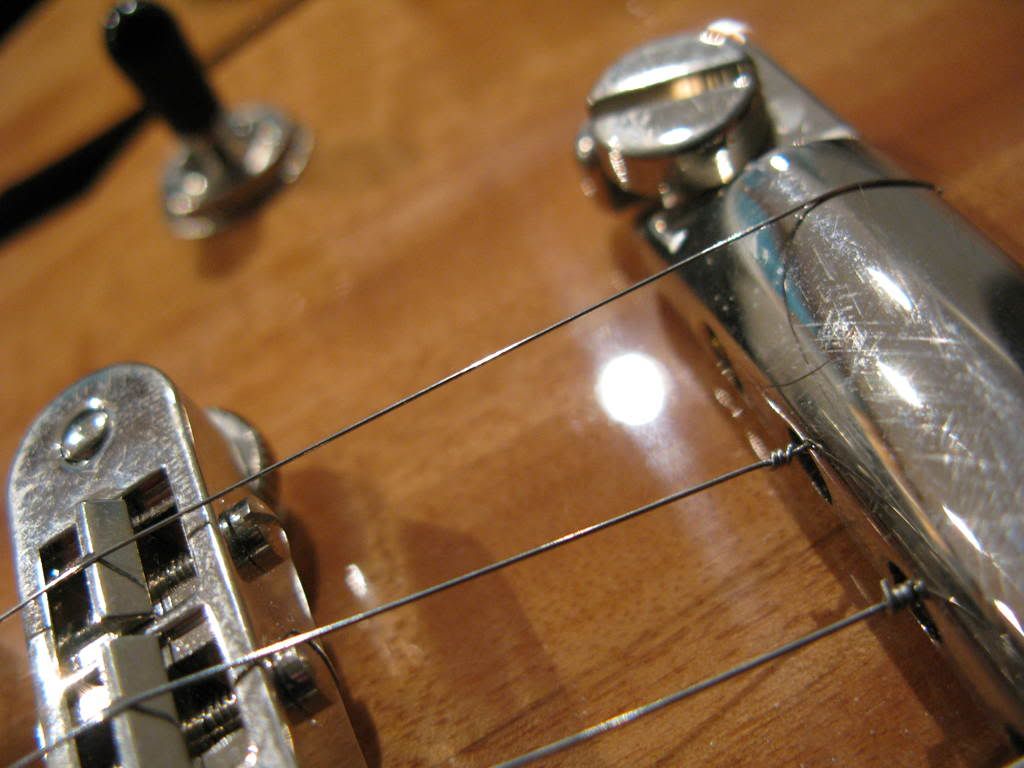
It turns like a conventional screw - lefty-loosy, righty-tighty.
In English: counter-clockwise to raise the screw, clockwise to lower the screw.
The screw is fabricated of cheap soft metal; in order to prevent chewing up the slot, use a slot-head driver that fits (which will be gigantic) or a piece of metal that fits tightly into the slot.
-
12-03-2016 03:00 PM

-
Top-wrapping the tailpiece does not decrease the tension of the strings (that would sharpen the note) but definitely lowers the break angle over the bridge. I use it in my les Paul because it makes bending and vibrato easier due to the reduced break angle (you need to apply less force to increase the tension). Also, I had a 335 that had a neck angle that needed top wrapping to screw down the tailpiece all the way, it would hit the bridge if wrapped conventionally.
Some say you get more sustain with the thing screwed down all the way, I never noticed a difference.
-
Tone Pro's locking tailpiece studs do a great job of increasing sustain while allowing you to raise the tailpiece. They also add a nice 'clarity' to the sound (not sure how to describe it, sounds more 'clear' and 'detailed').
At a minimum the tailpiece should be high enough that the strings don't hit the back of the bridge. I agree with those that say there's a 'magic spot' where string feel is improved.
Another tailpiece change I like is aluminum (Gibson historic's tend to have them, Gibson USA often doesn't). Gibson aluminum tailpieces can be expensive, but the Gotoh aluminum tailpiece can be found for $30 - $35.
-
Huh. Back in '74 when I worked in a local small music store ... most of our sales were to the dudes playing all the local rock, country, pop, and blues venues. We even had a couple jazz "houses" in town. One of the jazz keyboard guys showed me how to setup the tone of a Fender Rhodes to blend better top to bottom.
 Originally Posted by Hammertone
I saw a LOT of boxes with that style tailpiece and don't recall seeing any that didn't have the string wrapped over the top. They all said the strings lasted longer that way ... there were some pretty... enthusiastic?... strummers and benders in that group ...
Stumbling fingers still need love ...
-
"Is everyone that apathetic about the adjustment?"
I Don't know about everyone else but I am.
-
I have installed plenty of aluminum tailpieces - it's a great way to make Les Paul and ES-335 guitars lighter, along with replacing Grovers with light-weight vintage-style tuners. Hofner Verythins do not need to be any lighter - they are all Verylight as well as Verythin, ha! I have sometimes swapped the metal buttons for plastic or wooden buttons on the Schaller tuners, which lightens up the headstock and improves the balance. Originally Posted by MaxTwang
Last edited by Hammertone; 12-05-2016 at 12:01 PM.
-
Originally Posted by Hammertone
While I'm not quite that frail, yet, to replace the tailpiece to shave a few ounces - I do prefer the tone of an aluminum tailpiece.
Reminds me of a conversation I once had about high-cost, high-end lightweight bicycle parts, my coworker commented: "If I wanted to shave a pound or 2 off my ride home, I'd skip lunch".
-
Getting a Les Paul to lose weight, especially to under 9 pounds, is as much about resale value as it is about shoulder and back health, IMO: Originally Posted by MaxTwang
A
Les Paul Buyer: "how much does it weigh?"
Les Paul Seller: "Er, ah, just over 9 pounds."
Les Paul Buyer: "Sheeh…I dunno…can you knock a few hunderd off the price?..."
B
Les Paul Buyer: "how much does it weigh?"
Les Paul Seller: "Just over 8 1/2 pounds."
Les Paul Buyer: "Ooooohhhh, tell me more…"
-
[QUOTE=MaxTwang;718170]Tone Pro's locking tailpiece studs do a great job of increasing sustain while allowing you to raise the tailpiece.
Max do you know if these screws would work on my AS200 Quick Change ii like in the picture
how do you get the studs out sorry i am not handy or good at DIY
-
NOBODY has EVER brought the weight up as a bargaining chip when dealing with a sale in my neck of woods. Originally Posted by Hammertone
Never have, probably never will.
-
Arf, arf... if someone did that to me I would ask how the lower price would make the weight feel better. Originally Posted by LtKojak
-
You're in Italy. Lovely country. Come to the United States, where many consumers are preoccupied with weight, in addition to other factors. Many high-end Les Paul dealers routinely list the weights and the neck sizes of the guitars they sell. Originally Posted by LtKojak
Ahhh, logic. You'd use logic with buyers of high-end Les Pauls. The logic is simple - all things being equal, lower weight Les Pauls sell for more money than heavier Les Pauls. Originally Posted by GNAPPI
Last edited by Hammertone; 12-04-2016 at 07:47 AM.
-
Originally Posted by LtKojak
The aging US guitar market is very weight conscious, a Les Paul that is 9 lbs or more is unacceptable to many buyers.Last edited by MaxTwang; 12-04-2016 at 11:37 AM.
-
[QUOTE=Durban;718201]
TonePros makes SAE, metric and metric for PRS studs. I would contact TonePros through their website to verify the metric studs will work with the tailpiece inserts on your AS200. If the metric studs don't fit your AS200 I wouldn't proceed as removing the brass inserts in the guitar is difficult and you could easily damage the guitar. If the metric studs fit your guitar then installing is very easy. Originally Posted by MaxTwang
The studs come with a wrench for installing and adjusting. Instructions are here:
http://www.tonepros.com/installation-instructions/
When adjusting tailpiece height - loosen your strings and slightly loosen the tops of the TonePros studs, then use the wrench to turn the stud. The flange on the shaft is square to accommodate the wrench. When the tops are tightened the tailpiece is firmly clamped in the studs.Last edited by MaxTwang; 12-04-2016 at 12:02 PM.
-
But... but... but... you're in Canada, are you not? Originally Posted by Hammertone

-
….sometimes…. Originally Posted by LtKojak

-
All this theory......it's great
Stevedenver said, "as a result -i often will try things and then make my own determination"
Now some practical.
I have an Epiphone "Lucille" I bought at a great price. Real nice guitar, a 335 variant with center block and stop tailpiece (now - as opposed to that thing with 6 mini-tuners on it) I used the same studs when I made the switch.
Problem(s) I had - (relevant to this discussion) was a muddy sounding neck pickup, worse on the bass strings.
So of course, we change the pickup, not enough improvement. Reading about these things on the LP Forum, I decide to mess with the bridge, bridge posts, and tailpiece.
Steel bridge (expensive) reduced the warmth, woodiness and semi-hollow tone. If I wanted a solid body tone, I woulda kept my 9 lb. Les Paul. So I went back to the stock Epi bridge, but with new and better BRASS saddles.
Added stainless steel bridge posts. On the bass side, made a huge improvement, on the treble side - again too bright, so I went back to the stock brass on that side.
Tailpiece - bought a lightweight aluminum piece and noticed a nice improvement. The guitar became smoother sounding, with nicer response and harmonics. But going further, I experimented. I raised the tailpiece up for a slight break angle. Not sold on it yet, I screwed the tailpiece all the way down. Bass strings rang clearer, but the treble strings felt tight. So? who said you can't have different angles (heights) on opposite sides? My treble side is high, and the bass side is low, about 1/4 " diff between the two, and that's where they stay. No ill effects yet but the guitar plays and sounds beautiful. I like the bass strings to feel tight, not sloppy, and I like the treble strings to be slinky smooth but with some firmness.
So go ahead, adjust till you find the sweet spots.Last edited by Jimmy Mack; 12-05-2016 at 11:41 PM.
-
I wanted to reduce the weight on one of my guitars so I made this Ebony tailpiece. It weighs only 18 grams. This photo makes it look kind of dull. I have since polished it out to a high shine.
I think maple or other hardwood types could also be used.
-
That's sure pretty. I wonder how it will hold up under string tension. You know wood likes to split.
Good luck with it. What is the tonal effect?
-
Thanks, Jimmy Mack! Wood can certainly "split", crack or even warp. But even though I haven't tested a tailpiece like this over long periods of time I can still be reasonably certain that this piece will stand the test of time. I selected the wood for this piece from a much larger piece of ebony that I have used for bridges, saddles, and trapeze style tailpieces. There are many different types of ebony out there and this is a particularly dense and strong piece of "pinhole" ebony. The name pinhole describes that there are tiny pinholes found randomly in the stock. This pinhole ebony sells for less and is good for making small parts that are taken from between the pinholes. I also think other hardwoods could be used as long as you are careful with your selection and have the wood grain oriented in the right direction. The tone difference between wood and metal would be subtle with an amplified guitar. My experience with acoustic instruments teaches me that tone is often improved with a lighter tailpiece or bridge. For an amplified instrument, I am less certain but good acoustic tone generally translates into good amplified tone. Originally Posted by Jimmy Mack
-
That's one light tailpiece! Originally Posted by Matt Cushman
The Gotoh replacement aluminum tailpiece weights in at 80 grams.



 Reply With Quote


Interesting Acoustic-Electric 7-String
Yesterday, 06:32 PM in Guitar, Amps & Gizmos