


-
This may be a tired subject.
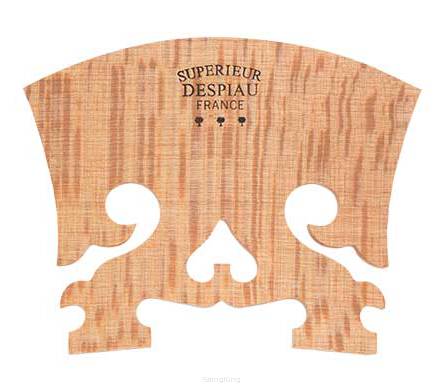
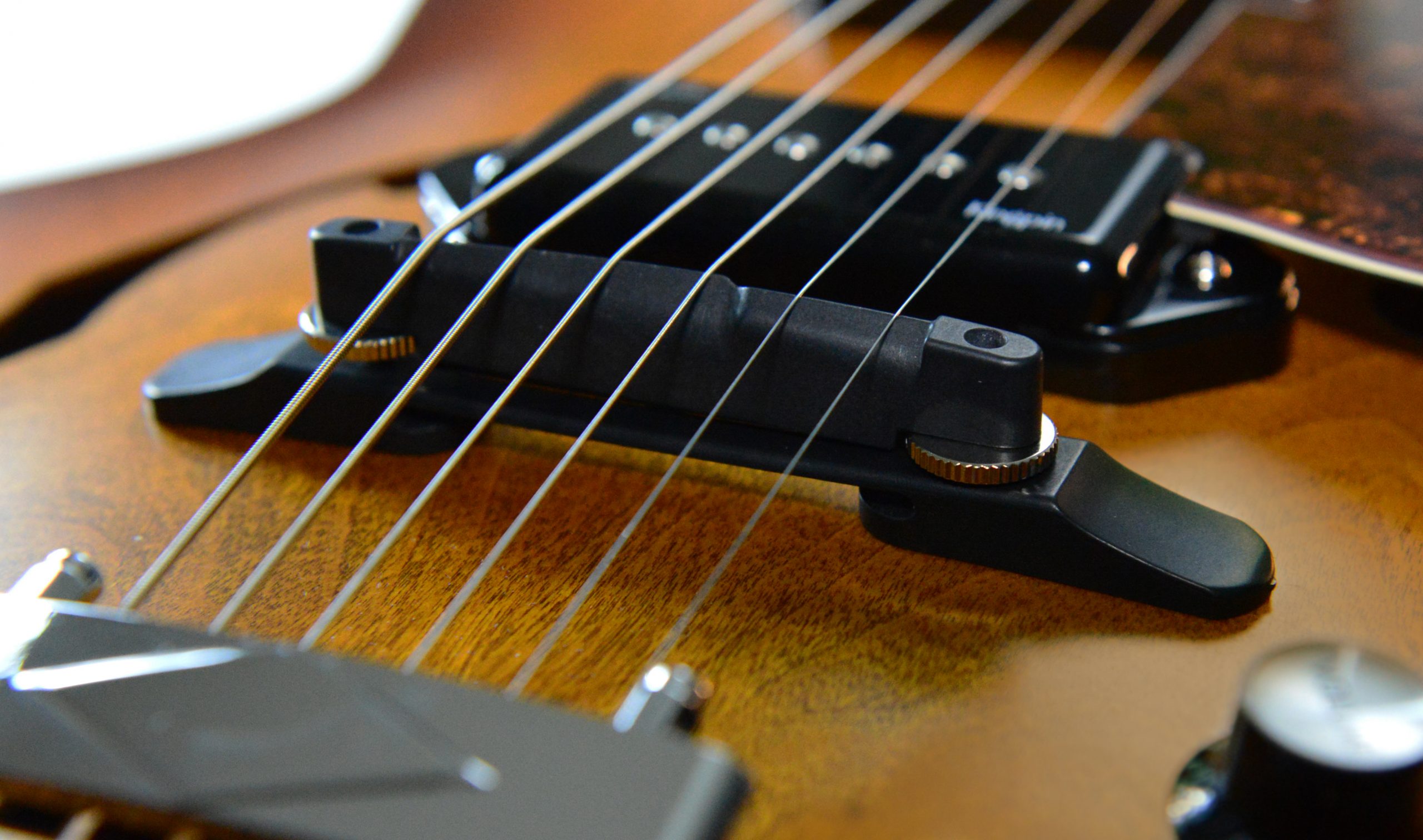
The first image is a bridge for a Stradivarius. There is little top contact. The next is a Martin flattop. This has full top contact. Few would disagree that the instruments using the bridge don't produce excellent results. Then the electrics emerge. Forget the metal saddles if you can for a moment.
Is it OCD (perfectionism) that leads us to a full contact base? I have spent a lot of time sanding down bases for that contact. If so, what about all the lost acoustic energy in the open bases? Or is it not lost, rather projected from the bridge, not the top?
A second question is this: Does a full contact base matter when the sound is coming out of an amp, the L-5 for example?
I wonder if I was chasing a phantom when fitting bridges to an instrument with mounted pickups and pots.

-
08-08-2024 07:57 AM

-
Footed bridges sound somewhat different from full-contact bridges. Better is a subjective judgement. Personally, I find that I prefer different base types on different guitars, and I am absolutely unable to predict which will sound better on any guitar. The only thing I've been able to do is try both, and use the one that I like better. I have archtops with both types. I do think that the lighter the bridge the better. I have not tried a metal saddle that I liked on any guitar. I have several lying around that I removed from archtops, and they just gather dust. Periodically I decide to try them again, and always remove them. If I want a solid-body sound, I'll just get a solid-body guitar. There is no shortage of them in the world. But it's always a personal, subjective decision, so use whatever gives you the sound you prefer. For that, I know of no better, or even slightly effective, method than experimentation.
-
I have been reading a lot of history about Gibson archtops recently, particularly the L-5, and Gibson went from full contact to footed bridge in early 1955 as it reduced the labor required to fit the bridge to the contour of the particular guitar and made the same bridge compatible with all of the archtops. The full contact bridge, however, remained in use on the L-5Cs as Gibson considered it important for the transmission of acoustic tone (Source: The Gibson L-5 by Adrian Ingram Page 41). I don't think this changed later in the L-5 production, but am not 100% sure.
-
FWIW, Jimmy D’Aquisto moved toward a bridge with a lot of contact area toward the end of his career/life.


Sent from my iPhone using Tapatalk
-
Another advantage to a full contact bridge is that the load on the top is stretched over a great area and better for the top in terms of stability and construction. The two-foot bridge will put on pressure on these points and that can be a factor. Not so much in a solid carved top but in laminated ones that sometimes have been known to sink. The start sinking right at the points of contact. Spread the load and you are better off, sound-wise it is mixed results.
-
FWIW, Ken Parker also uses a wide one-piece bridge, but severely hollowed out for maximum weight reduction, so only thin strips on the edges touching the top. But I still cannot predict in advance what bridge will sound better to me on any individual guitar. Perhaps it's a character flaw.

-
Mine kind of splits the difference between full contact and split bridge. The guitar sounds great as is, so I’m not tempted to experiment and don’t know whether a different form factor would make a difference.
-
In the big picture, as I see and hear it, they all work for an electric archtop. My question is: does the weight of the bridge matter? Violin bridges mostly follow a very uniform, traditional shape. If you look closer, the grain orientation varies from one maker to another, i.e. either horizontal or vertical. I'd imagine that vertical, being less compressible, transfers string vibration to the instrument's top more rapidly. My own, by no means conclusive, experience is from banjo bridges. The adage there is, the lighter, the better. Commercially available bridges (like Grover) come with two or three legs. As the banjo skin flexes, even the latter have a tendency of becoming concave over time. My solution was to look for harder wood, and I got good results with lilac and juniper. Taxus would be even tougher, but next to unworkable with my tools.
-
My non-expert opinion would be that density would be more of a factor than weight in terms of tone, but would probably have more of an effect regarding sustain. Everything matters, but is it a noticeable difference? I would think weight would be more of a factor with a banjo as the top surface is much thinner and more flexible. I would think that the weight of the bridge relative to the vibration of the wood top of an archtop would not have a noticeable impact on the tone.
-
My opinion, after trying many bridges on many archtop guitars, is that the weight of the bridge matters, and does affect the tone, both acoustically and amplified. Whether lighter sounds better is a different question, and weight is not the only factor which influences tone.
-
But is it the weight or the density making the difference? Based on acoustic principals, it is the density. A rosewood bridge and an ebony bridge will sound different. If the two bridges are the same size, the ebony being a denser material weighs more, but it is the density (tighter grain, etc.) that makes the difference. If you got a rosewood bridge that is a little bit larger, it will weigh more than the smaller rosewood bridge, but will sound like the smaller rosewood bridge, not the ebony bridge, even if it weighs the same as the ebony bridge.
-
I think both the weight and the density matter. More weight changes the vibration of the top, and this can also be heard through the amp. I think density is a lesser contributor, because there just isn't that much difference between the densities of different bridges. One bridge can be double that of another, though. Add in one or two humbuckers, and the vibration of the top is very much affected. Personally, I don't hear that much difference between rosewood and ebony, assuming both are properly fitted and of the same size and design. Again, though, which sounds better is totally subjective, and the difference in feedback propensity is also a factor. Definitely different, but better or worse is something an individual has to decide.
-
You can think that, but you would be wrong. You obviously don't have a background in acoustics- I design and build high end audio components and speakers. An ebony bridge will weigh more than a same-size rosewood bridge due to the density of the wood. If you say you can't hear a difference, that means the weight difference does not make a difference to your ears. Wood bridges don't weigh very much so we are only talking about a few ounces either way and it is going to affect the vibrations of the top.
 Originally Posted by sgosnell
Also, the downward pressure on a guitar bridge with light gauge strings (.009s) is 85 pounds, so the few ounces of weight of a heavier bridge is not going to affect the guitar top.Last edited by raylinds; 08-08-2024 at 06:25 PM.
-
A few years ago, i noticed that the curvature of the arch of my heritage 550 changed slightly due to seasonal changes in the humidity level, so that the bridge was not always in full contact with the laminated top. The problem was solved with a 2-foot bridge, as these are somewhat more flexible.
-
Due to their different construction principles, the tops of a violin (1 bass bar plus 1 sound post), a flattop guitar (low top thickness, demanding for multiple bracing plus a bridge reinforcement) and an archtop guitar are driven quite differently. Isn't it logical that we find different forms of bridge shapes on these instruments for best transmission of the energy input via the strings through the bridge to the top?
In my understanding - for best acoustic properties - an archtop guitar bridge is subject to simple basic criteria:
1. the weight must be as low as possible (a heavy bridge will generally absorb more of the already low 4 or 5 percent level of efficiency on a guitar than a light bridge will do)
2. the stiffness must be high, at least significantly higher than a violin bridge (to firmly define the actual string length, taking into account the much longer scale / neck length of a steel-string guitar)
3. the damping properties of the used material must be low
4. more or less precise saddle compensation is desirable, depending on the player and the music genre
5. a height adjustment is useful (again the player's preference, but also cyclic climate/RH changes)
There are other, subordinate criteria like:
6. easy fitting to the top curve
7. the overall production cost
These criteria relate to the approximate acoustic optimum for any archtop guitar, which - to the displeasure of many - includes the implication of longitudinal tonebars as well. This is the construction of what we could call the acoustic archtop "racing machines"; just think of the early L-5s.
Of course, many of us favor the tonal results of cross-braced guitars. Due to the softer mechanical construction, in comparison to longitudinal bars, the tone can generally be smoother, providing a bit more overtones to the fundamentals, though, conversely and necessarily, sacrificing a bit clearness, maximal loudness without noise interferences, power and cutting through. The reduced mechanical top stiffness that cross-bars provide, all other factors unchanged, must usually be compensated by a stronger plate thickness. For compensation, the luthier might also increase the arching curves, but today the willingness to experiment is low (time is money, and fine, thick tonewood is expensive).
It does make sense to always remember that different mechanical stiffness (different thickness, bracing, arching curves, wood gradation) always translates into different tone and acoustic properties. Some luthiers carve the tops according to certain tap tones until they're satisfied, some others flex and twist the wood: tone and mechanics are just two sides of the same coin.
In comparison to the inherently stiffer construction of longitudinal bracing (again, all other factors unchanged and assuming good build quality), on cross-braced archtops you have another option to reach the necessary top stiffness, just by placing an additional transverse bracing under or over the top. It doesn't matter much, if that crossbar is floating or not: this was probably D'Aquisto's idea of a large, wide and relatively heavy archtop bridge. Does it change the tone of a hollow-body guitar? Sure it does - see above.
Unarguably, D'Aquisto was one of the most remarkable guitar makers in the past, although, when reading certain of his "Variables in Archtop Design" given to the conventions of the Guild of American Luthiers, a smile crosses some lips, at least mine.
According to the above, my personal requirements for bridges include the use of seasoned, dense and stiff ebony (or Macassar or African blackwood or something similar). The design not too large nor too wide (weight); full contact is not favorable (weight), but the base must be stiff as well, something that these thin and ultra-flexible two-feet bridges won't offer.
Weight reduction (by about 50 percent) by removing "excess material", not necessary for the targeted stiffness, at the base and the saddle part is mandatory, as well as replacing brass or steel bridge posts and thumb wheels by lighter materials like aluminum or titan. The routing out of hard, really brittle materials, like ebony, separates the wheat from the chaff - this is more precision metal working than woodworking. The walls of the base part are left not stronger than 1,5mm (approx. 1/16"). As a bonus, adapting the base to the top arch can be done very fast.
Some wide-awake guitar makers should think now about making full titan archtop bridges. These should be a step forward, though the conservative bunch of archtop players ...
All in all, it makes a big tonal difference, IMHO - worth the effort. One of the biggest tonal influencing factor though remains the really neglected influence of the lacquering or varnishing procedure.
The more you orient yourself towards electric sound, the less important the acoustic principles mentioned become. Personally, I see an L-5CES with two humbuckers, as iconic and familiar these guitars may sound in jazz, as belonging on average far more to the electric than the electro-acoustic camp.
If someone here is thinking that violin makers use the ever-same bridges since about four centuries - well, that could be right. But just have a look (dalla prima alla dodicesima parte) how a good violin maker cuts and adapts his violin bridges: Violin bridge cutting - Taglio del ponticello di violino - YouTubeLast edited by Ol' Fret; 08-08-2024 at 06:14 PM.
-
You need to consider the laws of physics- since the downforce on the guitar top is 85 pounds with light gauge strings (more with heavy gauge jazz strings) a few ounces saved in the bridge is going to have an inconsequential effect on the guitar top. Originally Posted by Ol' Fret
-
My preference in archtop guitar tone def. goes to the electric variety ever since I first heard the 60's/70's recordings of Jim Hall, Wes, Kenny B and Pat Martino. Therefor the amount of overtones is of lesser if not NO importance to me BUT these other aspects :
- sustain
- definition
- string separation
- Intonation
are of the utmost importance to me. I found that my Super-400 CES sounded best with it's original 2-footed rosewood base and the tunomatic bridge with brass saddles.
I have had quite a battle with my Trenier Jazz Special though : somehow the guitar with it's original D'Aquisto-style ebony bridge could not be intonated to my standard regardless of type and gauge of strings I tried, the G and B strings were out of whack. I don't know, maybe the builder had the flu on the day he carved this thing ... I had my local luthier try and rectify the issue and he came close with adding a small piece of wood to the bridge and re-carving it to a degree but it was still just a compromise. I tried a metal tunomatic bridge (had to re-locate the two metal posts) but the sound was just awful, most of the warmth, fatness and sweetness in the tone was gone - then by chance I found a GraphTec archtop bridge and tried that on the original base - and voila, it works just fine, it did the trick. That bridge is super light, VERY stiff, intonates properly and looks the part, being all black.
So I can only concur : the bridge issue IS wórth your scrutiny, most definitely.
-
I would think that the weight issue has less to do with the downforce/pressure on the guitar's top that with it's specific physical properties re the transfer of energy. A heavy bridge would suck up more energy , don't you think ? Stiffness and light weight make sense to me and when I look at fine classical guitars and lutes with their low-profile bridges it makes even more sense ... In acoustic instruments. I wouldn't ever use a wooden bridge on my ES-345 ! Originally Posted by raylinds
-
I think you are forgetting here that it is string vibrations that drive the top, so variations in the downforce and not that parameter in itself. According to you it shouldn't make much difference to put a hotel mute on the saddle (let alone palm-mute...) because even with lead in it that mute is still going to weigh significantly less than 85 pounds. I only have a violin hotel mute which doesn't fit on my archtop but it's still a lot lighter than the typical 20 or so pounds of downforce, and it carries its name very well. Originally Posted by raylinds
And we all know that you don't have to exert force on the saddle to muffle the sound.
Of course the laws of physics apply, AFAICS they also tell us that since top and bridge move as one, your argument can be made for the top itself too. Which would mean luthiers could stop being so OC about thinning down their tops as much as structural integrity allows.
For me, physics dictate that the bridge/saddle assembly should be as transparent as possible so string vibrations are transferred to the top (or PU, for e-guitars) with as little loss or distortion as possible. Which translates to what others have written above about it being lightweight but of high density (= stiff/rigid).
Anyone care to guess what this is?
-
What an interesting read.
I generally prefer solid wood bridges for thinner smaller archtops and metal/wood ones, for the bigger.
I recently purchases a Byrdland and instantly changed the top of the bridge to ebony.
The problem with metal bridges is they can introduce some metal ‘overtones'.
I also had a 1973 X-500 where the guy who owned it, had drilled two holes in the top and inserted threaded nuts in each hole. So he drilled two 1/4” holes in the top, where the adjustment poles would be. He then screwed the top of a bridge into the holes, so like a normal bridge but the bottom of the bridge, was now the top of the guitar itself.
This gave the guitar a great amount of sustain and a very strong pleasant tone.
I sold that guitar to a friend on the agreement I can buy it back but he seems reluctant. That was nearly 10 years ago.
-
Originally Posted by raylinds
So according to your laws of physics a guitar played with light gauge strings (less downforce) should be louder than a guitar with heavy gauge strings?
Physics here is less about the isolated downforce from the strings through the bridge to the top, it's about the transmission of waves, energy, and inducing of vibrational centers of the top. Impedance and interferences are also important factors.
Try to fix a weight firmly to your archtop bridge - listen, measure, and, if you like, report the results here. I would like to point you to some guitar videos, though, unfortunately, guitar folks are not known to be overly adventurous. A violin bridge and top has some different ranges of movement, but the physical effect of the bridge weight is the same. On a small instrument like a violin these dampers weigh just one quarter or so of an ounze; often it's just a little piece of ebony. In relation to the the instrument size: if you can save three quarter or even one full quarter of an ounze on your archtop guitar bridge, your guitar can only win acoustically, no matter if you use light or heavy gauge strings or increase / decrease the strings' angles.
-
I think that's where the answer lies. The bridge is coupled to the strings on its top and the top beneath it. It's only job is to transfer mechanical energy of vibration from the strings to the top with as much accuracy and as little loss as possible. Each interface (string-saddle, saddle-base, base-top) is an impedance mismatch at which some energy is lost. The design and materials at the interface determine how much of an impedance mismatch it is and how much energy will be lost crossing it. Originally Posted by gitman
"Downforce" is the key. The most efficient transfer of vibratory energy from the bridge to the top occurs when all vibratory movement of the bridge is perpendicular to the top at its point of delivery. As the angle formed by the direction of vibration and the top becomes more acute, less energy reaches the top - it's simple vector analysis. The better the impedance match across each interface in the system made up of the strings, bridge, and top, the more picking energy will turn into sound energy radiated by the top into the air (which is yet another interface and impedance mismatch).
Strings vibrate in 3 dimensions. Plucking stretches them, so their vibrating length is increased when you strike them. The plucked string vibrates around its axis, slightly stretching in length and thinning in diameter at the extremes of its excursion through the envelope of motion and returning almost completely to its resting length and diameter at the midpoint of its vibratory path. The energy you impart to the string by plucking it is the energy that causes these deformations and displacements. Some is lost to molecular interaction in the string as it is shifted and deformed repeatedly while vibrating. Some is lost to mechanical impedance mismatch in the saddle. Some is lost because string motion parallel to the saddle can't cause as much lateral movement in the bridge. Some is lost to vibrating the bridge materials themselves, eg cyclic vibratory compressions of the saddle and base materials. And some more is lost where the bridge tries to transfer this energy to the top.
Each saddle shape, material etc has its own mechanical properties and they affect how efficiently and accurately it will receive string energy and pass it on to the bridge base. The same is true for each bridge base and for each top. All of this can now be modeled and energy transfers visualized in computer simulation. The shape of the top's arch and the design of the bridge base can be varied to determine the theoretically best interface size and shape. The mechanical properties of the saddle and bridge materials can be varied the same way. There are now a lot of research papers on this, many of which are PhD theses. So we'll know more in the near future.
I strongly doubt that there's a single best design for bridges. Everything from top shape / thickness / materials to bracing details to resonances in the guitar body, strings etc to tail piece design probably affects both acoustic and amplified sound. Energy lost in translation was in the strings when first plucked. If it's dissipated by the bridge, it's no longer available to generate a signal in a pickup.
That's my theory, FWIW.
-
Wow! That's a lot of information in these posts.
Here's a more subtle question. How should the bridge slots for strings be shaped? It seems the string should be fully trapped in the slot so as not to lose more energy to the tailpiece.
-
Maybe this is relevant.
Years ago a friend went to NYC to buy a bass. He found a store in a loft filled with basses. He spent a day, played a large number of them and settled on one.
It had a sexy growl to its voice that he loved. Brought it home. We played. It sounded terrific.
Some time later, the bass needed something, I can't recall what. He took it to his expert luthier. It came back without the growl and sounding, relatively speaking, like crap.
He called the luthier who explained that his soundposts were too thin so he swapped in the proper sound posts.
Fortunately, he saved the old ones. My friend had him reinstall them and the growl came back.
The relevance to this thread is that sometimes what's right isn't what's best. Or, you can't easily apply some principle of physics or luthiery to determine how to set up an instrument. You have to hear it.
-
Even just switching the bridge top on the same base makes a difference. I have identical bridge tops, one of which is ebony (16 grams) and one is rosewood (11 grams). They sound very different on my carved 17" Benedetto style guitar. The rosewood is bright, overtone-y and even sparkly; the ebony is darker, fundamental-y and focused for lack of a better adjective. Ebony base in this case. I prefer the ebony bridge top on this guitar. My luthier said he found through experimentation that the mass of the bridge top made more of a difference to tone than the material.



 Reply With Quote


Interesting Acoustic-Electric 7-String
Yesterday, 06:32 PM in Guitar, Amps & Gizmos