

What are jazz guitar chords? How are jazz guitar chords built? What makes a chord minor or major? In this lesson, you will learn how to construct jazz guitar chords. Learning the (relative) simple theory behind chords will make your life as a jazz guitar player a lot easier and is essential when learning how to play guitar chords, so let’s dive straight in!
THE JAZZ GUITAR CHORD DICTIONARY (FREE eBOOK)
Download now and learn 244 chord shapes!
Major Chord Construction
To get started, we begin with a scale we all know, the C major scale. The 7 notes in this scale are numbered, these numbers are important (they are like a formula).
| C Major Scale | C | D | E | F | G | A | B |
|---|---|---|---|---|---|---|---|
| 1 | 2 | 3 | 4 | 5 | 6 | 7 |
Chords are based on third intervals. There are 2 kinds of thirds (or 3rds):
| Minor Third | Interval of 3 half steps | Symbol: minor 3rd |
|---|---|---|
| Major Third | Interval of 4 half steps | Symbol: major 3rd |
Let’s start by stacking 2 thirds on the first note (1, also called the root) of the C major scale:
| C | E | G |
| 1 | 3 | 5 |
The result is a C major triad or C (a triad is a chord that contains 3 notes).
- From note C to E is a major 3rd (4 half steps)
- From note E to G a minor 3rd (3 half steps)
Every major chord has this structure: first a major third, then a minor third. A chord like this is called major because there is a major 3rd (4 half steps) between the root and the 3rd.
Memorize the chord formula for major chords: 1 3 5
Minor Chord Construction
Now let’s stack 2 thirds on top of the second note (2) of the C major scale. This might be a bit confusing, but we now call that second note of the major scale “1”, because it becomes the root of our chord:
| D | F | A |
| 1 | b3 | 5 |
The result is a D minor triad or Dm.
- From D to F is a minor third
- From F to A is a major third
Every minor chord has this structure: first a minor third, then a major third (the mirror of a major chord). A chord like this is called minor because there is a minor 3rd (3 half steps) between the root and the 3rd.
Memorize the chord formula for minor chords: 1 b3 5
Important: the b (aka flat) before the 3 means a half tone lower (than 3). Further in this tutorial we’ll encounter a # (aka sharp), which means a half tone higher. A half tone on the guitar is 1 fret.
Dim Chord Construction
Back to the C major scale. Now we’re going to skip a few notes and stack thirds on the 7th note (7) of the C major scale:
| B | D | F |
| 1 | b3 | b5 |
The result is a B diminished triad or Bdim.
- From B to D is a minor 3rd
- From D to F is also a minor 3rd
Every diminished triad chord has this structure: a minor third and another minor third.
Memorize the chord formula for diminished chords: 1 b3 b5
Diatonic Chords
I’ll summarize and complete the other notes of the C major scale:
| Notes | Formula | Chord Name | Symbol | |
| 1 | C E G | 1 3 5 | C major | C |
| 2 | D F A | 1 b3 5 | D minor | Dm or Dmin or D- |
| 3 | E G B | 1 b3 5 | E minor | Em or Emin or E- |
| 4 | F A C | 1 3 5 | F major | F |
| 5 | G B D | 1 3 5 | G major | G |
| 6 | A C E | 1 b3 5 | A minor | Am or Amin or A- |
| 7 | B D F | 1 b3 b5 | B diminished | Bdim or B° |
These chords are called the diatonic chords of C major.
Finding Chord Tones
Next you’ll learn how to find the notes of a chord in a convenient way. There are actually 2 methods to construct chords. The first method is explained here, the second (more practical) method, you’ll learn a bit further in this lesson:
The first method starts from the major scale and involves 3 steps:
1) Find the major scale of a given key.
Example: to find the notes of a Gm chord, first find the notes of the G major scale:
| G Major Scale | G | A | B | C | D | E | F# |
|---|---|---|---|---|---|---|---|
| 1 | 2 | 3 | 4 | 5 | 6 | 7 |
2) Construct the major chord by using the major chord formula: 1 3 5
Example: In our G major example that would be:
| G | B | D |
| 1 | 3 | 5 |
3) Apply the minor chord formula to the major chord. The chord formula for minor chords is 1 b3 5.
Example: This means the 3rd of the major chord (G B D) has to be lowered half a step. This is because in a minor chord (1 b3 5) there is a b in front of the 3, meaning the 3 is a half tone lower than the 3 in the major chord (1 3 5), where there is no b before the 3.
Making the 3 (B) a half note lower is done by placing a b behind the note, like this: Bb (aka B flat). This is a bit confusing because in formulas we place the b before the note, but with actual chord tones, we place the b after the note.
The other notes of the chord don’t change, so these are the notes of a G minor chord:
| G | bB | D |
| 1 | b3 | 5 |
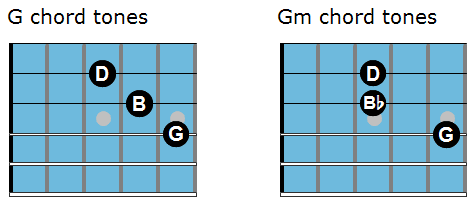
To visualize this, have a look at the notes on the guitar neck:
At the left are the 3 notes of G (1 3 5 = G B D).
At the right are the 3 notes of Gm (1 b3 5 = G Bb D). The Bb is one fret (= half tone) lower than B:
Maj7 Chord Construction
Let’s have a look at seventh chords.
Seventh chords are chords that contain 4 or more different notes and are the bread and butter of jazz music.
Again, let’s start with the C major scale:
| C Major Scale | C | D | E | F | G | A | B |
|---|---|---|---|---|---|---|---|
| 1 | 2 | 3 | 4 | 5 | 6 | 7 |
The construction of seventh chords follows the same principle as constructing triads: stacking thirds on top of each other. Triads were made by stacking 2 thirds on top of the root. Seventh chords are constructed by stacking 3 thirds on top of the root.
Let’s stack 3 thirds on the 1 of the C major scale:
| C | E | G | B |
| 1 | 3 | 5 | 7 |
The result is a C major 7 chord (Cmaj7).
- From C to E is a major third.
- From E to G is a minor third.
- From G to B is a major third.
Every major 7 chord has this structure: first a major third, then a minor third, followed by a major third.
Memorize the chord formula for major 7 chords: 1 3 5 7
m7 Chord Construction
Let’s do the same for the 2nd note of the C major scale:
| D | F | A | C |
| 1 | b3 | 5 | b7 |
The result is a D minor 7 chord or Dm7.
- From D to F is a minor third.
- From F to A is a major third.
- From A to C is a minor third.
Every minor 7 chord has this structure: first a minor third, then a major third, then a minor third.
Memorize the chord formula for minor 7 chords: 1 b3 5 b7
Dominant 7 Chord Construction
Now let’s skip some notes and stack 3 thirds on top of the 5th note of the C major scale:
| G | B | D | F |
| 1 | 3 | 5 | b7 |
The result is a G dominant 7 chord or G7.
- From G to B is a major
third. - from B to D is a minor third.
- From D to F is a minor third.
Every dominant 7 chord has this structure: first a major third, then a minor third, followed by another minor third.
Memorize the chord formula for dominant 7 chords: 1 3 5 b7
Learn more about dominant chords in this lesson: What Is a Dominant Chord?
m7b5 Chord Construction
We’ll skip some more notes and stack 3 thirds on top of the 7th note of the C major scale:
| B | D | F | A |
| 1 | b3 | b5 | b7 |
The result is a B half diminished chord or Bm7b5.
- From B to D is a minor third.
- From D to F is a minor third.
- From F to A is a major third.
Every half diminished 7 chord has this structure: first a minor third, another minor third, followed by a major third.
Memorize the chord formula for half diminished 7 chords: 1 b3 b5 b7
Diatonic 7th Chords
I’ll summarize and complete the other notes of the C major scale:
| Notes | Formula | Chord Name | Symbol | |
| 1 | C E G B | 1 3 5 7 | C major 7 | Cmaj7 |
| 2 | D F A C | 1 b3 5 b7 | D minor 7 | Dm7 or Dmin7 or D-7 |
| 3 | E G B D | 1 b3 5 b7 | E minor 7 | Em7 or Emin7 or E-7 |
| 4 | F A C E | 1 3 5 7 | F major 7 | Fmaj7 |
| 5 | G B D F | 1 3 5 b7 | G dominant 7 | G7 |
| 6 | A C E G | 1 b3 5 b7 | A minor 7 | Am7 or Amin7 or A-7 |
| 7 | B D F A | 1 b3 b5 b7 | B half diminished 7 | Bm7b5 or Bmin7b5 |
Now that we know how seventh chords are constructed, we’ll focus our attention on tensions in the next section.
Maj9 Chord Construction
Tensions (aka extensions) are notes that are part of a chord, but are not chord tones (1 3 5 7).
The first extension we’ll have a look at is the 9
Here’s the C major scale again:
| C Major Scale | C | D | E | F | G | A | B |
|---|---|---|---|---|---|---|---|
| 1 | 2 | 3 | 4 | 5 | 6 | 7 |
There are 3 notes left in the major scale that are not chord tones: 2, 4 and 6
If we add these tones to the chord, they become tensions. Most of the time we play tensions an octave higher than chord tones because otherwise they get in the way of the chord tones (the chord would sound “muddy”). That’s also the way tensions are notated:
- 2 becomes 9: 2 + 7 (the amount of notes in an octave) = 9
- 4 becomes 11
- 6 becomes 13
So if we add the 2 to Cmaj7 we get Cmaj9:
| C | E | G | B | D |
| 1 | 3 | 5 | 7 | 9 |
Special Cases – 4ths and 6ths
The two other notes that are left in the scale (4 and 6), are special cases in combination with major chords:
- First of all, there is something we call avoid notes: notes that are a half tone above a chord tone. Avoid notes sound dissonant, that’s why they are generally avoided.The 4 of the C major scale (f) is a half step above the e (the 3rd of Cmaj7). So the 4 (f) is an avoid note for Cmaj7 and is not often used on this chord.
- The 6 is also a special case in combination with major chords. Most of the times when we add a 6 to a major chord, the 7 is omitted and there is no octave added to the 6. This is because the 6 and 7 get in each other’s way.
So if we add the 6 to C major chord we get a C6:
| C | E | G | A |
| 1 | 3 | 5 | 6 |
The same goes for 6 in combination with minor chords: the b7 is omitted.
If we add the 6 to Dm7 we get Dm6. Note that the 6 is no longer A like in the C6 example above because the root of the chord changed to D. The 6 is now B (D E F G A B C).
| D | F | A | B |
| 1 | b3 | 5 | 6 |
The 4 is not an avoid note in combination with minor chords because it is two half tones above the b3 and not one half tone.
When you add the 4 to Dm7, you get a Dm11 chord:
| D | F | A | C | G |
| 1 | b3 | 5 | b7 | 11 |
(Note: theoretically, the 9 should be included as well in a minor 11 chord)
The 4 is also a special case in combination with dominant chords. When a 4 is added to a dominant chord, the 3 is omitted. Chords like these are called sus4 chords and often function as a delay for a dominant chord.
Sus4 chords often include a 9. Here’s the G9sus4 chord:
| G | C | D | F | A |
| 1 | 4 | 5 | b7 | 9 |
There’s also something called altered tensions (b9, #9, b5, b13). These tensions come from the harmonic minor scale or from the altered scale and will be covered later in another lesson. The same for goes for #11, which comes from the Lydian dominant scale.
Diatonic Tensions
Here’s a list of all chord types we’ve seen so far and their tensions:
| Chord Type | Extension | Symbol | |
| Major | 9 (=2) | Cmaj9 | |
| 4
#11 (=#4) |
/
Cmaj7#11 |
avoid note
#11 comes from the lydian scale |
|
| 6 | C6 | 7 is omitted | |
| Minor | 9 (=2) | Cm9 | |
| 11 (=4) | Cm11 | ||
| 6 | Cm6 | b7 is omitted | |
| Dominant | 9 (=2) | C9 | |
| b9 (=b2) | C7b9 | b9 comes from the altered scale or the 5th mode of the harmonic minor scale | |
| #9 (=#2) | C7#9 | #9 comes from the altered scale | |
| 4 | C7sus4 | ||
| 13 (=6) | C13 | ||
| b13 (=b6) | C7b13 | b13 comes from the altered scale or the 5th mode of the harmonic minor scale |
Chord Formulas
Here’s a summary of the chord formulas we covered until now + some additional chord types.
| Chord Type | Chord Formula |
| Major Triad | 1 3 5 |
| Minor Triad | 1 b3 5 |
| Diminished Triad | 1 b3 b5 |
| Augmented Triad | 1 3 #5 |
| Major 7 | 1 3 5 7 |
| Minor 7 | 1 b3 5 b7 |
| Dominant 7 | 1 3 5 b7 |
| Half Diminished 7 | 1 b3 b5 b7 |
| Diminished 7 | 1 b3 b5 bb7 |
| Augmented 7 | 1 3 #5 b7 |
| Suspended 4 | 1 4 5 b7 |
| Minor/Major 7 | 1 b3 5 7 |
A Practical Method For Chord Construction
Earlier in this lesson you learned a first method to construct chords. Now you’ll learn a faster and more practical method.
The first step is memorizing the chords and chord tones of the C major scale and their chord formulas:
| Cmaj7 | C E G B | 1 3 5 7 |
| Dm7 | D F A C | 1 b3 5 b7 |
| Em7 | E G B D | 1 b3 5 b7 |
| Fmaj7 | F A C E | 1 3 5 7 |
| G7 | G B D F | 1 3 5 b7 |
| Am7 | A C E G | 1 b3 5 b7 |
| Bm7b5 | B D F A | 1 b3 b5 b7 |
You must be able to picture the chord types, chord tones and formulas of C major without thinking.
The rest of this method is best explained with some examples…
Chord Building Examples
Now that you know the chords of C major, it’s easy to find chords of other keys.
Example 1: to find the chord tones of Cm7:
- You know the chord tones of Cmaj7: C E G B
- You know the chord formula of Cmaj7: 1 3 5 7
- You know the chord formula of minor 7: 1 b3 5 b7
- Adapt the chord tones of Cmaj7 to the formula of minor 7: bring the 3 and the 7 a half step down.
- Conclusion: the chord tones of Cm7 are: C Eb G Bb
Example 2: the chord tones of Ddim7:
- You know the chord tones of Dm7: D F A C
- You know the formula of Dm7: 1 b3 5 b7
- You know the formula of diminished 7: 1 b3 b5 bb7
- Adapt the chord tones of Dm7 to the formula of diminished 7: bring
the 5 and the 7 a half step down - Conclusion: the chord tones of Ddim7 are: D F Ab B
Example 3: the chord tones of F#7:
- You know the chord tones of Fmaj7: F A C E
- To find the chord tones of F#maj7 you just have to raise each chord tone a half step: F# A# C# E#
- You know the formula of major 7: 1 3 5 7
- You know the formula of dominant 7: 1 3 5 b7
- Adapt the chord tones of F#maj7 to the formula of dominant 7: bring the 7 a half step down
- Conclusion: the chord tones of F#7 are: F# A# C# E
Now you know how to find the notes of a chord, but how do you translate this to the guitar?
Translating Chord Theory to the Guitar
The first thing you need to know is that not every chord tone is equally
important:
- 3 and 7 are the important notes of a chord because they determine the chord type. They are also important for voice leading.
- The 1 is the least important note, because it is usually played by the bass player.
- The 5 is not so important either and can be disturbing sometimes.
- Tensions add color and interest to a chord, so it’s preferable to use tensions instead of 1 and 5.
The second thing you need to know is that 1 half step equals one fret on the guitar.
Here’s an example with chord diagrams, we’ll start with a C: C E G (1 3 5)
Let’s have a look at the chord diagram:
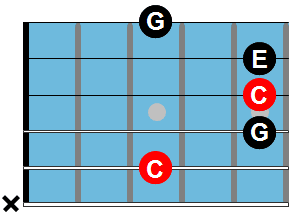
X15135: C
From bottom to top (from low E string to high E string) we have:
- X: the low E-string is not played
- 1: the 1 or root of the chord is played on the A-string
- 5: the 5th of the chord is played on the D-string
- 1: again the root, but now on the G-string
- 3: the third is played on the B-string
- 5: the 5th is played again, but this time on the high E-string
You see that it is OK to duplicate chord tones, like the 1 and the 5 in our example.
This chord doesn’t sound very jazzy though, so let’s spice it up a bit and make it a Cmaj7 (1 3 5 7) by replacing the 1 on the G-string with the 7:
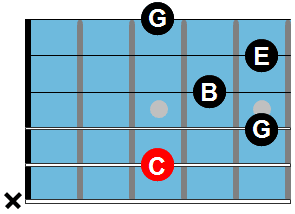
X15735: Cmaj7
Instead of duplicating the root on the G-string, we exchanged it for the 7 of the chord.
Now let’s add some color, let’s make it a Cmaj9 chord (1 3 5 7 9):
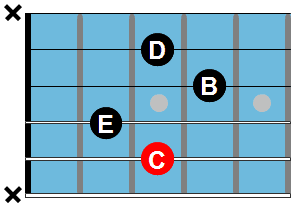
X1379X: Cmaj9
We exchanged the 5th on the D-string for the 3rd and we changed the 3rd on the B-string to a 9.
This Cmaj9 would be a nice chord if you’re playing Bossa Nova, solo guitar or in duo setting, but if you play with a bass player and you don’t want to get in his way, it’s better to omit the root and to play on the higher strings only:
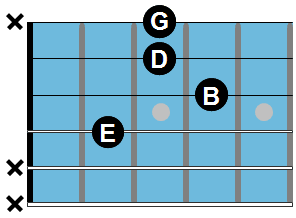
XX3795: Cmaj9/E
Chord Inversions
Instead of playing the root of the chord, we play the 5th on the high E-string in the previous example. A chord like this is called a chord inversion
A chord inversion is a chord that doesn’t have its root as its bass note.
There are three types of chord inversions:
- First inversion: the 3rd in the bass.
- Second inversion: the 5th in the bass.
- Third inversion: the 7th in the bass.
In our previous example we have a Cmaj9 chord with the 3rd (E) in the bass, notated like this: Cmaj9/E
What do you need to do if you want to make this chord dominant? Simple, just look at the chord formulas: the 7 has to go a half step down (major is 1 3 5 7, dominant is 1 3 5 b7).
Have a look at the chord diagram, the b on the g-string has to become a b flat. The result is the first inversion of C9: C9/E
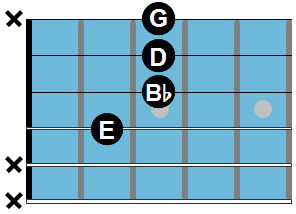
XX3b795: C9/E
And if we want to make this chord minor? Starting from the dominant chord we have to lower the 3rd a half step (dominant is 1 3 5 b7, minor is 1 b3 5 b7). On the guitar, this means we have to lower the e note on the d-string half a step to an e flat. The result is the first inversion of Cm9: Cm9/E
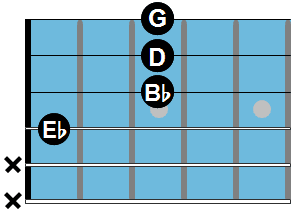
XXb3b795: Cm9/Eb

This is amazing. Thank you for making your knowledge and expertise available like this. So many things I’ve put off learning for so long that are just clicking and making sense as I study all of this.
Hello, Dirk.
I would like to order to learn , practicing
how to construct Jazz Chords.
Thanks, Pieter/ Breda.
Is there such a thing as minor dominant 7? And is there a major 7 b5? It’s starting to gel a little, but sometimes one word throws everything off. I’ll keep it going. Great stuff…..
Hi, a minor dominant 7 does not exist. The closest thing would be a minor major 7 chord (1 b3 5 7). A major 7 b5 chord does exist but is not very common (it occurs on the 3rd degree of the melodic minor scale).
Is there a reason you are switching between notes of the scale when comparing chord types? I’m seriously missing something. Why dont you show us the difference between Maj. Min. and dim. with the same chord so I can see the difference? Its not good being this confused at the very beginning. Can someone help me here?
they are chords starting from the diffeerent degree of the c major scale c was major 135 d was minor 1 b3 5 and so on sometimes he skipped the remaining to get to the 7th degree a diminished 1 b3 b5.
i dont get it. how do i know where to place my fingers on the fretboard? do i just take the most convenient finger placement or is there some hidden logic i dont get yet?
This was awesome. I didn’t know these things …
my head is spinning
Oops 🙂 Anything in particular you don’t understand?
Excellent material
This is an awesome lesson. I can see I need to study more.
fabulous!!!
Super lesson. Many thanks
Hi,
this really helped me to understand how chords are built and what the different ‘tokens’ in a chord name mean. MANY THANKS!
However I think one statement is actually confusing (if not wrong).
You wrote:
“This is a bit confusing because in formulas we place the b before the note, but with actual chord tones, we place the b after the note.”
Shouldn’t that be:
“Please note that we use the b in formulas to indicate a distance of three halftones between two notes whereas a b in a chords diagram means that a note in a scale is lowered a halftone to built a certain chord according to the respective formula.”
Best Regards
Hi Jürgen, thanks for the feedback!
What that phrase means: in formulas, we use 1 b3 5 b7 (b before note degree). In actual chords, we use G Bb D F (b after note).
The b in formulas doesn’t always mean a distance of three halftones. In 1 b3 b5 b7 for example, there are 4 halftones between b5 and b7. The b in formulas is always relative to the major scale.
I understood it to mean this: if (for example) I read bA I know is the note played on the 6th string 4th fret (or every other position where I may find a bA). If I read Ab is the chord half step before A chord. Am I wrong (could be because I am completely lacking in theory)?
your understanding to me reads like b minor A major bA .
Your explanation is very well out lined. It is getting it into a old brain, as mine is and breaking those long etched in patterns . of cord placement and when and were. As most music is by tone of what is being played and in proper order as Jimmy Hendricks never followed and wowed the world. As so many others did also.
Thanks
Very good lesson but no mention of sus2 chords. Do these have no place in jazz ?. Also, the so called Steely Dan chord 1235. Thanks.
Very very good lesson which will give me, a beginning jazz enthusiast, much information to go over and learn. Thank you, much appreciated!
Full disclosure….i am music theory challenged (why not label notes A through L and jettison those evil # and b things?) it would be helpful to me when starting the lesson to have a chart showing all steps between notes….so when we count 4 half steps from B it doesnt go CDEF….but BCC#D…i guess the lesson assumes the student knows there isnt a B# nor an E#….
Guess i need a more basic lesson….
B# = C
E# = F
Apparently illogical, of course.
Easiest to measure on a keyboard, but in the end, all down to the intervals.
S – semitone, next fretted note, above or below.
T – tone, next but one fretted note, above or below.
Major scale – TTSTTTS
And those ‘devilish’ modes, Ionian, Mixolydian and Dorian etc., simply use these intervals but based on the given chord as start and end point of the scale, season with salt and pepper to suit!
Really good lesson. A lot for me to take in so still working on it. Promise i won’t look at the answers to the quiz.
Thank you.
Kind regards
Rob
A great organizational presentation.
Great lesson! Thanks! God bless!
I added the correct answers to the quiz result. Here they are for the people that already did the quiz:
1) Gm7 : G Bb D F
2) Abmaj7: Ab C Eb G
3) Dim7: 1 b3 b5 bb7
4) False: to turn a major 7 chord into a minor 7, you not only have to flat the 3, but also the 7 (there was a typo in this question, I meant to write major 7 chord, but wrote major chord instead, sorry about that :))
5) 2nd inversion of Cmaj7: Cmaj7/G
6) C#maj7: C# E# G# B#
7) D7b9: D F# A C Eb
8) Aug7: 1 3 #5 b7
9) F sounds dissonant on a Cmaj7 chord.
10) True: if you raise the root of a Cmaj7 chord with a half step, it becomes a C#m7b5 chord.
A surprising 90%! Would be nice to know which was the wrong one.
I would also like to know where I went wrong. Fun quiz, though.
I take it that there were 10 questions. I got 90%, so would be interested to know which one I got wrong. I strongly suspect it was the augmented 7, which I chose 1,3,#5, b7. As I went straight to the quiz, I didn’t read the body of the text, so there are different ways of writing chord symbols.
I’m skeptical on the scoring (and can’t see the answers, so …). I’m pretty sure there was no correct answer to one question — I think it was the spelling of a D7b9 chord. It should have been DF#ACEb but the only choices were DF#ACE (not Eb) and DF#ACDb (also not Eb).
I studied EIS (equal interval system, Lyle Spud Murphy) so I might be in contention with the diatonic system.
Can you please tell me what I missed as I’ve been a professional & would like to know-thanx. Jay
I scored 60%. Wonder if you can show the answers some time in the future. Thanks Dirk.
Thanks a lot Dirk for this lesson ?
Thanks for the info and quiz. I wish the quiz would show which questions were answered incorrect…
Not seeing my score…