


View Poll Results: Thumb over neck?
- Voters
- 182. You may not vote on this poll

-
This statement is obviously right, but the catch (and this is also obvious) is that when learning to play the guitar a kid should learn a 'right' technique. My son has lessons (on a spanish guitar) and this thumb-technique is not considered a right way to play. It's not even considered at all . . .
 Originally Posted by mikeSF

-
07-08-2020 01:05 PM

-
If I had it to do all over again, and I was physically capable of using my thumb that way, I'd do it.
It allows you to play chords you couldn't otherwise play. That's huge.
Has anybody here never had the idea to play a bass note with your nose? It doesn't work well, but you have the idea when you want to hear a low note you can't reach with your hand.
Occasionally, in Eb, I'll end a tune with a descending run and, for the last note, detune the low E.
Jose Neto's white guitar has a lever that lowers the low E to D.Last edited by rpjazzguitar; 08-25-2020 at 03:07 PM.
-
When a kid starts out it's good to set some ground rules re posture, left/right hand technique etc. because it serves to produce a good tone and prevents back/shoulder/tendonitis problems in the future - it should also be clear that these "rules" are NOT cast in stone but rather serve as a guidance , to be "bent" or even discarded in later years. When I studied classical guitar as a kid (12) I adapted to the traditional posture etc. but as soon as I got my first steelstring guitar (14) and a flatpick I learned to adapt again. Same story with my first electric guitar (16) - by then I knew that the tone begins in your head and your right hand has to try to make it happen, one way or the other, with a pick or with your fingers. Re the "thumb over" technique I first noticed that when I watched Jimi Hendrix and Ritchie Havens in the Woodstock movie and the dam broke when I got a gig in a dance band that played dance tournaments , looooong nights of practically non-stop playing and several nights in a row. I had to find a way to save energy and avoid a raw lefthand index finger so using my thumb for the bass notes (only when needed) and generally reducing the number of notes in the chord to the minimum was the way to go, to this day. I developed a callous on my left thumb because of it but that's ok .... Originally Posted by Marcel_A
-
There's no single right way to play guitar - just more or less dogmatic doctrines. Ha, says someone who went through a successful, but hidebound classical violin school (Otakar Sevcik)!
Like most human-related things, human anatomy, here the left thumb, is bound to a Gauss-Poisson distribution, i.e., it varies.
You can fret the notes with any finger. Just keep in mind that the thumb is the only opponent two-part finger, thus a bit more limited in its motion range, and more prone to chronic joint and tendon disorders. The thumb is also exposed to higher load-bearing, that's why it is generally the thickest of our fingers.
So be gentle to the thumb, listen to your body (thumb), it will tell you after some time of training whether it'll endure without fuss what you're demanding from it, or not!
Even if all the fingers won't be able anymore to fret the strings, some creative characters were able to help themselves:
This may sound like raw music to some ears, but it often fulfills the function of music better, i.e., to express feelings through emotions and to address listeners, than virtuoso high-speed fretters with smooth, polished fretting techniques can achieve.
Of course, this is no statement of denying the learning of an established guitar technique in the initial period, quite the contrary: some great teachers are out there!
-
The best guitar players have tended to be the ones who did things the “wrong” way.
-
-
Nope. Tried it. Don’t like it. Supremely uncomfortable. I’ll find some other voicing for the chord or some other workaround.
-
I do it extremely infrequently; it's more of a "last resort" approach ...but if ya gotta get that extra note in there and my thumb is the most convenient digit, then hellz yeah Imma use it. By Any Means Necessary, right?
I probably use a finger from my plucking hand to finger an extra note in a chord more often than I use my fretting hand thumb. But that's a whole 'nother thread...
-
I FINALLY gave this a try, mostly accidental, but needed to grab the bass note and went over the top. woohoo & I'm never doing that again. Originally Posted by mikeSF
-
When I was a kid taking lessons my teacher taught me to use the thumb.
I think I even had a chord book that had thumb placement.
That doesnt make it right....but I never knew it was considered poor form.
-
As a teacher, you probably shouldn’t teach someone else to do it. It’s not poor form, but a lot of people can’t do it without their wrist in pretty extreme flexion which is not great for the nerve and tendon health.
If you can do it with a healthy wrist, by all means.
-
It's proper technique if you have large improper hands like Tal Farlow or Jimi Hendrix.
-
GJ players will fret 2 notes with their thumb (like A and D)
-
I've been a thumb-over player for almost as long as I can recall. But then, I spent the first forty years of my playing life as a folky fingerpicker, and much of that time on a Guild dreadnaught with a nicely radiused 1-11/16" neck. In my mid-seventies, my left thumb started to have issues with some of my guitars (very wide and flat fingerboards), but on other guitars I still grab thumb-over grips on what would otherwise be barre chords. And but-then part deux, I don't do single-string solos or attempt classical pieces, so left-hand position isn't as crucial to me as it might be to others. (And for swing rhythm and comping, I finally managed to shift mainly to shell chords.)
-
In a musical world where pianists use their elbow or shoe to reach distant keys, trumpets and trombones wiggling toilet plungers over their bells, saxes's and woodwinds' altissimo...
As a musician on any instrument, there is the underlying faith in technique and form that is the confidence what you hear played by another is within your potential grasp and execution.
One may draw an arbitrary red line for the instrument (like slide classical guitar) but when the division is how much thumb you have that's not fair; an abomination.
-
I sometimes play the V in All Blues with thumb fretting both E and A strings (554565) because it sounds cool in certain contexts. Hats off to anyone who can play that sans pollex intervention, though I'm still calling the Men in Black.
-
It’s the correct way to play many Manouche chord grips. I’d go as far to say that you can’t really play the style without thumb fretting?
Sent from my iPhone using Tapatalk
-
It is dependent on the positioning. Originally Posted by pamosmusic
Guitarists of the swing era tended to play the instrument less flush against the body and at an angle for two main reasons - AFAIK - which have to do with the nature of the guitars that they played and maximising projection.
- to point the f holes up as well as out
- to allow the back of the guitar
to resonate freely (if you play an acoustic archtop you’ll appreciate that this adds another 30% or something to the sound.
As a result you end up with a playing position that encourages thumb fretting, (as well as left hand muting and a bunch of other things) and for authentic acoustic big band rhythm this is the way. Freddie Green is the poster boy for that style of course, but he represented a tradition.
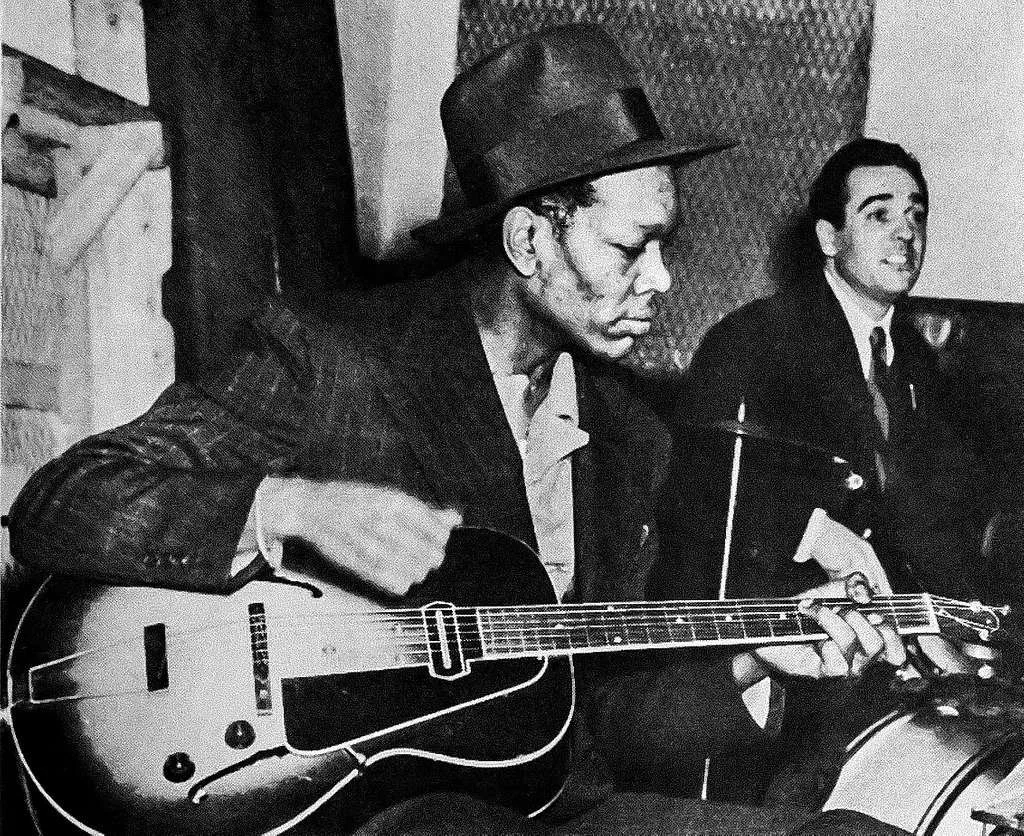
This carried over somewhat into the single string style that we see with Charlie Christian and Wes who played with a thumb over/flat fingered stance. (We also see it with Manouche jazz guitar although the guitar is usually more traditionally positioned in this style.)
See the Charlie christian pic above, obviously.
In terms of teaching a student …. It’s probably best not to lol. If a kid wants to learn to play Jimi or Django I guess I cross that bridge when I come to it.
Sent from my iPhone using Tapatalk
-
The more you pronate you hand, the more your thumb hangs over; and the less you want to use your 4th finger. The more you supinate your hand, the lower down your thumb goes and the easier it is to use your 4th finger.
so classical players raise the angle of the neck toward the ceiling so the degree of supination required is less. GJ players, with the neck basically completely horizontal would have a hell of a time doing that...it would strain their elbow and wrist greatly.
-
Here's an example:
the D-7
x5x565
you most likely naturally pronate your hand compared to the Gmaj7
xx5432
to use your 4th finger on the lowest note, it is best to supinate
In this first picture of Johnny Smith, his hand is supinated in an unnatural way. This could never be his default position, it is for playing a certain chord shape. This might be how it looked when he played the famous Moonlight in Vermont. He could never use his thumb like this. Because the guitar is more horizontal than a classical player, his wrist is really twisting. He is also dropping his shoulder to try and compensate for the horizontal guitar position.
In this picture Johnny's wrist is relaxed and pronated. He could use his thumb, but not easily the 4th finger
Last edited by joe2758; 07-21-2026 at 12:26 PM.
-
Also notice the angle of the guitar with respect to the body - that’s old school archtop positioning
Sent from my iPhone using Tapatalk

 Reply With Quote


Andy Bartosh plays "Dolphin Dance"
Yesterday, 04:20 PM in The Players