


-
I do my absolutely damnedest to be equal opportunity with my pinky, but it's also worth mentioning that even someone like me is going to use the first three fingers a good bit more. I absolutely practice chromatic enclosures with like ... 4 2 and 3. But in the wild, I'm quite sure I'm using 3 1 and 2 nine times out of ten.
 Originally Posted by Christian Miller
I would also say that it's worth being honest about the limitations of the fingers. I do a lot of big positional jumps and the pinky is the weaker finger on those. I definitely use them, but still.
I agree with this too. I also think even if you use the pinky a lot, there is some favor you have to pay to the ring finger to avoid the weakness of the pinky in certain situations. I end up doing some chromatic stuff like maybe B on the third string, first finger ... to A on the fourth string third finger ... to Bb on the fourth string, fourth finger. Which I guess I would do with a fourth finger slide on that fourth string if I were really treating those fingers equally.Assuming you are talking about jazz - Nah. Not really.
Ooooh see above, I actually don't always do this. But to the point of the post, I'd rather split a chromatic enclosure across two strings than play it on one string with the 2 3 and 4 fingers.Which means for example enclosures are fingered along the length on one string in relation to the target note. This cannot be done without shifting.
Would be interested to hear what you mean by "harmonic" fingerings. Just mirroring arpeggio or chord shapes rather than strict positions?I think people say stuff like this because they think bop lines need to fingered positionally. Actually I’d always say bop fingerings need to be harmonic.
This is interesting because I've done loooooooaaaaads of intentional work getting my slurs placed the way I want them to be, and I think three fingers would probably make some of that stuff a bit more automatic. Downside is that I also know a lot of folks who play that way who have never really put much thought into the articulation (ain't broke don't fix it) which is not really a disadvantage. More like an unfortunately byproduct of the natural advantage in that respect.Take the first few bars of hot house. That chromatic run can be managed easily with three fingers and if you slide from the ‘and’ to the beat it swings.
-
10-07-2024 10:07 AM

-
Yup, it's a dirty job.... but with the overwhelming support (or so it seems) on this forum for the 3 fingered approach, I just like to remind folks that it's no sin to use the pinky Originally Posted by Christian Miller
 . It's not an issue of sunk costs, I actually prefer the "feel" of 3F and have worked a lot on doing things both ways to evaluate the differences, particularly as it relates to playability of certain lines. You say Benson is the guitar's answer to Oscar, but he isn't really, in the strictest sense that he prefers playable ideas that suit his horizontal approach. Same goes for Pass, Wes etc. There are some kinds of lines that piano or horn players have access to that just go against the grain for guitar players, and if they are attempted, then I feel there are more downsides to 3F vs 4F. It's hard enough to move in and out of position with stretches and what not using 4F, but I've found 3F is stronger but not cleaner at fast tempos (270+).
I get what you're saying and your video (as always) makes a good case for 3F, just saying that my experience with the kind of things I like to practice has shown me that 4F suits me better. Is that OK?
-
Well, I don't. Originally Posted by Peter C
I can----I learned 3 nps fingerings starting on each note of the major scale. I find that approach useful mentally: when I'm falling asleep (or bored) I'll say to myself, "Ab" or another key, and visualize those fingering positions and name the notes. (This is more about learning the names of all the notes all over the fingerboard than it is about practicing scales.) It's also great for shredding, though I don't do much of that.
In Jimmy Bruno's five fingerings, there are 3 notes on some strings but only two notes on some others. Jimmy would rather shift than stretch.
-
Yeah I’m certainly not saying that everybody should stop what they are doing and switch now. I can give you a list of great players who have a much more CG style right hand. What I’m trying to do is point out that this is a solution that clearly works, esp given so many players are using this into their late years. Originally Posted by princeplanet
And it can solve playing health problems - I remember reading Kurt for example moving to a more shift/less stretch approach for left hand after encountering playing health issues, although I haven’t been able to track down the interview again, yet. He certainly has a rather TOP right hand although he uses his pinky quite a bit.
The dichotomy is not 3F/4F really. That’s kind of a canard? If that’s the right word? TOP players may use the pinky a lot less than CG style players, but I can’t think of any that don’t use it all, at least in the jazz world.
The OP actually needed a deeper explanation of how technique works than 3F/4F, not an inevitable argument for not trying it. So I’d rather get away from talking about fingers and talk about left hand posture, because I think the fingers discourse (so to speak) is clearly unhelpful from the problems “charlie” is having.
If you want to learn from someone like Wes or George you really need to look at the way the player plays with attention to detail.
Lastly this stuff about Benson playing ‘playable ideas’ (presumably pre baked material thats chained together into longer lines?) - Every player does this, including horns and pianists. Adam Rogers, mr perfect thumb behind 4 fingers, said ‘if you can play it fast you’ve played it before.’ Bebop 8th note style improv at speed is highly modular.
You can improvise freely in longer note values of course, and Jim hall is a great example as is Peter Bernstein, but if you are talking about the likes of Oscar that stuff is dialled in. You may find it easier to play these ideas one way or the other, but we are all playing ‘playable ideas’ - if you get my drift. You probably already know duh understand this, but this is a common criticism of George which I feel is a little unfair.
Sent from my iPhone using Tapatalk
-
So here’s a question … what is the dichotomy? Or is there one? Originally Posted by Christian Miller
It’s interesting, I hear people referring to four-fingers sort of synonymously with more stretching. But I use four fingers and avoid stretching as much as possible. Hate stretching.
Is that the dichotomy? Regardless of the fingers you’re using … stretch v shift?
-
Nah, I mean he's worked out (amazing) things that he can finger comfortably, as opposed to fighting against he guitar to get his ideas out. Originally Posted by Christian Miller
My problem is I don't listen to guitar players much (yeah I know, I shoulda learned a different instrument?), so what I've ingrained is never going to feel comfortable to play, but that's OK. I know trumpet players who never feel "comfortable", despite sounding great.
-
I think with respect to those trumpet players, you might want to draw a line between physical comfort and artistic comfort. Originally Posted by princeplanet
I know loads of players of all instruments who are just unsatisfied with their playing and uncomfortable with the music they produce.
I also know a couple (two that jump to mind) trumpet players who were physically uncomfortable, despite sounding great, and both had to stop playing for several months and relearn the instrument over the course of a year or two so that they were physically comfortable.
-
Well, you know me. I’m as into horns and pianos and harpsichords and wotnot as guitar and I’ve never transcribed a lick of George Benson Originally Posted by princeplanet
but I know one thing - if I fight the guitar, the guitar wins.
Sent from my iPhone using Tapatalk
-
Hehe, well doesn't it always? As for Peter's remark about artistic comfort v physical comfort, I can be comfortable with what I'm playing, at the same time feeling constantly physically challenged, but not enough to put me off my game (or am I, without realising? hmm). But i do take some "comfort" in the realisation that some instrumentalists have it tougher. Originally Posted by Christian Miller
I onced asked a trumpeter how they cope with the physical demand, "It's a cross to bear" came the reply, with a forlorn look on his face that I'll never forget...
-
Maybe Originally Posted by pamosmusic
(It depends on the music. I mean if I’m playing a Bach two part invention I’m stretching baby.)
There’s obviously a bunch of things at play. A technique suited to polyphonic music is not necessarily well suited to playing violinistic lines all over the fretboard for example.
My contention is more that TOP represents a remarkably consistent approach to left hand technique that should be admired and studied in itself. It should be considered not ‘bad playing’ but a technique in itself. And there should be books and technical studies.
And that’s more or less it. I don’t have a product to sell or nothing. I’m still finding out myself.
In terms of sound and vibe, I think there is a difference. Time, bends/vibrato, tone, all are affected by that type of technique. For example Jim Mullen would not sound like that if he had ‘legit’ technique. He just wouldn’t. There’s so much warmth from his playing, same as Wes, or Pete. Juice.
A style of playing that seems more adjacent to rhythm guitar than polyphony, perhaps.
It’s not to say the other guys sound bad- it’s more, different?
Sent from my iPhone using Tapatalk mi
-
I don't think it needs to be either/or. Sometimes I use four fingers, sometimes I use three. Originally Posted by pamosmusic
On the high strings, hammer-on/pull-offs are much better with three fingers. It's more articulate. But on the lower strings the fourth finger works better, perhaps because it's reaching over more.
Stretching is always something I've tried to avoid. It just feels terrible for my hand. On the other hand, I really like shifting. It has a sound all its own. It's a type of slur, basically, but different than a hammer-on/pull-off.
-
In terms of the thread, as I’m sure you’ve noticed, the dichotomy didn’t originally come from me. I just wanted to advise the OP on that specific technique.
Sent from my iPhone using Tapatalk
-
A more vertical neck?
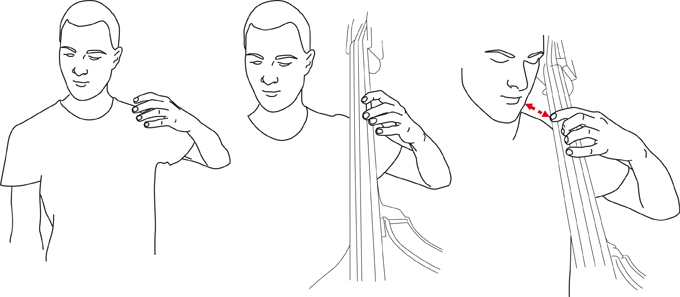
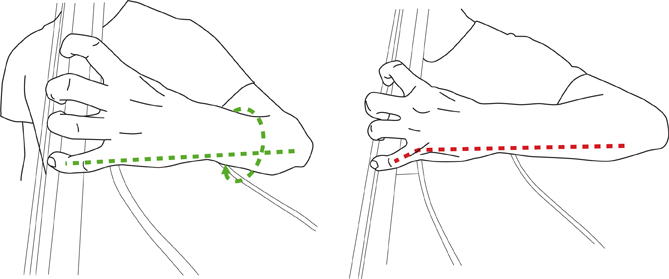
3.3 Double Bass Ergonomics - Artist- & Musikerhalsan
-
As a 4F guy, I stretch... a lot. And I hate it. Originally Posted by pamosmusic
-
Beginners or not, if you commit to fingering the scale notes like that, it's liable to lead to the same limitations as your first example, i.e., ackward fingerings and mechanical phrasing. Originally Posted by Peter C
For example, here's a series of notes from your "plot twist" scale fingering. If you attempt to finger them, ascending or descending, just as you did your scale, it will lead to inefficient fingerings, e.g., playing consecutive notes on adjacent strings with your pinky.
This has the same inherent drawback as the previous example if not played as ascending arpeggios. For example, when descending from the B to the G string (Notes Ab >F), will you play those consecutive notes with your first and 4th fingers? But maybe you only play ascending phrases so it's not a problem? Originally Posted by Peter C

However, my point was that one's fingerings should be dictated by what one plays and not by set fingerboard patterns.
-
I liked how you put it, that playing with three fingers seems to have a better feel and sound. You definitely never said it was either/or! Originally Posted by Christian Miller
-
Oh I just remembered another relevant issue - obv everyone is different, but I find shifting with the little finger hard. I believe most players do FWIW. Originally Posted by pamosmusic
Lage Lund has made this point in comparison with piano - where the pinky is used for direction changes. So he prefers three fingers except when the line is changing direction.
The argument is that therefore favouring three fingers whether in a CG position like Lage or TOP grab and whack like Wes or Pete encourages a mobile left hand - it’s actually less to do with stretching in this case.
But there are players who shift with the pinky habitually. Allan Holdsworth is one. Perhaps Peter Amos may be another?
So… is this a hard and fast universal emergent from the biomechanics of the human hand and conquerable only through concerted practice - or more a personal inclination/tendency? I don’t really know.
Sent from my iPhone using Tapatalk
-
He was f***ing with you. Originally Posted by princeplanet
I asked one of the trumpet players I mentioned who’d lost his chops the same question … his answer …
“Rest at least as much as you play.”
I always think the whole “you have to wrestle your instrument” thing is very “suffer for your art” and I don’t really buy it, honestly.
-
Dave Creamer used to use his pinky to play consecutive chromatic notes as in the pattern below, I could never get used to it (but I did not try all that hard).
12-Tone Pattern:
-
Interesting thread, but short of time right now. Would anyone care to post a bop head whose "feel" they believe is favoured/enhanced by the (strictly) 3 finger approach? I'll give it a go, see what happens.
-
Straight no chaser
-
Also I think with jazz the more different ways people find to play a thing , the better ….
idiosyncrasy is probably a good thing
as long as it’s comfortable to play
and sounds good , go for it
-
Notice in the article the first thing they talk about is posture. I think that might have something to do with it. Like...posture first and hand position and fingering follows that. I've noticed that most guys who have the guitar on the right thigh and neck parallel to ground tend to be TOP (nice C!), therefore more 3 fingery. Originally Posted by GuyBoden
The higher the neck angle the more likely to be thumb behind, and therefore likely to be more 4 fingery.
Lots of exceptions and in-between-ers. I'm just talking generally, and it follows what Christian has been saying: don't put your thumb behind if you want to work on 3 fingers and not hurt yourself with the neck down. In the clip Pass's thumb hangs out on the side sometimes, but his hand isn't pronated as much because of the angle. He does both. Forman's also more angled than PB and he's more like Pass but not as much. Gypsy guy totally parallel to floor.
Umm... when I said we just pick it up and go for it, I forgot to mention I played cello for 5 years as a kid before picking up a guitar. I started out holding it folky style and quickly came to strapping in at an higher angle. Just felt right.
I'll say again: just because you use the pinky doesn't mean you can't move the hand to get the phrasing. I guess I learned that from cello too.
But... yeah... experiment with everything. WTF not? You might learn something. And don't hurt yourself.
-
I smiled at the picture of the crossed fingers on Christian's bebop fingering video; sure, you don't want to cross your fingers on the finger board, but do you want to cross the bones in your forearm* using TOP, even a little?
I'm sticking with (TBS)4F (Thumb Behind Supinated Four Fingers).
* I also do not cross my legs when playing, do not give cross looks at the drummer, and avoid crossing paths with singers and harmonica players I have not heard perform.
-
Lucky you! Seems I'm always in some sort of guitar related pain, fingertips, tendinitis, carpal tunnel, tennis (guitar?) elbow, neck and even back pain. Heck, I even have pain on the side of my index finger where I grip the pick! I've tried changing technique, posture etc to no avail. Originally Posted by pamosmusic
It's OK, I don't expect any sympathy, not even from other guitar players!


 Reply With Quote


$10,500 1968 Gibson L-5C Acoustic Archtop Electric Guitar w/ Full Size...
Today, 01:51 AM in For Sale