

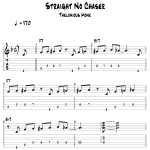
Straight, No Chaser is one of Thelonious Monk’s most famous blues heads. The original 1951 recording is in B♭, but Miles Davis’s Milestones version popularized it in F, which is the key we’ll use in this lesson.

In this lesson, you’ll learn the melody of Straight, No Chaser in two octaves.
The chord progression of the tune is a typical 12-bar jazz blues in F.
This melody is a great way to expand your blues vocabulary in a classic jazz context, work on jazz phrasing and articulation across positions, and explore Monk’s unique use of repetition, displacement, and chromaticism on guitar.
Recommended Listening:
- Thelonious Monk – Genius of Modern Music Vol 2 (1952)
- Miles Davis – Milestones (1958)
- Wes Montgomery – Echoes of Indiana Avenue (1958)
- Tal Farlow – The Return of Tal Farlow (1969)
- Oscar Peterson (with Joe Pass and Toots Thielemans) – Live at the Northsea Jazz Festival (1980)
- Mike Stern – Standards (And Other Songs) (1992)
Straight No Chaser – Video
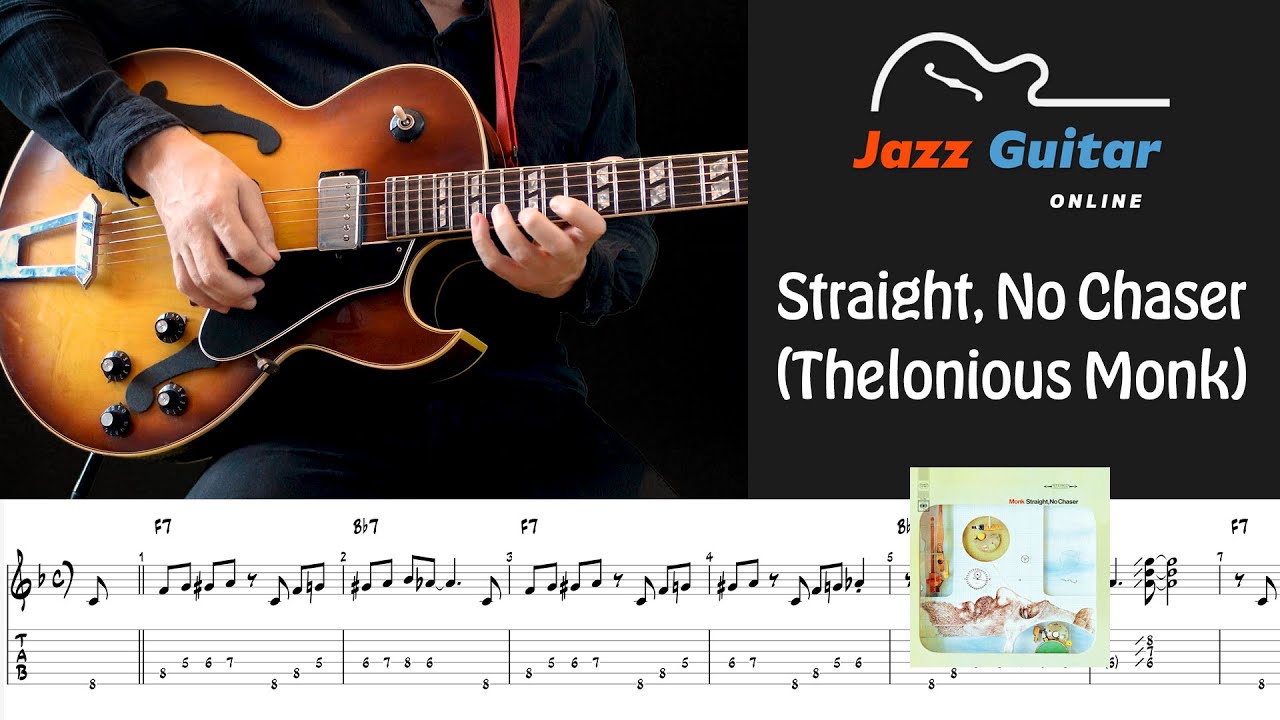
Straight, No Chaser – Notation/Tabs & Backing Track
Backing Track
Listen & Play-Along



Very nice, little blues piece to practice, thank you. Enjoy learning about Thelonious Monk
Thank you very much, Dirk. One more great tune to enjoy and learn. I’m always learning cool things in your lessons. You are the best!
What a great classic – well done! Thanks Dirk👍😁!
Thank you so much! I’ve been looking to learn this for a while. This is just what I was looking for.
John
Very nice. Thanks, Dirk!
Nice. Thanks Dirk!
Just what the doctor ordered! thanks again/inspirational Dirk!
Muchas gracias great job.
Silly question, perhaps:
Why are the a-flats in the melody notated as g-sharps? It’s a standard bluesy minor-third to major-third move.
Is it just the convenience of not needing the extra natural?
Thanks!
Hey Artie, not a silly question. Chromatic approach notes are usually spelled according to their direction: going up you tend to see sharps, going down you tend to see flats.
Thanks learned something new, had the same question
Thank you now I will practice and when memorized try to transpose to other keys.
You’re welcome! Try it in Bb, that’s the original key. I don’t think it’s very efficient to learn it in other keys, it’s better to focus on learning new standards.
Belíssima transcrição, excelente método também. Monk tem muitas melodias interessantíssimas!
Trés bonne transcription. Je le joue habituellement en Bb. Tes tablatures me permettront de l’apprendre plus facilement en F. Merci pour le partage.
👍👍 Two thumbs up young man 👌 you play with such heart and feeling. Thanks for sharing.
Frank