

This gypsy jazz guitar lesson is an introduction to “La Pompe”, the signature rhythm strumming style of gypsy jazz, also called Manouche. You’ll pick up the basics of the technique, along with the chords and progressions that give gypsy jazz its authentic sound.
Learning La Pompe takes patience and regular practice. Go through the exercises in this lesson at a slow pace, focusing on relaxed, steady movements before you try to play faster.
The video lesson below is a great way to see how the technique works. Make sure to read the tutorial as well, as it offers extra tips to help you build a strong sense of rhythm.
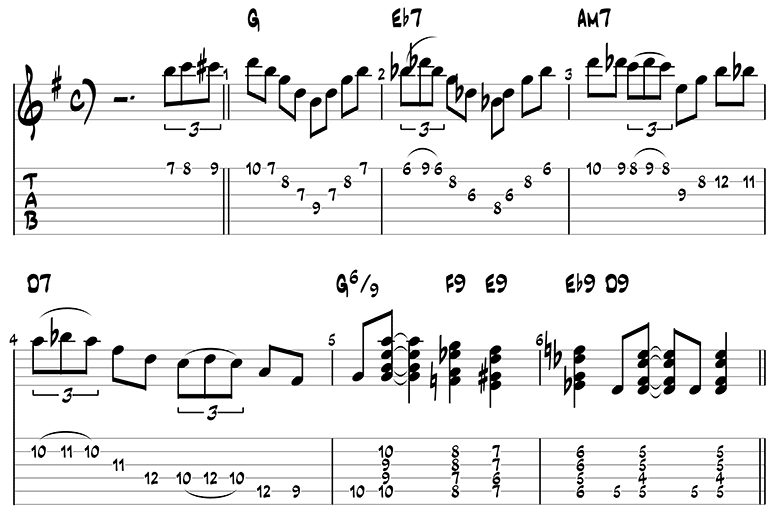
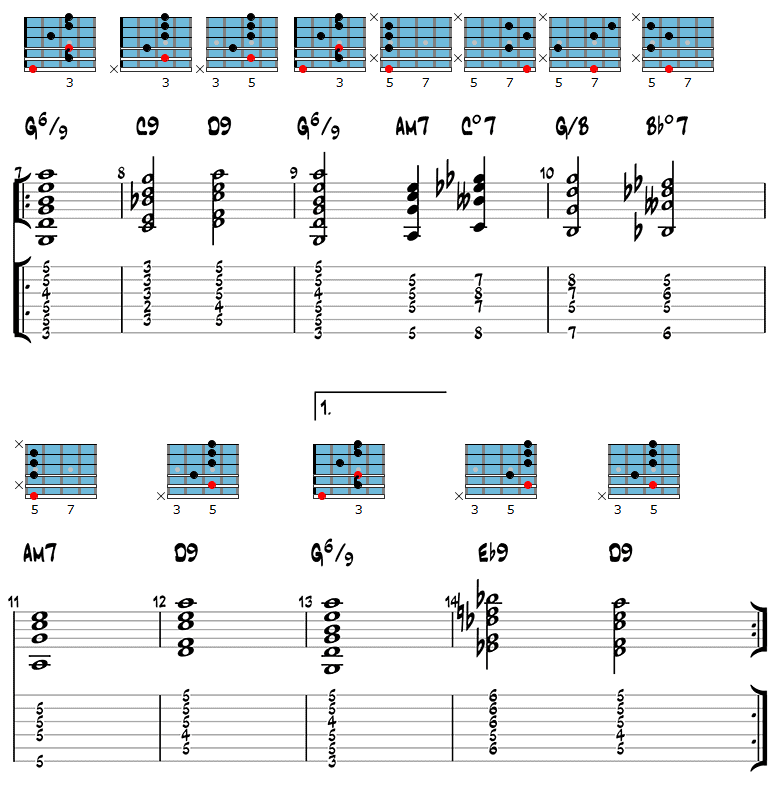
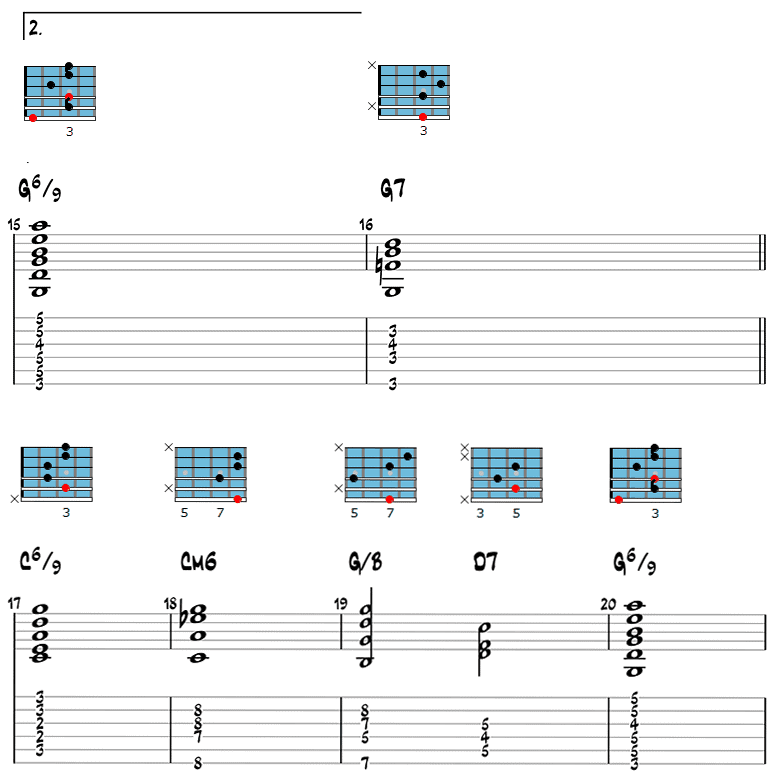
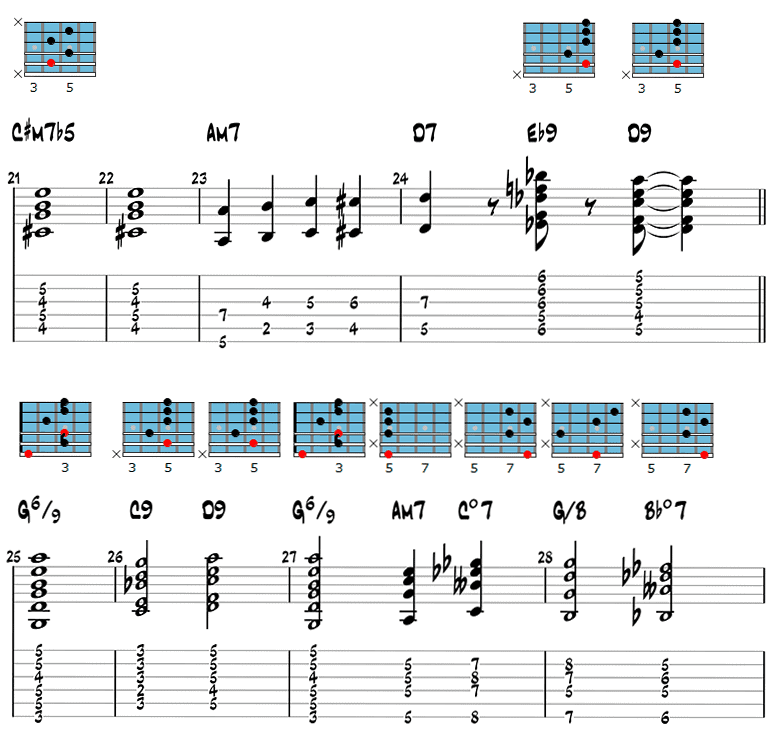
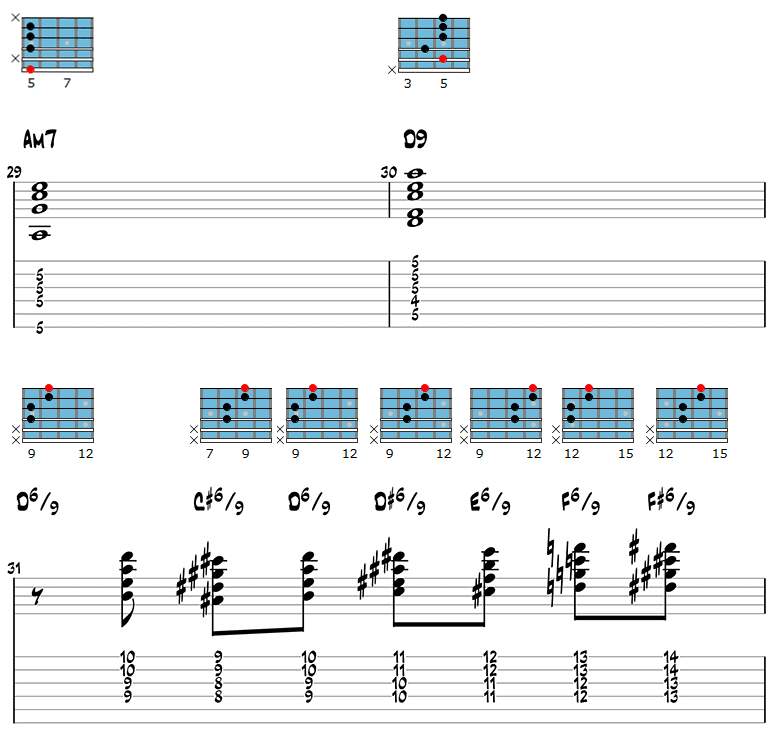
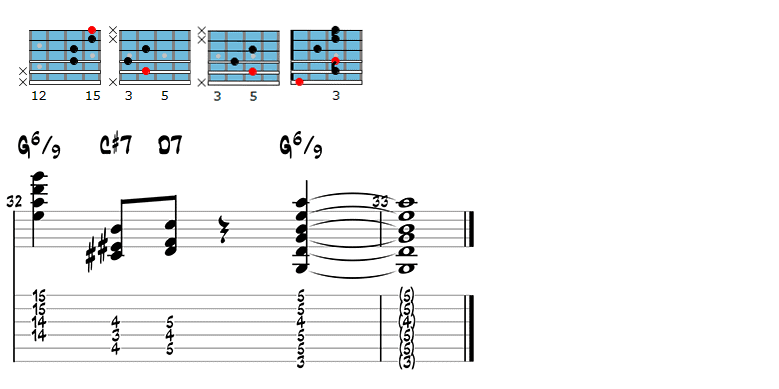
Many people have asked for it, so you’ll also find the guitar tabs and chord diagrams for the video’s introduction included here.
La Pompe – The Technique
The notation below shows the basic La Pompe rhythm pattern. This is the main rhythm used in gypsy jazz guitar. Start by practicing it slowly, and only speed up once you feel comfortable.
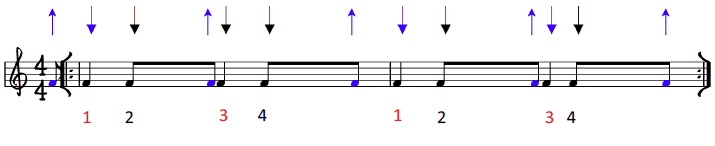
Put the next two steps together to play the basic La Pompe rhythm.
Step 1
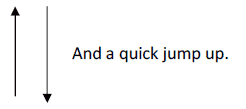
Play an upstroke followed by a downstroke.
Right after you hit the strings, quickly lift your picking hand back toward the top of the guitar so it ends up raised and ready for the next stroke.
Emphasize the sound of the lower strings more than the sound of the upper strings.
Step 2
Step 2 is a fast, accented downstroke, often called the slap. Make this stroke short, crisp, and percussive.
This time, emphasize the sound of the upper strings more than the sound of the lower strings.

Tips:
- Use your forearm and elbow for most of the movement, and keep your wrist relaxed.
- Keep your wrist slightly bent.
-
Hit all six strings with every stroke.
-
After Step 1, quickly bring your hand back to the starting position.
- Try not to make extra movements. Keep each motion small and controlled.
-
Start by practicing slowly. As you get more relaxed and consistent, you’ll naturally get faster.
The Intro
Below are the guitar tabs, standard notation, and chord diagrams for the introduction played in the video.
Chords & Chord Progressions
The video introduces several jazz chords and chord progressions that are often used in gypsy jazz.
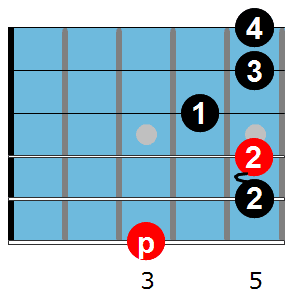
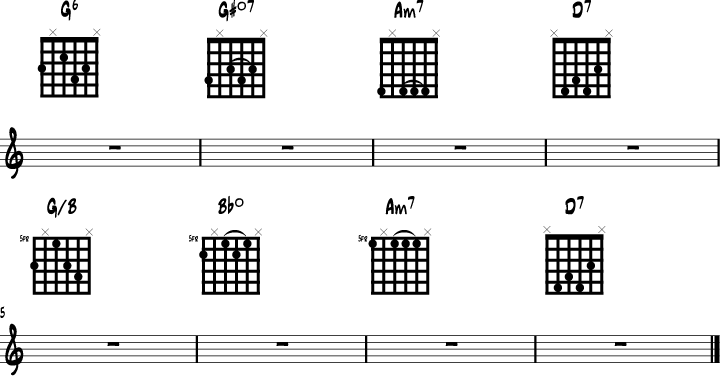
The first chord shown is G6add9, also called G13, and you can see it at 4:07 in the video.
This chord sounds rich and full, but it can be tricky to play since you need to fret the bass note with your thumb (p in the chord diagram) and use your second finger to bar the 4th and 5th strings.
If this chord shape feels too hard, try the G6 from the first bar of chord progression 1 instead. You can find it at 5:00 in the video.
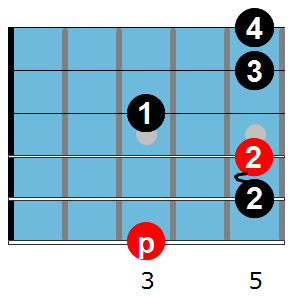
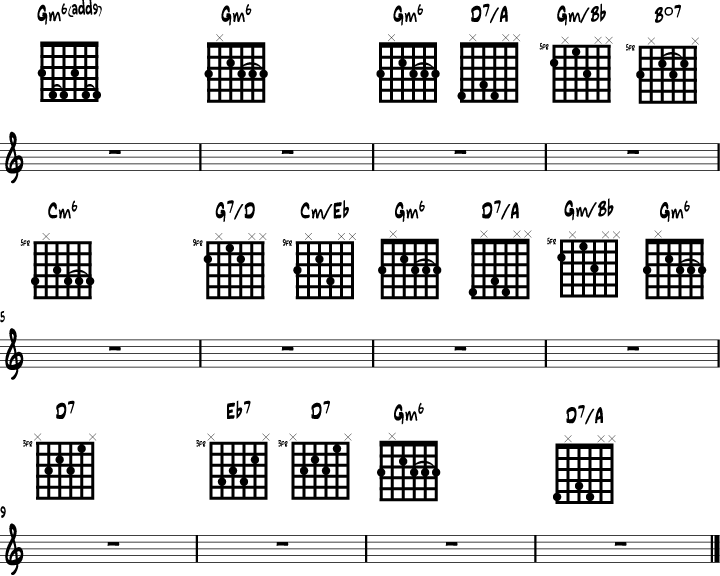
At 14:47, the video introduces a minor variation called Gm6add9. This chord has a warm sound that’s typical of gypsy jazz.
Chord Progression 1
The first chord progression starts at 5:32 in the video.
Chord Progression 1 – Long Chords
Chord Progression 1 – Short Chords
Chord Progression 1 – Faster Version
Chord Progression 2
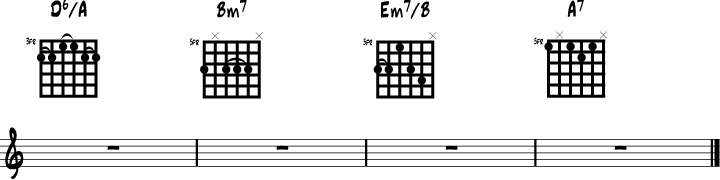
The second chord progression starts at 11:20 and is a I–vi–ii–V in D major.
Chord Progression 3
The third chord progression, which you’ll find at 14:38, is a G minor blues. It uses the La Pompe rhythm in a blues style.
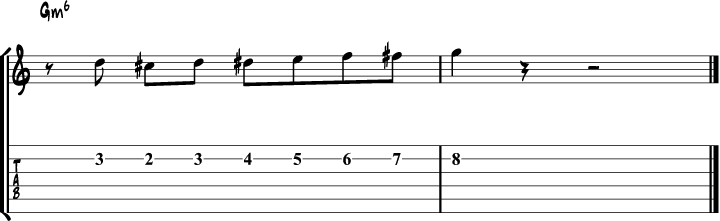
Here are the guitar tabs and notation for the ending, as shown at 19:04 in the video.
Download the PDF, GP file, and audio with JGO+ (Click here to join)

Very well explained lesson. Thanks, Jacob and Dirk!
Thanks so much for this. This is very useful.
Thank you for this introduction. A great lesson that will improve my right hand technique and give me some new chord forms. Brilliant!
Thank you. This is my favourite style.
thanks very much for the inspiring lessons, very clear instructions
Hi.
Je joue essentiellement du jazz manouche et même je compose mes propres chorus.
Vous avez fait une synthèse de la base du gipsy swing de façon éclatante.
Ce qu’il convient de dire aussi c’est le relâchement de la main gauche immédiatement après la frappe.
Bravo .. c’était super
Dobra lekcja
Great lesson, thanks!
Gracias Dirk, super interesantes estás lecciones, cada vez que ingreso a estas, aprendo más. Saludos desde Quito Ecuador.
happy sound
Similar to Freddie green voicings
Great lesson! Thanks a lot. I love Gipsy Jazz, Django and his disciples. And Yaakov is surely one of the best musicians of this rich and soulful style. He is also a generous teacher. Greetings from Brasilia. Pedro Noleto
Muy instructiva, buena lección, gracias, buen día
This is so great! I’ve been struggling with chords and the breakdown of La Pompe.
Thank you!
great lesson! what is this song’s title and writer?
The chord progression is from “Oh Lady, Be Good” by George Gershwin
Congratulations!!!
Mamash enjoyed your lesson pal. I am going through trouble with chords. So this lesson was really useful. Really nice of u to make this knowledge public. Are u giving lessons online?
wow, this is quite good, thanks!
toda raba! This is such a clear way of explaining things with tabs and diagrams.Thank you.
My pleasure. Happy you love it!
Exactly what I was looking for! Thank you.
Great! Enjoy
Thank you Dirk for this nice “La Pompe” lesson! I love Django Reinhardt jazz guitar style!
Yes, there is so much to learn from Django!
Very enjoyable lesson, Yaakov! Love your passion👍.
Thanks so much for your comment! Cheers
wow! i never knew that jazz gypsy has a lot of minor 6. thank you very much.
When you see what was left of the fingers of Django the minor6 was “in line” with his left hand, but still…
Minor6 and 69 is also a latin favorit
That’s right. Django listened to a lot of classical music. He really loved Ravel and Debussy and I think that the 6 sound in major and in minor in Django’s music has a strong connection to the classical music he loved. Cheers!
Hi! Is available also the score of the intro you play at the beginning of the video? Thanks!
Hi Elettra, I added the guitar tabs and chord diagrams for the intro…