

In this study, you will learn how to play a melodic solo over the chord changes of Bluesette (Toots Thielemans) using simple triad shapes. Rather than relying on full scales or 7th arpeggios, this approach zooms in on compact three-note structures that outline chord tones or extensions.
Triads are a powerful melodic tool because they:
- Highlight the upper structure of the chord changes.
- Encourage melodic phrasing.
- Are easy to visualize and connect on the fretboard.
- Offer voice-leading opportunities without using full scales.
Unlike regular 7th arpeggios, which spell out the full chord (1 3 5 7) predictably and linearly, triads allow for a more selective and melodic approach.
To learn more jazz guitar patterns similar to the ones you will use in the study below, check out our course Jazz Guitar Patterns & Phrases Volume 1.
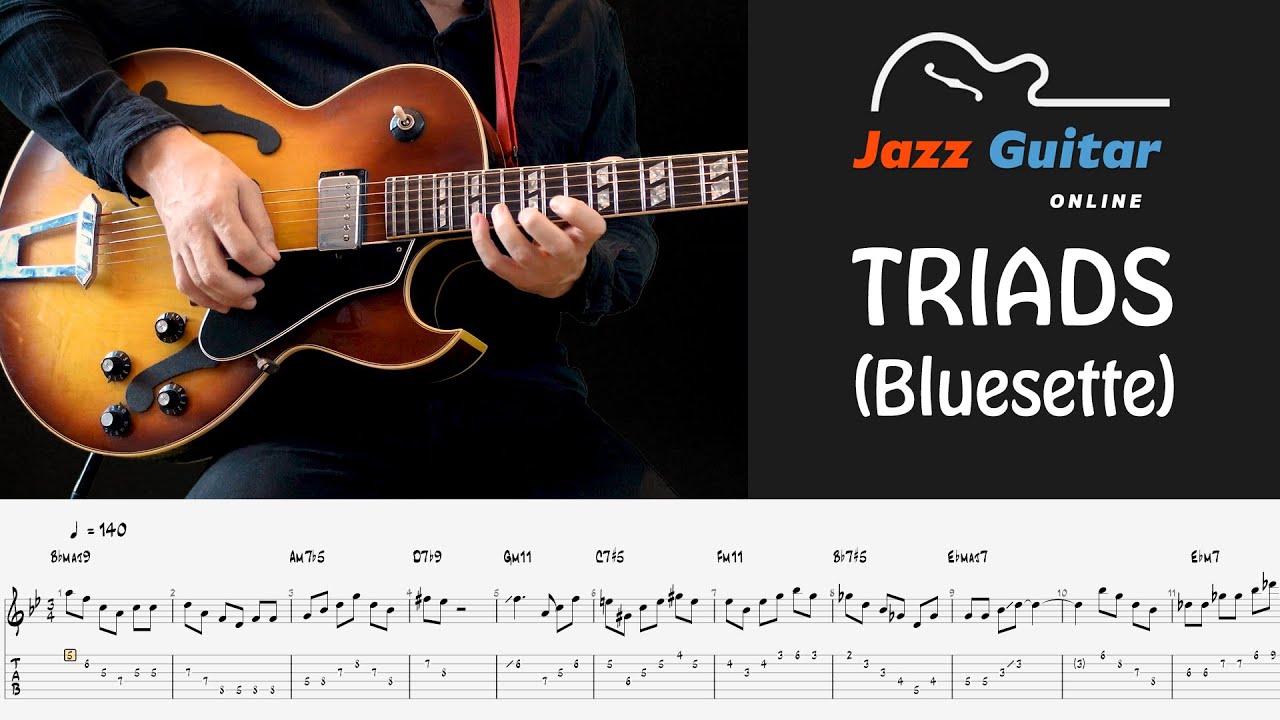
Bluesette Triads Study Notation/Guitar Tabs
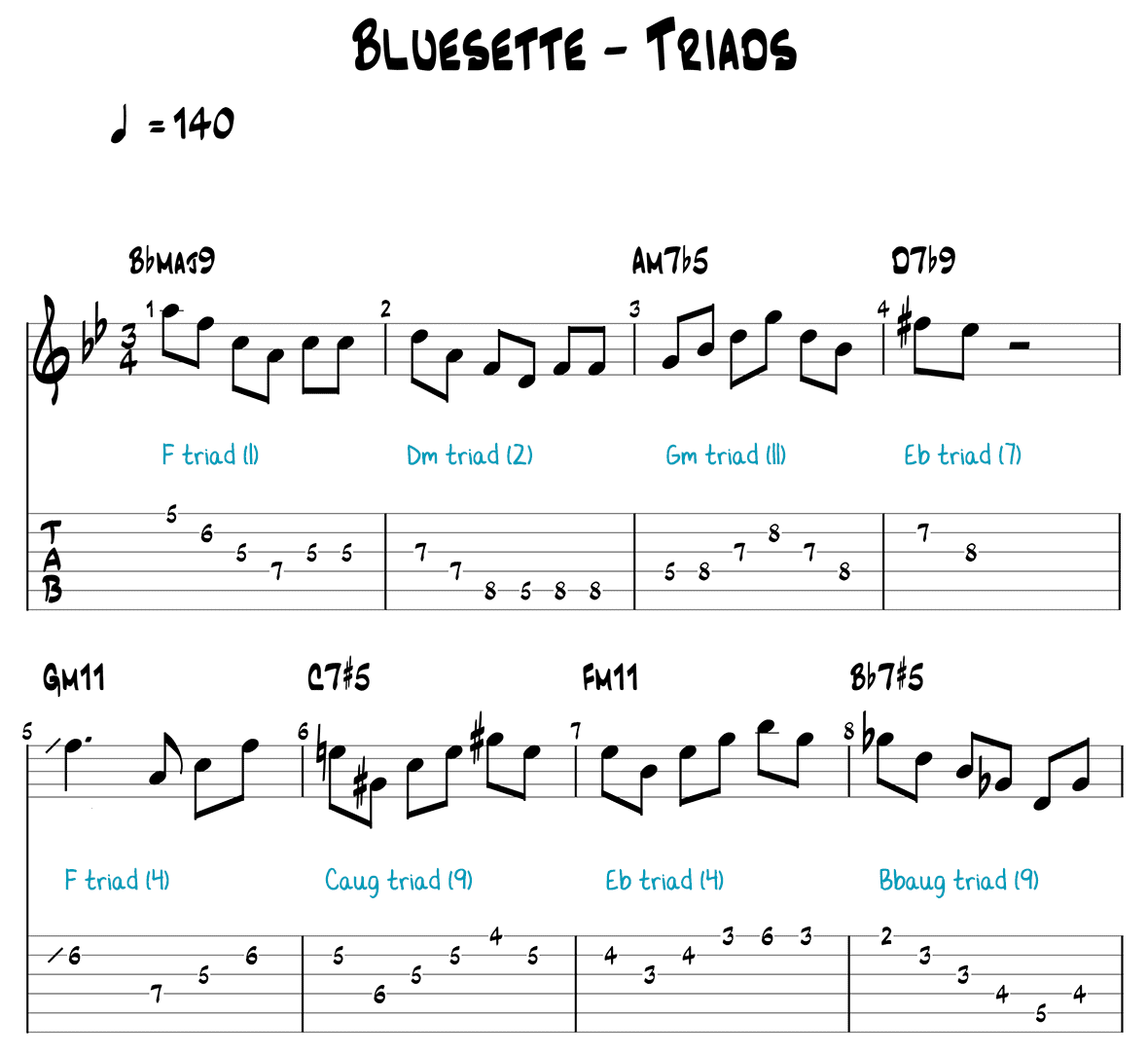
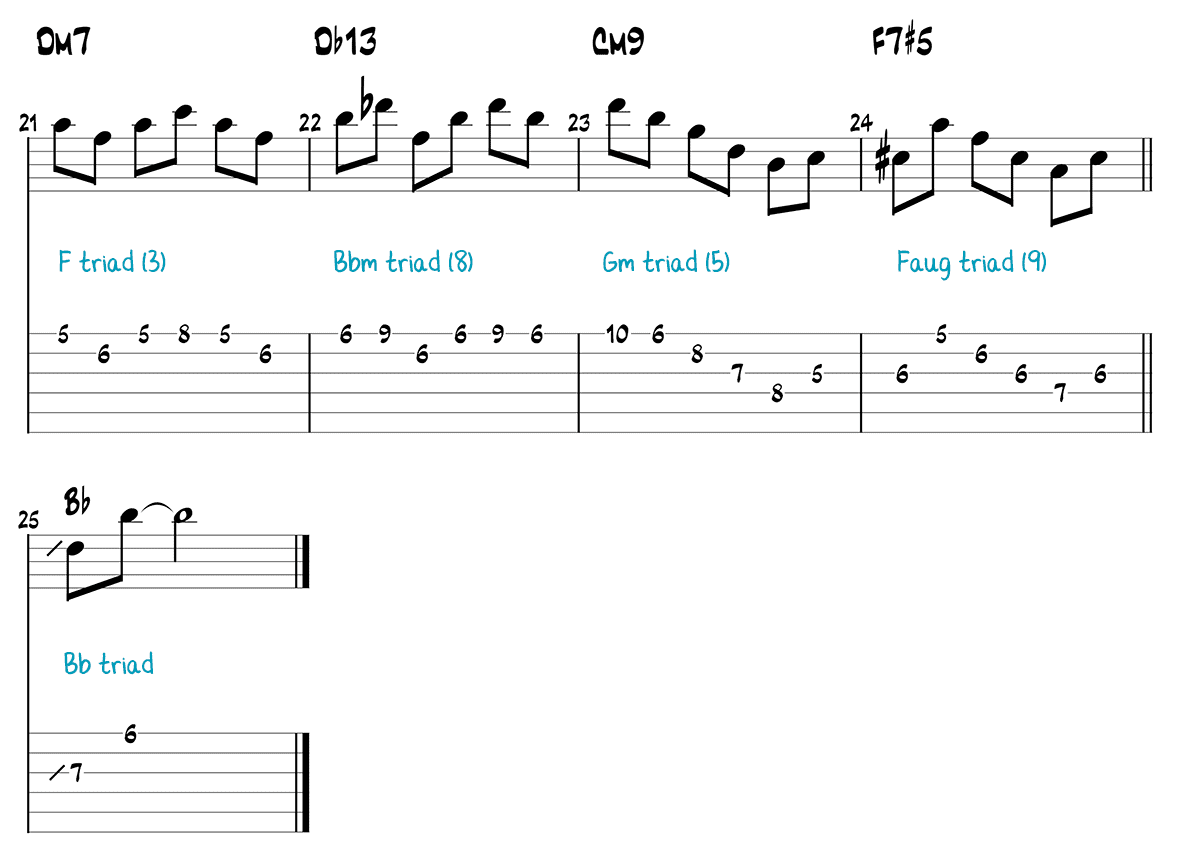
Here is the full notation and TAB of the study.
Every bar uses a triad as the basic building block. You’ll find the triad name below each measure, the number in parentheses refers to the triad list below the sheet music.
Backing Track
Listen & Play-Along

Triads Substitution List
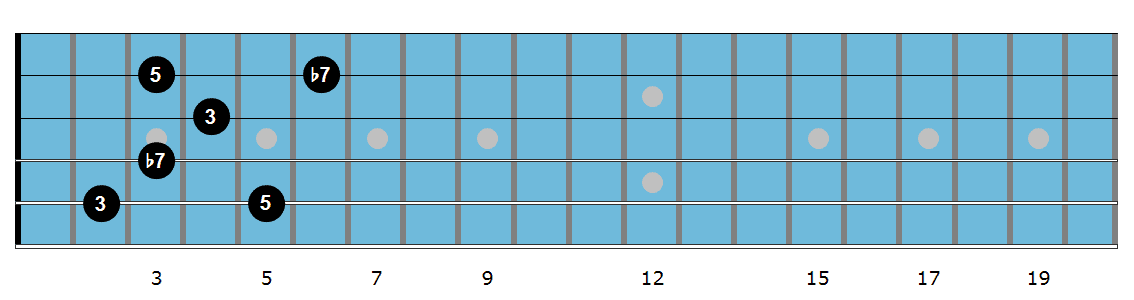
Here’s a quick reference of the triads used in this study, sorted by chord type. These are great to memorize and apply over other jazz standards.
For example:
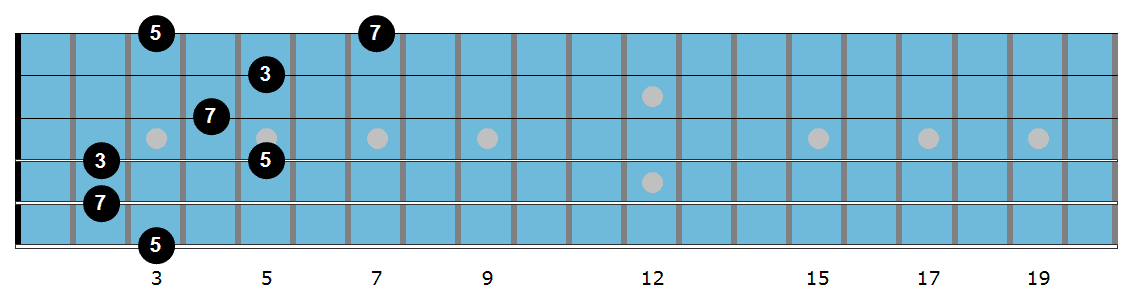
- The first option uses a major triad on the 5th of Cmaj7
- The 5th of Cmaj7 is G
- ➡ over Cmaj7 we play a G triad
- This produces the 5, 7, and 9 of Cmaj7
Triads Over Major Chords (Cmaj7)
| 1 | Major Triad on 5 of Maj7 chord | 5 | 7 | 9 |
|---|---|---|---|---|
| G Played over Cmaj7 | G | B | D |
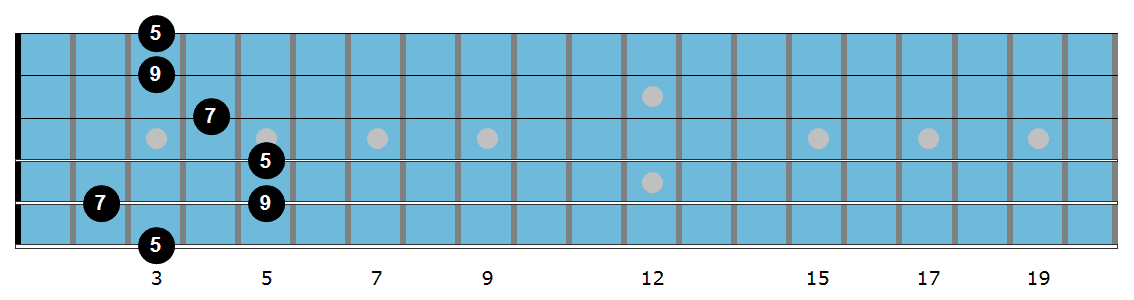
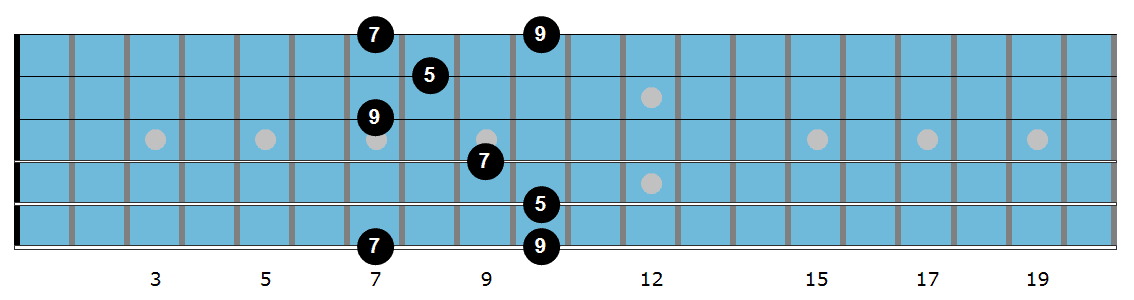
| 2 | Minor Triad on 3 of Maj7 chord | 3 | 5 | 7 |
|---|---|---|---|---|
| Em Played over Cmaj7 | E | G | B |
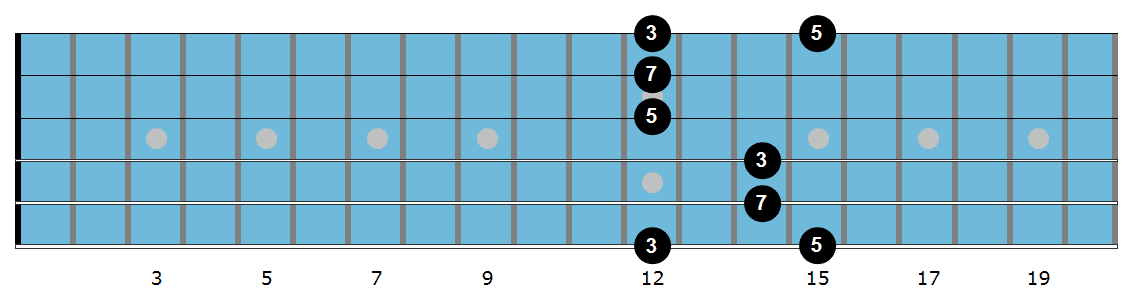
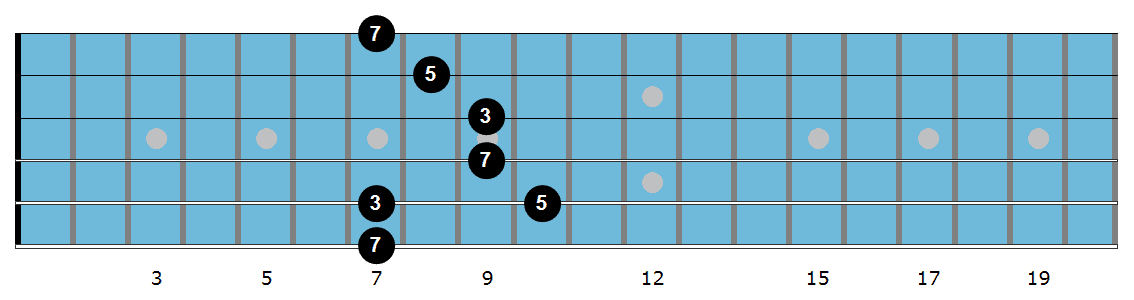
Triads Over Minor Chords (Am7)
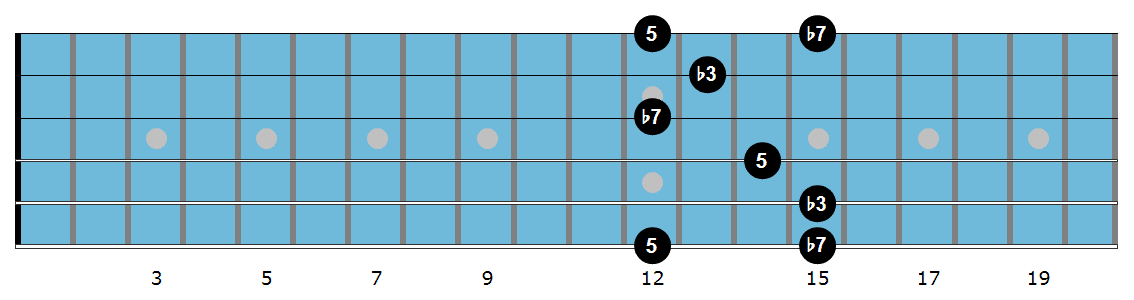
| 3 | Major Triad on b3 of m7 chord | b3 | b5 | b7 |
|---|---|---|---|---|
| C Played over Am7 | C | E | G |
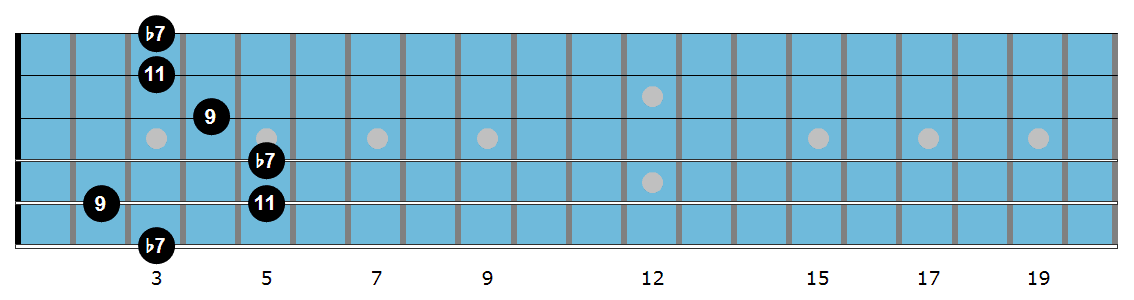
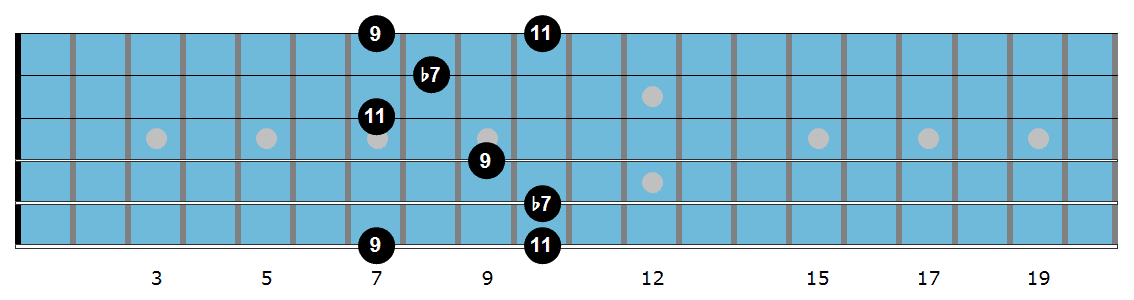
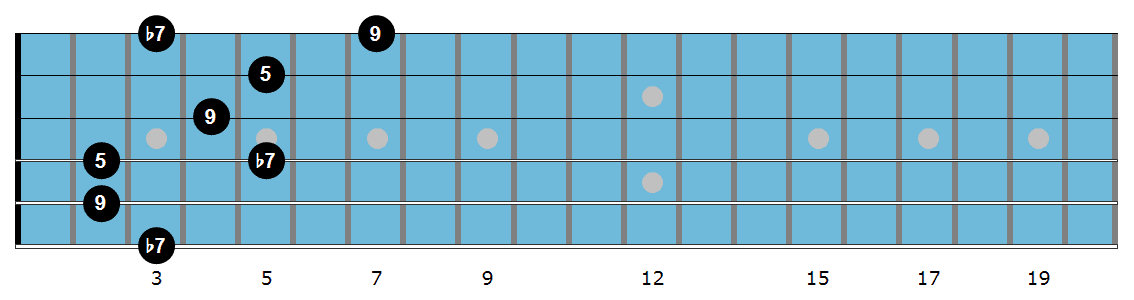
| 4 | Major Triad on b7 of m7 chord | b7 | 9 | 11 |
|---|---|---|---|---|
| G Played over Am7 | G | B | D |
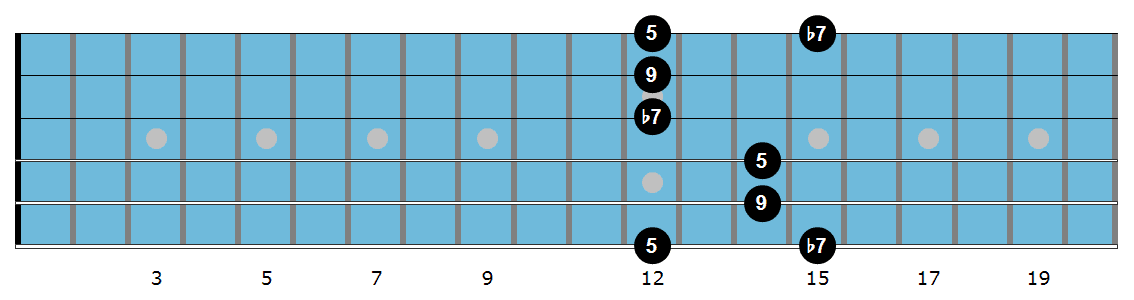
| 5 | Minor Triad on 5 of m7 chord | 5 | b7 | 9 |
|---|---|---|---|---|
| Em Played over Am77 | E | G | B |
Triads Over Dominant Chords (G7)
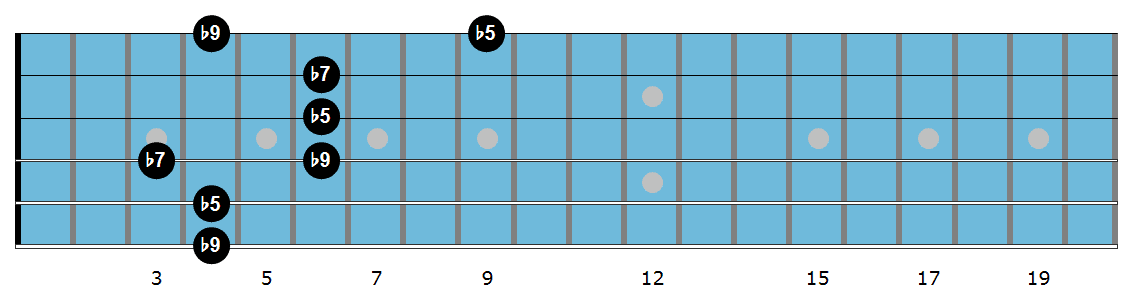
| 6 | Major Triad on b5 of Dom7 chord | b5 | b7 | b9 |
|---|---|---|---|---|
| Db Played over G7 | Db | F | Ab |
| 7 | Minor Triad on b9 of Dom7 chord | b9 | 3 | b13 |
|---|---|---|---|---|
| Abm Played over G7 | Ab | Cb | Eb |

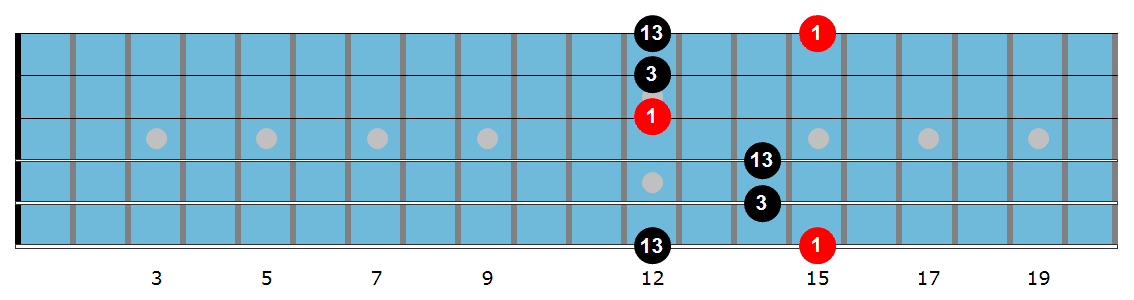
| 8 | Minor Triad on 13 of Dom7 chord | 13 | 1 | 3 |
|---|---|---|---|---|
| Em Played over G7 | E | G | B |
| 9 | Aug Triad on 1, 3, or #5 of Dom7 chord | 1 | 3 | #5 |
|---|---|---|---|---|
| Gaug Played over G7 | G | B | D# |

| 10 | Dim Triad on 3, 5, b7, or b9 of Dom7 chord | 3 | 5 | b7 |
|---|---|---|---|---|
| B° Played over G7 | B | D | F |
Triads Over Half-Diminished Chords (Bm7b5)
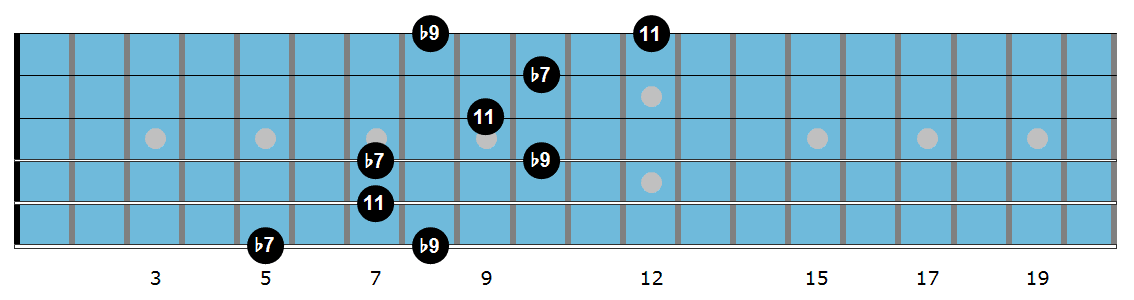
| 11 | Minor Triad on b7 of m7b5 chord | b7 | b9 | 11 |
|---|---|---|---|---|
| Am Played over Bm7b5 | A | C | E |
I think that I need to gain a better understanding on how and when to use these triads. Suggestions are welcomed. Thanks for your jazz lesson formats.
Great lesson Dirk – Thankyou so much.
Great and useful lesson. Thank you so much.
I’ve started playing jazz seriously in the last year and im at the point where Im learning jazz standards and basing my playing around the arpeggios. But that’s getting a bit stale now and this lesson is perfect for me to take it to another level. I’ll be applying all these concepts before the next meet up with my jazz buddies.
Hi Dirk,
Your posts are truly important for anyone who wants to start learning how to play jazz guitar. They contain all the information needed to put together the piece in question, nothing is missing; your followers simply need to dedicate their time to the instrument to perform the piece perfectly. When I was young, I enjoyed playing; I loved the music of Santana, but then I stopped playing the guitar. This year, I gave my nephew a guitar as a gift, and to teach him the basics, I picked up my own guitar and played with him. By chance, I saw one of your many videos on YouTube, which really got me interested, so much so that I’ve started studying again despite my age (70), and I’m having a blast.
Thanks, Dirk
Have a nice day!
Hi Sergio, I’m glad my lessons inspired you to pick up the guitar again! Thanks for the feedback!
Great lesson , as always.
Sometimes simple is more interesting than complicated.
Thank you !
You’re welcome!
I find many jazz artists, including the very best, like to play a lot of notes at a high tempo. I think they’re trying to create interest by speed rather than by chord tones. Many of my non-jazz friends don’t like the genre because all they hear is a lot of notes.
It’s a lot harder to create phrases at slower tempos.
It’s idd like you said “genre related”; the very best Jazz Artists (like Charlie Parker, Sonny Rollins, Stan Getz, Miles Davis, John Coltrane to name a few) will play ‘double time’ and even ‘triple/quadruple time’ in slow tempos.
For Parker; take “Parker’s Mood” at BPM 76: not a ‘lot’ (pun intended) of eight note lines to be found. Or his “Ballade” at BPM 70; eight note lines can be counted on 2 fingers.
Even slow tempo compositions of J.S. Bach will contain so-called ‘high tempo’ note passages.
So is it ONLY for ‘creating interest’? Don’t think so…
In #4 – it says
Major Triad on b7 of m7 chord b7 9 11
G Played over Am7 A C E
Shouldn’t it say G B D ?
Thx for the best jazz guitar site!
You’re right, fixed the typo!
Very useful and melodic as usual. Thanks!
Thanks Dirk
I’m enjoying all you send me. I can’t afford your lessons any other way so thank you. I’m grateful for it all.