Upper structure triads are useful for bringing new elements into your solos and comping. Upper structure triads and superimposition are something that you will hear popping up all on recordings by just about every single well-known jazz musician. As with every new improvisational device, the most important part is getting your ear acclimated to this sound and internalizing the tonality. Once you make it part of your personal database of ideas, it will naturally work itself into your playing. In this lesson, you will learn which upper structure triads work best.
Triads are a foundational element that every jazz guitarist should be completely familiar with.
If you can’t quickly find a triad voicing at any specific position on the fingerboard, it would be well worth taking the time to really get them down before you start using the applications in this lesson.
Accessing a triad is a simple task, yet when carefully placed over a specific harmony they can result in some really sophisticated sounds.
THE JAZZ GUITAR CHORD DICTIONARY (FREE eBOOK)
Download now and learn 244 chord shapes!
The Upper Structure Triads of Cmaj7
Let’s start with the upper structure triads of the Cmaj7 chord.
Here are the triads from the root on:
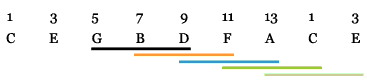
Some things to keep in mind:
- The upper structure triad must contain at least one tension which is not an avoid note. Avoid notes only play a role in major chords.
- An upper structure triad can be major, minor, diminished or augmented.
- You can use upper structure triads for soloing as well as for comping.
| Triad |
Notes |
Played Over Cmaj7 |
|
| C |
C E G |
|
Not an upper structure triad because it contains only chord tones |
| Em |
E G B |
|
Not an upper structure triad because it contains only chord tones |
| G |
G B D |
|
The first upper structure triad for Cmaj7 |
| Bm(7)b5 |
B D F |
|
Not a usable upper structure triad for Cmaj7 because it contains the avoid note (11) for C major |
| Dm |
D F A |
|
Not a usable upper structure triad for Cmaj7 because it contains the avoid note (11) for C major |
| F |
F A C |
|
Not a usable upper structure triad for Cmaj7 because it contains the avoid note (11) for C major |
| Am |
A C E |
|
The second upper structure triad for Cmaj7 |
A List of Upper Structure Triads That Sound Good
Here’s a list of upper structure triads that sound good to my taste.
I’ll do the first one with you so you can see how the list works:
- The first upper structure triad in the list is for a major chord.
- V means we build the upper structure triad on the 5 (compared to the root) of the chord.
- So in case of a C major chord, the upper structure chord is G: G B D (5 7 9)
Here’s what the abbreviations mean:
- Vm means a minor triad on the 5th note.
- V+ means an augmented triad on the 5th note.
- bVII means major triad on the b7.
- And so on…
| Chord Type |
Chord Tensions |
Triad |
Note Functions |
| Major |
9 |
V |
|
|
9, #11 |
II |
|
|
|
VIIm |
|
| Minor |
6, 9, 11 |
IIm |
|
|
|
IV |
|
|
|
Vm |
|
|
|
bVII |
|
|
|
bIII+ |
|
| Minor/Major |
9 |
V |
|
| Dominant |
9,13 |
Vm |
|
|
|
VIm |
|
|
9, #11, 13 |
II |
|
|
|
II+ |
|
|
|
bVII+ |
|
|
b9, #9, b5, b13 |
bIIm |
|
|
|
bIIIm |
|
|
|
bIII |
|
|
|
III+ |
|
|
|
bV |
|
|
|
bVI |
|
|
b9, 13 |
VI |
|
| Sus4 |
9, 13 |
IIm |
|
|
|
IV |
|
|
|
bVII |
|
| Half-Diminished |
b6, 9, 11 |
bVI |
|
|
|
bVII |
|
| Diminished |
b6, 9, 11 |
II |
|
|
|
IV |
|
|
|
bVI |
|
Upper Structure Triads Example – B over D7
We’re going to look at a triad placed over a dominant chord in a ii – V – I.
The upper structure triad we are using is B (VI over D7).
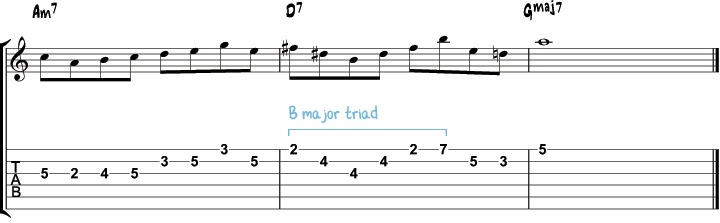
When we analyze what’s going on here, we can see that the line contains a B major triad in the second measure. If you were to rename each note in the triad based on its relationship to the D7, you’d end up with the 13, b9, and 3.
| B major triad |
B |
D# |
F# |
| Played over D7 |
13 |
b9 |
3 |
The reason this ends up working so well is that the B major triad serves two purposes simultaneously:
- It highlights some very tasteful chord tones and tensions.
- More importantly, we’re hearing it exist as a triad occurring separately from the D7 harmony.
Just like any other chord substitution device, it’s very important to have a quick way of accessing the triad while improvising. There are a few ways to memorize this technique:
- You can think of it as a major triad built a minor third below the root of the dominant 7 chord.
- Similarly, you can think of it as a major triad built upon the 13th of the dominant 7 chord.
- Lastly, you can think of it as a major III chord in the key of the ii – V – I.
Another interesting way to access this superimposition is in the following example:
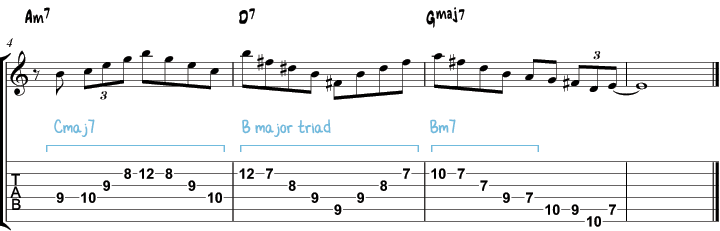
Note: I use the Wes Montgomery fingering for the major 7 chord arpeggio but some may prefer playing the 7th (B natural) on the 1st string at the 7th fret to avoid shifting.
In this line, we start out by playing a C major 7 arpeggio built on the b3rd of the ii chord. This is an upper structure arpeggio that ends up as the b3, 5, b7, and 9, a really nice minor 9th chord sound.
The interesting part of this line is the root movement of the implied chords. We start with a major 7 arpeggio that resolves a half step down into a major triad, which then maintains the same root but changes to a minor 7 arpeggio.
This series of substitutions is really easy to access and ends up highlighting some really nice upper structures and colorful tensions. Work this into your vocabulary by practicing ways to quickly locate the b3rd of the ii chord.



Hi again,
My understanding of jazz is probably such that I shouldn’t assume to be here, but anyway, here’s my question:
In your first example you use Bmaj over D7. But what if the II chord had been the more anticipated IIm? Would the same Bmaj upper structure still apply? I’m guessing so, but I need to check.
Apologies if I have missed the obvious and thank you.
Cheers,
Sean
Hi Sean, do you mean playing B over the Am7 (the IIm of the progression)? Over Am7, the B would produce 9, b5, and 6. The b5 is not really a desirable tone over Am7 and is going to sound off.
Hi Dirk
Glad I apologised in advance for missing the obvious. For some reason I thought the key was C with Am, D7 and Gmaj7 representing the VI, II, V of VI, II, V, I. The absence of I and the maj7 for the G should have stopped me.
Thank you, I grasp your exlanantion regarding Bmaj over Am7. But considering a II, V, I in C where the chords being played are D7, G7 and Cmaj7, would B major played over Dm7, instead of D7, still work? I’m now suspecting that it wouldn’t work because, in relation to Dm7, it would add a 3 to a b3.
Thanks again,
Sean
Hi,
Thanks for that. I do have a question though. In the first table, is “Bm” there just the shorthand for the half diminished, hence F and not F# for the 5th?
Cheers,
Sean
Hi Sean, that’s indeed a typo, should be half-diminished.
Thanks Dirk,
No typos is not credible. 🙂
Cheers,
Sean
Hello Prof, I do appreciate your lesson but still I do not see the sense of it. IOW, I am talking about harmonic rules which I am agree are there just for brake them, but to do it we should start from there. So, you changed D7 to Bmaj (D-F#-A-C to B-D#-F#-A) in a Gmaj key. The intruder in this case is D# which doesn’t belong to Gmaj key. Why (which criteria) did you choose a chord that includes D#? Wouldn’t it be also possible F#m7(5nat) or Am7dim(Gb) or Amaj7dim?
Thank you
Thanks Marceff!
I was doing this lesson and couldn’t understand why the dissonant D# was accepted. It still is not 100% clear to me, but good to see I wasn’t the only one catching the D#
Thanks again.
Marceff,
There’s a sensible explanation for this concept but before I explain it, I think it’s worth mentioning a sort of “golden rule” when it comes to this stuff…if it sounds good, play it. If you like this sound, don’t let any technical nonsense keep you from using it. As for the explanation…you said that I “changed” D7 to B major. Nothing is being changed here at all. This concept wouldn’t work without the rhythm section playing a sting D7 sound. The B major triad being played WITH the D7 is what makes this work.
As for a technical explanation, think of it this way…all I’m doing here is playing a D13b9, which is a sound that I love and notice to be occurring often in the music I listen to. A b9 is a very typical tension to add to a dominant chord and the 13 is just an artistic choice that also sounds nice on a dominant chord. In terms of technical theory talk, that’s all this is…period. I’m just organizing the notes in an interesting way and they happen to spell a major triad. The other arpeggio subs are just an easy way to access a mental map while playing.
Very well explained, Pete!
He Prof. Peter, I would like to thank you for this great lesson. It has given me a new perspective how to approach a II-V-I progression. For me it’s kind of a advanced lesson/knowledge of modal playing or with other words tweaking with scales.
Greetings from Suriname, South-America
Thanks Kevin. The concept/sound may be advanced but the application is simple…those are the best kinds of techniques in my book.
Why does the Bmaj triad (instead of the dominant 5) sound “harmonic” in this 2-5-1 sequence?
Well, I think, because two of the three notes are part of the following key chord Gmaj7!
Plus, the third note (not belonging to the key chord – the d#) resolves to the fifth of the key chord just a half tone below.
So at the bottomline, the Bmaj triad represents a half tone approach to the key.
Fortunately, the d# occurs only for short time as a kind of chromatic note, so it’s disharmonic sound produces this type of “tension” which is acceptable.
Thanks again, I always appeciate your ideas! And step by step my playing can improve a bit.
Best regards, Torsten
Hi Torsten. When I said that the B major retains a harmonic “identity”, I’m talking about the triad itself with no relation to the underlying chords being played. In other words, when we hear B-D#-F# played, we recognize it as something familiar that we’ve heard before and as a listener we can wrap our ears around it. That’s the “identity” that Im referring to…a simple and familiar major triad. What makes this technique so interesting is that something as simple as a basic major triad can serve such a complex purpose with careful placement.
Hello Pete. When you say “…I’m talking about the triad itself with no relation to the underlying chords being played…” B triad (or B7) has too much relation with D7 I would say. Just in the key of Gmaj, B7 is the dominant of the minor relative Em who is the most common substitute of Gmaj7, but to say something else, B7, D7, F7 and Ab7 are substitutes because of the diminished family. I wouldn’t consider B triad over D7 superimposition but it’s true that every triad has strong sound by themself and could sound like two different things at the same time. Hey! try F# triad over D7 going to Gmaj7. Please tell me what you think! Kind regards
David,
We were talking in terms of how a listener responds to the sound of the B major triad. Of course what you said is true…a B major triad can certainly be related to a D (or D7) from an analytical standpoint, but not so much from a listening standpoint. When someone hears the B – D# – F# sequence being played in this line, chances are if you ask them what’s going on there, they’re likely going to identify that sound as a major triad. They wouldn’t say that they’re just hearing the 13th, b9th, and 3rd being played on top of each other. Obviously if you’re a trained improviser and you’re very familiar with this concept, then you can start hearing those notes as just upper structure tensions.
PROF, GRACIAS POR ESTA INFORMACIÓN DE SUPERPOSICIÓN DE ACORDES ELLAS ENRIQUECEN MI MÚSICA SI PUDIERA OBTENER MAS INFORMACIÓN POR MEDIO DE UN MÉTODO SERIO DE SUPERPOSICIÓN DE ACORDES PARA LA IMPROVISACIÓN ME ES MUY ÚTIL, GRACIAS POR LA GENTILEZA DE SU ATENCIÓN A MI PEDIDO,,,,