


-
I'm pretty sure I posted about this pickup back when I made it for my L7 in 2016.
I can't find the thread anywhere. Did the thread disappear?
If someone remembers the thread and can post a link to it that would be great.
-
02-18-2023 04:17 PM

-
Could not find it on Wayback machine. So, will re-post the story.
After making my ES-150 tribute guitar out of a L50, I wanted to do something similar with a larger guitar.
I found a 1948 L7 with a crack and re-fret. A good player guitar.
-
The headstock needed minor repair:
\
-
I collected information about McCarty's Fingerrest Pickup so I could make a replica.
I used the original Patent drawings and photographs from the internet to get the dimensions.
Last edited by icr; 02-19-2023 at 09:27 AM.
-
From internet sources:
The Gibson "finger rest" pickup (better know as the McCarty Pickup) was originally presented at the June 1948 NAMM Convention as a device to electrify an acoustic archtop guitar without compromising it's acoustic tone. It was initially offered as a standard appointment on the L-7. By the time it was pulled from the gibson catalog in 1971, had been available in many variations (cutaway/non-cutaway, single/double, gold/nickel hardware). It was essentially a pickguard with a built-in Gibson pickup, similar to a P-90 but thinner, (or two) that would allow owners of acoustic archtop guitars to amplify their instrument.
-
All the parts to make the pickup were available from common sources. For example the pole pieces were cut down from commonly available Stratocaster pole pieces.
-
The metal pickup case and bobbin were crafted with hand tools.
-
Winding the pickup to a resistance target, rather than a '# of winds' target.
-
The fingerrest or pickguard was made from commonly available laminate, cut and beveled by hand:
-
Like the original, the pots are mounted on top. The knobs are like caps that fit on top of the pots.
-
The underside of the pickguard is routed to fit the bobbin:
-
Wiring the assembly:
Reinforcements added to prevent twisting, similar to the original:
-
Preparing the guitar to accept the pickup:
-
Finished:
-
Very nice work. That's a lot more work than I would be willing to do, I think, but of course I'm not you. Someone has to do the hard work so the rest of us can admire it.

-
-
Nice job.
Oh, same guy...I didn't realize.
You do nice work on everything.
I saw a shutter tester on Youtube, too.
-
This one too...
 Originally Posted by murrayatuptown
1937 Gibson ES-150 Tribute Guitar
-
This is amazing work.
Question: how did you eliminate the buzz? is it grounded somehow?
I have a beautiful 1949 L7 with a Mccarty and the pickup buzzes terribly. Am looking for a solution (ground to the bridge?)
Thanks
Res
-
The usual way to ground an archtop pickup to the strings is through the tailpiece. A ground wire generally runs from the back of the volume pot through the body to the tailpiece, which grounds the strings. Grounding the bridge only works if it's a metal TOM. Wood is an insulator, to a large degree, and won't provide a ground.
-
Right makes sense...gotta touch the strings. So basically a wire running either outside to the tail piece, or through the F Hole to the end pin? Originally Posted by sgosnell
-
I would not consider running a wire outside. If there is an endpin jack already installed, the ground may already be in place. The endpin jack should be grounded to the tailpiece if the ground side of the cable from the volume control to the jack is connected to the jack case. If it isn't, a simple jumper should do the job. It's not hard to check with a multimeter, just check continuity between the strings or tailpiece and the case of the volume pot, which includes the shaft.
-
Indeed, this guitar came to me with an endpin jack already installed. I attached a cable to that which plugs into the pickguard jack through the f-hole. So, it is grounded through the endpin jack to the taipiece/strings.
-
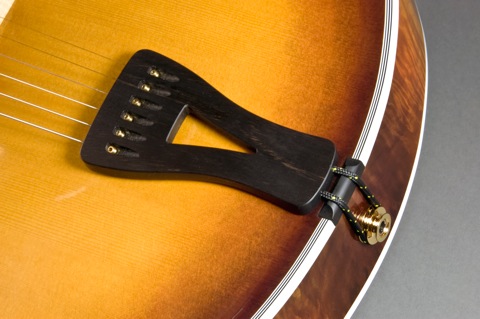
How do you ground the strings on an ebony type tailpiece? Originally Posted by sgosnell
See pic below.

-
That's hard. You can install copper tape under the tailpiece to connect the strings, then another piece of tape or a wire to wherever the connector from the controls goes. I see a white connector, but I don't know where that goes on that guitar. It's not hard to get the strings grounded to themselves, but getting them grounded to the thumbwheel controls may be more difficult, depending on how the wiring is done overall. Where is the output jack installed?


 Reply With Quote


Interesting Acoustic-Electric 7-String
Today, 06:32 PM in Guitar, Amps & Gizmos