


-
That's true of the Reverberocket as well. Rotating the tone control changes both tone and volume.
 Originally Posted by Bill Eisele
I did my comparison fairly quietly. Think coffee shop duo. Adjusted both amps to get what I think of as my sound at about the same volume. I don't recall the settings.
Another factor is placement, tilt and so forth. Others have posted that the LJ is particularly sensitive to positioning because of the ported cabinet. I usually prefer it flat on the floor, so that's the way I positioned it for my comparison. But other players have posted that they like it tilted. It does make a noticeable difference.
But all that said, after adjusting things as best I could to reflect how I play, the two amps didn't sound that much different.
-
03-02-2019 05:53 PM

-
Placement is something I might want to experiment with. I too just keep both amps on the floor just as a matter of convenience. The Rivera is just too big and heavy to move around. And I don’t play through the Little Jazz as much but would be easy to get off the floor or tilt. At least worth a try. Originally Posted by rpjazzguitar
-
I've tried the LJ flat, tilted and two feet or so off the floor. My preference was flat on the floor, but I did my experiments on carpet and I suppose that could change things. I've noticed that some amps produce significantly more bass when on the floor ("coupled to the floor" is a term I've seen) and others don't seem to. The Zeta LB sounded particularly screechy off the floor, but my Crate 12 watt GFX15 practice amp (which is a great sounding amp, when it works) doesn't seem much different off the floor. The LB is closed; the Crate is open back. My JC55, open back, doesn't seem to care either. Originally Posted by Bill Eisele
I don't play archtops, but if I did, I'd probably follow Johnny Smith's advice to put the amp where the headstock is pointing right at it -- meaning the top of the guitar isn't broadside to the soundwaves. That limits position a good deal and the crowded stages I play are not very compliant. So, there's something to be said for an amp that's not that sensitive to position, if there's any way to assess that.
Sorry for the thread hijack.Last edited by rpjazzguitar; 03-02-2019 at 07:31 PM.
-
Hey Bill,
Does your Rivera have a 1/2 power switch on the back? I have the Venus 2 and it has a vintage/modern switch on the back that changes the tone color significantly along with the power output. The vintage low power mode has a thicker tweedier sound for sure. Also, the Rivera tone controls have tons of options -- some serious exploring to do there. I know the Jazz Suprema is geared toward cleans, so you should be able to play with gain, and those funky push-pull knobs for all kinds of fun options and still stay within a jazzy clean territory.
-
Originally Posted by rpjazzguitar
Well, there was the fountain of sound and the photo in the "Johnny Smith's Amps" thread which shows his non-FOS amp also laying on its back.
-
Originally Posted by Bill Eisele
Tweeds are very different from Blackface amps - they don't have a midrange scoop. In fact, the tweed Bassman is what Jim Marshall was trying to "clone" using available British tubes of the time when he was making his first amps. Tweeds will have grit when driven hard, but will have a nice and full tone when set clean. I don't really care for Blackface amps, but the Tweed and Brownface amps are fantastic in my opinion.
-
Action Man! That was quick. Originally Posted by Bill Eisele
The JBL D140 is a bass speaker, not a wide range speaker. That may work for you - I guess you'll decide that one for yourself. Some useful info about the JBL D130F and D140 speakers, from a few places:
The D130F was designed as a guitar speaker. The cone is smooth, lighter than that of the D140, and it has a higher resonance frequency (Fs). It also has a higher sensitivity, and an extended high frequency response. It has an aluminum voice coil.
The D140 was designed as a bass speaker. It has the concentric rings around the cone, which stiffen it, make it heavier, and supposedly help control breakup, so that the polar response (dispersion) is better in its upper range. It has a lower Fs, giving it a more extended low frequency response, and lower sensitivity overall, due mainly to the heavier cone. It has a copper voice coil.
The frames and magnet structures are the same, so they can be reconed from one to the other (I wouldn't do this - I'd simply sell one to get the other).
Sensitivity for the K130 is 103dB/1w/1m, swept from 500-2500Hz.
Frequency range for the D130F is 50-6000Hz.
Sensitivity for the K140 is 98dB.
Frequency range for the D140 is 40Hz to 2k5Hz.Last edited by Hammertone; 03-03-2019 at 03:06 AM.
-
Not a problem with the thread hijack. All useful information. I wonder if if what you’re hearing with some amps has to do with the Allison Effect: Speaker Setup -- Minimizing the Allison Effect — JansZen Blog. Basically how sound waves in the bass region combine constructively and destructively dependent on the distance from the woofer to reflective surfaces, primarily the boundaries of the room. Originally Posted by rpjazzguitar
And, good advice from Johnny Smith. I’ve been caught trying to get a better sense of how a guitar sounds through an amp by pointing the speaker end of the amp towards me. Almost instantly, the amp starts to howl with feedback. Not a good sound!
-
I didn’t think there was such a switch but just checked again and there isn’t a 1/2 power switch. Sounds like it would be very useful. Yes, there is a “fat” push-pull switch and notch filter to reduce feedback. I typically have the fat switch engaged. And, the gain control is somewhat useful to add a little “dirt” to the tone, but it still generally stays in the clean territory. There is a lot to play with. I am somewhat confounded by the presence and focus controls, and tend to fiddle with those, particularly when plugging in a guitar that I haven’t played in a while. Originally Posted by Longways to Go
-
I think I’ve seen that photo. I might try it with the Ampeg M-15 when it arrives! Originally Posted by Cunamara
-
Thanks for the clarification! I didn’t know that. Perhaps an early Fender tweed clone is in my future. Collecting amps might be as much fun as collecting guitars. But they usually take up more room so they’re harder to hide! Originally Posted by SandChannel
-
Perhaps, I moved a little too quickly, Hammertone! I realized that the D140 was a bass speaker only after doing a little research post purchase. Thanks for the information on the differences between the two speakers. Originally Posted by Hammertone
I guess I’ll figure it out once the amp arrives. I’m with you on not attempting a recone. I did check online and D130 speakers are available at a variety of price points. More D130s available than D140s, but around the same price point so it would be essentially an even trade. I’m wondering if a Jensen P15N AlNiCo would be a reasonable substitute for a D130 tonally and size wise. The Weber AlNiCo California 15 appears to be a direct substitute for the D130.
-
Again, the D-140 may very well work great. If not, it should be easy enough to sell.
Yes, the The Weber AlNiCo California 15 appears to be a direct substitute for the D130F.
Also, there are differences between the D-130 (hi-fi speaker that can be used for guitar) and the D-130F (modified from the D130 specifically for guitar).
I use the later JBL K-130, which has the same AlNiCo motor, but is painted black with updated graphics. These are essentially the same thing, but fly under the vintage radar, because they are not painted grey.
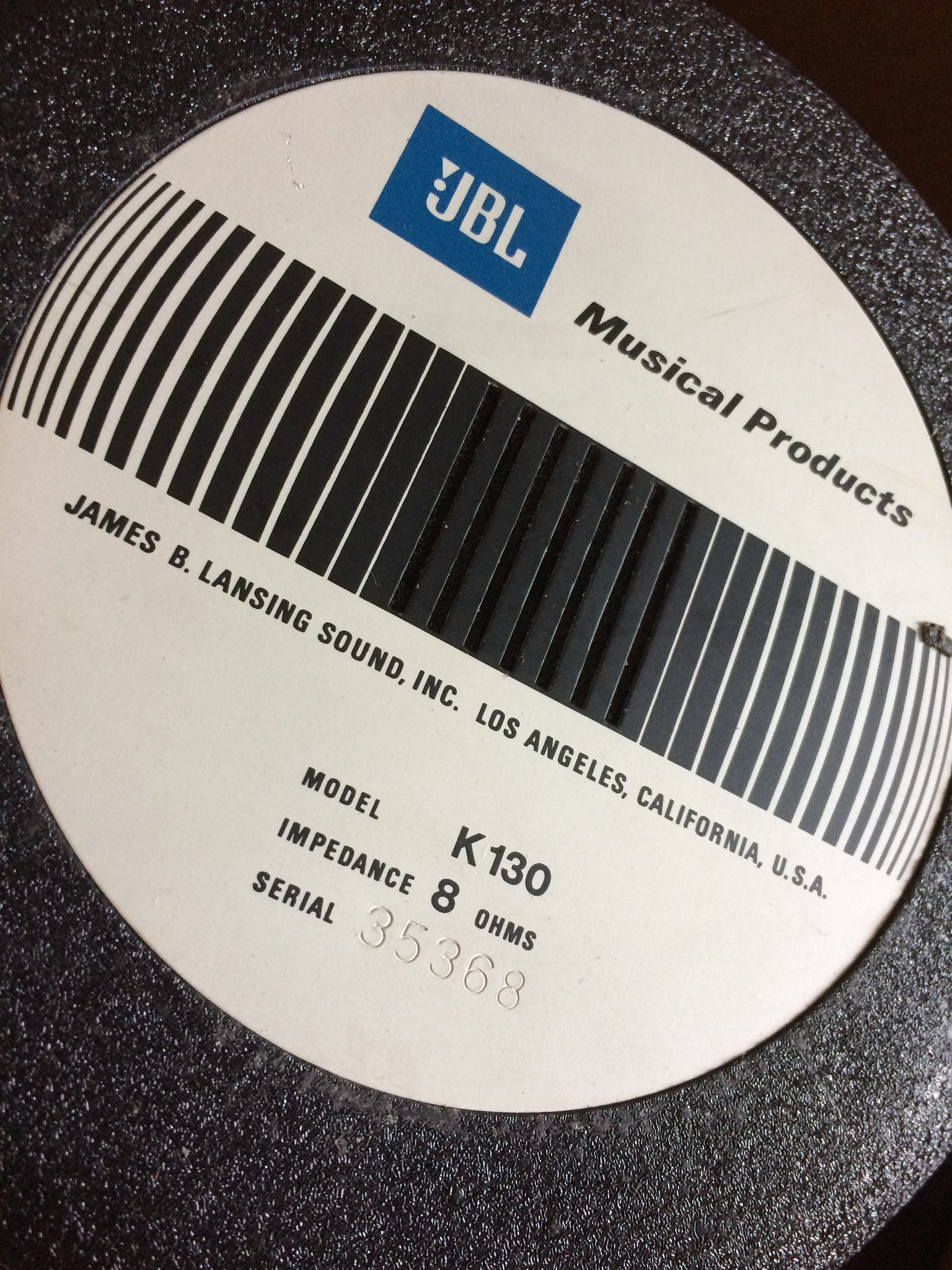
Last edited by Hammertone; 03-03-2019 at 01:58 PM.
-
Talking Ampeg, I'd love to have a Gemini I. It's 60s, and 7159 tubes, but still. A whole lot of great jazz was played on that amp. (Didn't Rudy Van Gelder have one in his Englewood NJ studio?)
The M12 and M15 are also worthy choices. For octal preamp and 6v6 power, I've yet to find anything better than the '58 Gibson GA40 I had. Traded it before getting into archtops and jazz, so I cannot comment on those sounds. Too bad, as that amp had the fattest, most beautiiful clean sound at lower volumes. They're famous for louder, overdriven sounds ... to me it sounded best clean.
If you're going to consider tweed: Put Jim at L'il Dawg amps on the list. This guy has something going on. My Dlux 1x15 from him is one of the two or three best or the many tweed amps I've played or owned.
-
Originally Posted by Hammertone
Yes, it seems that the D140F should work just fine. Many guitarists like playing through the Fender Tweed Bassman, so hopefully this should be similar. And, if not, it should be easy to sell as they seem to be scarce. And, thanks for the information regarding the differences between the D130 and D130F, and using the K130 as a substitute. I’ll report in when the amp arrives. Hopefully by the end of this week.
-
Ampeg is definitely one of the sweet spots for that 50s and 60s jazz tone. I wish I had clued into it earlier on. And, I had my eye on the Gemini I. I think I read somewhere that RVG did have one in his studio. Originally Posted by mad dog
And, I had my eye on those post-war Gibson octal amps as well. I have a friend who has a BR-6 and it definitely has the tone. I’m wondering if these Ampeg and Gibson amps are going to be as coveted as the Fender tweed amps at some point? With a price to match. Here’s an interesting article on the GA-40: Vintage Bench Test: 1956 Gibson GA-40 - Signature Sounds.
Thanks for the reference to L’il Dawg amps. I will put him on the list. As I said previously though, it’s easier to hide guitars than amps in the house! So, not sure how many amps I can have at any one time. Right now, I’m under a one guitar in one guitar out rule!
-
No. Originally Posted by Bill Eisele
-
Perhaps because not favored by the R&R crowd? Originally Posted by Hammertone
-
The old Ampegs typically sell for under $1000, apparently. You have to pay a lot more for a new boutique amp of roughly the same power. But, the newer amps typically have three pots for EQ, whereas some of the Ampegs just have one. That may limit their usefulness for some people. And, some players may prefer the Fender sound (not that there's only one Fender sound). But, maybe not that many people have played through an old Ampeg. Originally Posted by Hammertone
For pure value, I'd rather pay around $600 for a vintage Reverberocket, Jet or Gemini than upwards of $2000 for a new Fender type. Even if you have to do the cap job and install the three prong plug (although many have already had those mods), it's a lot cheaper for a great amp.
-
Originally Posted by Bill Eisele
To me, favoring something over another thing is about trying both and choosing one over the other. Not what's happened here. They simply don't know about them. They don't know what a Baxandall tone circuit is. And they are not that interested. No big deal. The rest of us can continue to enjoy them. Every once in awhile someone will discover them and be happy. It is what it is. Originally Posted by rpjazzguitar
-
All true, Hammertone! Originally Posted by Hammertone
-
Hammertone is, alas, prophetic, here. Ampeg and Gibson amps are likely never to be as coveted as Fender amps.
Reason: they were designed for jazz/pop music. Fender designed for country/pop/rock music. MUCH larger markets.
That said, the M12, M15, G12, G15 amps were/are terrific jazz machines.
-
I have a 1966 Ampeg Gemini II and I like it as much as my 1962 Fender Pro, both with Altec speakers. I paid $500.00 for the Ampeg and $1800.00 for the Fender. I love them both but one was a much better deal. These two amps are the last one I would let go, each with it's own sound..
Thanks john
-
However, on the flip side, there are a couple of Ampeg models that are right in there. IMO, the Ampeg B-15N is one that vintage collectors have warmed up to in the past few years. It figures prominently enough in pop music history, increasingly apotheosized and popularized by all the rose-tinted documentaries about the great studio bands behind the hits (The Wrecking Crew, the Funk Brothers, Muscle Shoals, etc.). Every studio had/has a Portaflex. And they are wonderful amps. But it's essentially a '60s amp, not a '50s amp. Originally Posted by Greentone
Ampeg hit another home run in the 1970s with the SVT - which ticks off all the boxes for foggy rock nostalgia. Old SVTs are worth big collector dough, as are middle-aged and new ones. They were and are used everywhere, by everyone.Last edited by Hammertone; 03-05-2019 at 10:07 PM.
-
It sounds like you have your bases covered, amp-wise! I’m looking forward to the Ampeg M-15 arriving this Friday. It will be interesting to compare to my Rivera Jazz Suprema. I’ll report in as to what I think about the Ampeg by itself and the comparison. Originally Posted by powerwagonjohn


 Reply With Quote


Interesting Acoustic-Electric 7-String
Yesterday, 06:32 PM in Guitar, Amps & Gizmos