


-
Niels, I like your overthinking of the tuners' positioning in relation to the Glassl headstock above ...
Well, if you really want to get to know why the Glassl workshop put these 3-on-plate tuning machines in such a way - or for that matter anything else looking and/or sounding funny on a guitar -, I can give you a hint: just put yourself in the shoes of the guitar maker at that time, analyze his/her working options and alternatives. If this would be difficult for you, I could offer my help and extend on this.
Still too much confusion about Hopf top-end archtops. Glassl built in his tiny workshop the following better archtop guitar models for the Hopf company:
- Hopf 320L (body width ca. 450mm, at least two binding reinforcements or "side-bumpers" around the sides, fully carved, split-soundholes, flat or Maccaferri-style cutaway, blonde or red-sunburst, Lang-style rhomboid or block- or lance-/Höfner-style MOP inlays. When Arthur Lang had stopped making his big-body, flat-cutaway "Super" guitars around 1955/56, he allowed Glassl to make own guitars with those characteristic features. The Glassl 320L are not just copies of Lang's early Supers, Glassl added some own ideas. 320L models can have top thicknesses of over 10mm and are still, perhaps precisely because of this, acoustic archtop guitar powerhouses. Nothing like a sad "silent wonder" or anything similar. If you don't believe it, you should try out a 320L. In my opinion the best of all Glassls)
- Hopf 320SL (characteristic body shape, size around 440 to 445mm, two side-bumpers, fully carved, cateye-soundholes, Venetian cutaway, most often block MOP inlays. These were the most expensive archtop guitars in the Hopf catalog)
- Hopf 319SL (characteristic body shape, size, soundholes and cutaway like the 320SL above. Carved spruce top, laminated maple back. Rosewood fretboard with bar perloid inlays. Usually one sidebumper. Often called the "Bill Haley model" because Hopf designated a 319SL model fitted with a DeArmond 1000 to Bill)
- Hopf 319S (a more conventionally shaped smaller body, once again: Venetian cutaway, cateye-soundholes, rosewood fretboard with bar perloid inlays. Can have a side-bumper or not. The spruce top can be carved, solid-pressed or laminated; the maple back is laminated. These were the Hopf/Glassl workhorses: made from fine tonewoods and by masterhands, durable and well playable with a modern feeling. In my opinion among the best German archtop guitars of the 1950s/60s for the price. I agree with Hammertone that the fully carved A. Hoyer "Solist" is still the best bang_for_the_buck for players, though, personally, I'd always prefer a carved-top 319S)
- Hopf Special and Special de luxe (These can differ significantly, not only in binding and purfling. Usually, these do not show the big-bodies of the 320L, 320SL and 319SL)
Of course, Gustav Glassl made also models under his own trademark "GG", plus models that were not labeled at all. Marketing and selling was clearly not his main motivation.
If available at the time in the Glassl workshop, these guitars got maple-pearwood neck blanks supplied by Kollitz; Lang added the steel square-tube-reinforcements. If not abused later by some rock guitar afficionado ... or kept in an overly dry atmosphere for decades, these necks stay straight. Acoustically, I'd prefer these to any later neck reinforcements, perhaps comparable to prewar Martins. In my own observation, Glassl increasingly used adjustable trussrods around and after 1963, when the US gear influence got stronger. In contrast to Artur Lang, and other brands like Soli, Astro, Klira etc., Glassl favored a scale length of 640mm.
The most distinctive mark of any archtop guitar is the body shape and size.
All Glassl-made Hopf 319S that I've come across measure a lower bout width of 415mm, plus/minus 2mm. Please, use a large caliper for precision... So, it is doubtful that, for example, a guitar with a lower bout width of 410mm was made in the Glassl workshop. Exceptions may prove the rule.
Kield Andersson, alias Lacquercracks, has listed some identification tips on Glassl-made guitars on his website, as had been collected on the then hot and thriving, now long-gone European Guitars Forum: West Germany – Lacquercracks (scroll down). This list certainly doesn't claim to be exhaustive. There are a few more points to mention regarding Glassl archtops. Nevertheless, this list can be useful for novices.
Glassl, a former student of Franz Hirsch, IMHO, was a skilled master box or body maker and one of the most colorful German luthiers. He made hundreds, probably far more than one thousand archtops, most of which he referred to as simple utility or commodity guitars ("Gebrauchsgitarren"). However, it is recorded, almost as a testament to his great affinity for fine archtop guitars, that before his death he decided to take one of his last great top-end models with him to the grave.
Btw., if something like a Hopf 320S ever existed, please show some pics (and dimensions) - unless the S stands for one of the above mentioned Special models, early custom makes ... or simply Glassl's chameleons.Last edited by Ol' Fret; 05-06-2026 at 12:06 PM.
-
05-06-2026 11:47 AM

-
Ol' Fret, Thanks again for taking your time to respond. Will send you a pm about the tuning machine strips.
My mistake Ol' Fret, sorry. I was referring to this Hopf on Oscars guitars. Originally Posted by Ol' Fret
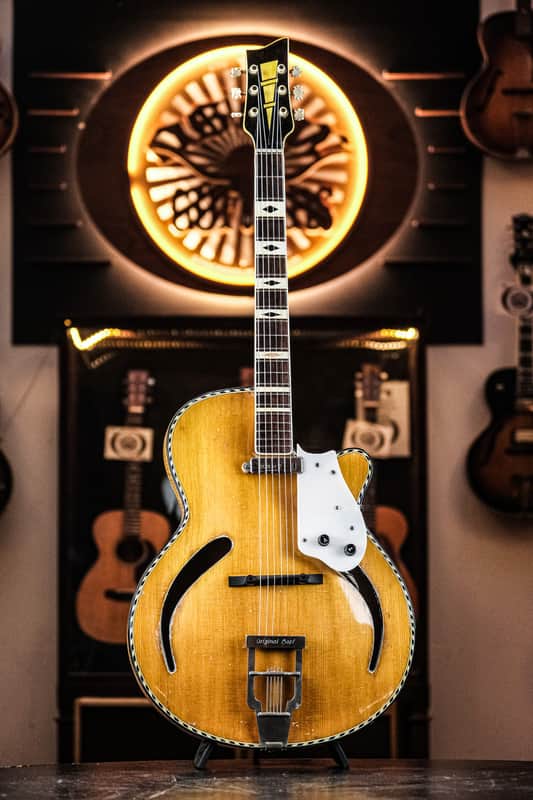
1960s Hopf Model 320S Spezial Deluxe natural
In one of the pictures the sound hole binding that matches mine can be seen:
Last edited by niels; 05-07-2026 at 03:32 AM.
-
Hopf Model 320S
Same guitar is on Reverb.
The Marketplace for Musicians | Reverb.com
-
@ niels:
Sorry, I don't think I have my pm-system activated here since several years now! If you have a specific question about these old RoKo (Robert Kolb) tuner strips, please post here. Maybe it would be best to post one or two thoughts about the positioning of such strips on the headstock, just for a general understanding how Glassl - and others - had to deal with that tuner design with regard to the circumstances at the time. I had started my last post on this, but got interrupted, and this system just ate my gab, perhaps with wise foresight ... let's see today or tomorrow if I'm not too lazy again to cache some lines on this.
@niels and GuyBoden:
Yeah, I've seen the pics of that Glassl made Hopf, offered as a 320S Spezial Deluxe.
You have to consider that neither Glassl nor Artur Lang did care about model names or numbers; both were luthiers whole-hearted. It were the distributors, mainly Alosa/Bubenreuth, later Hopf for Glassl; for Artur Lang it was Alosa, Schmidt/Frankfurt, Zöphel/Aschaffenburg, Klier/Munich, Barth/Stuttgart, and some more, who more or less schematically tried to give the children a marketable name.
Most of Lang's numerous models had recently to be redefined and given new names or abbreviations, as you can see here: Artur Lang Gitarren – Herbert Rittinger . That's much more precise than my inconvenient description of some Hopf/Glassl archtops above. And yet, it's still not too easy for us to differentiate, for example, a Lang model HMS1 from a HML1. The discussion is still open.
Other brands like Arnold Hoyer, used an own, though really bedlam register to designate their guitar models. Often, they used the same name or designation for really different models, just in different periods. That's why it's so difficult to straighten out German vintage guitars. I don't see it being a personal bug, it's just a necessity, and I'm aware that US guitarists can only shake their heads at this whim. Well, everyone knows pretty much exactly what is meant when a 1958 L-5CES is mentioned. The German guitar world is different, more complex, though not inferior.
Back to Glassl:
In the mid and late 1950s, when Hopf resorted to Glassl made guitars for their top-end archtop guitars, that line wasn't as straight as was in the next decade. Glassl lived his wonderful chameleon-like nature to the fullest, and Hopf didn't care much. Glassl had developed the Arnold Hoyer carved models "Solist" and the big "Special" during his stay at Hoyer from 1946 and about 1951. When Glassl started his own workshop in the neighbourhood of Hoyer, he refined his babies, to a small extent under his own name, but much more for the Alosa company. The derived, corresponding models he made for Willy Hopf were the smaller Hopf 319S (lower bout 415mm plus/minus 2mm) and the large-body 319SL/320SL. Nobody really knows what the S (Super or Spezial?) and L (Luxus, Deluxe, Large?) means. 320L (Luxus, Deluxe, Large, Lang?). Hopf was the name giver, Glassl didn't care much, if at all.
Even if the above pictured Hopf 320S Spezial Deluxe, at Oscar Guitars, would show such a Hopf-label inside (does it?), I'd see it much more in line with the regular 319S models. The given lower bout of 420mm (measured how precisely?) proves to me it is rather a 319S model, as does the shape of the body. What I said above: The Spezial models, especially of the 1950s, do not fall in the regular later Hopf model category. Often though, these are regular 319S models with more bling, like here with the binding of the higher 319SL/320SL models, or more fancy fretboard inlays, etc. For the Hopf company, to be sure, it was more lucrative to offer such guitars as 320 models.
Btw., this 320S, or whatever it may be designated, looks like it had spent some decades in the Death Valley, in addition to some celluloid outgassing, in my experience not often seen on Glassl guitars, except for some of his black string spacers ... I don't mind at all a good player guitar, but this one would probably no longer meet my expectations.Last edited by Ol' Fret; 05-07-2026 at 03:16 PM.
-
Just adding some info on the assumedly Tellson guitar.
Took another look inside with this nice endoscope toy, looking for clues. Found this pencil marking by the heel.
Is that 11?
Could this guitar be a Tellson 11 variety?
-
Posted elsewhere, but here’s a good spot as well. One of Glassl’s guitars for Hopf.
...and a super-clean Hopf 319SL for sale on this very forum by Mr. Atomic himself.
Last edited by Hammertone; 05-18-2026 at 04:08 AM.
-
Originally Posted by niels
I don't know, but you might be on to something here!Last edited by Ol' Fret; 05-11-2026 at 11:34 AM.
-
Glassl-made Hopf 320L on the left, Lang Super on the right. The Glassl measures exactly 450mm at the lower bout.
I hope you can see on the pic that the carving is a bit different as well, though both instruments, "the original" and its sanctioned homage, in combination with careful longitudinal bracing, don't need amplification for playing at home, in intimate settings or in a traditional big band.
Both guitars were made in the late 1960s, around a time when D'Aquisto was still making archtops in the D'Angelico style.
-
Two lovely guitars!
-
The Forum is so crowded by "visitors" that my post yesterday never made it. I've always been fascinated by the German archtop tradition. I admire the experts who keep this very long and winding thread alive and interesting. My interest in jazz guitars stems from the early 1960s, when one would have expected to see German archtops in action in Finland. After all, in those days very few Finns could access Gibson, let alone afford one. Yet, Levin seemed to be the second best, by a margin. On entry level, you had the Finnish makers Landola and Noso. I did buy a Höfner in 1963 - can't remember the model name, and they were all different anyway. In hindsight, a looker rather than player. The famous fretboard flaw above 13th fret they had of years. But what did I know back then?
Last Saturday I visited the Tonefest Gallery near Helsinki: a fast-growing vintage guitar and gear shop shipping worldwide. They recently sold a Dumble amp head for a six-digit figure to a US collector. Lo and behold, several old German archtops! All different, all basic to midrange but with great looks nevertheless. On closer inspection, all had major issues: warped pickguards, missing bindings, bent necks, no truss rod, badly cracked finish etc. If this is what has survived in the hands of collectors, one is entitled to question the quality of materials, components, glues and finishes available to German luthiers back then. How about their approach to lasting quality? I confess I haven't read all the posts, so what I'm saying may be repetitious, contradictory or nonsense altogether.Last edited by Gitterbug; 05-13-2026 at 05:29 AM.
-
Gitterbug, I have to admit that, for one second, I’ve been tempted to doubt your observations and respond strictly with a short phrase of denial and dead-end argument so typical for many forums’ today, like: “No, that’s not the case - not possible!“
Then I went on to consider that such a reply might potentially put you, and a few others, in a state of cognitive dissonance - a state for which I would be responsible.
More seriously, thinking about all the possible and impossible issues to be found on basic (i.e., usually laminated construction) to mid-range vintage German archtop guitars (the smaller part of better-made laminated guitars and many solid pressed top instruments) - I can really see your point!
Personally, I would prefer to discuss or showcase vintage German archtop guitars made by master hands. Not necessarily collector grade, but good players’ guitars. A factory-made, mass-produced archtop bearing the label or stylistic hallmarks of brands like Hopf, Framus, Klira, Soli, Astro, Fasan, and others, has little in common, apart from the identical brand name, with a master-grade guitar.
The listed brands exported basic and mid-range archtops in bulk, and not all of them had these products made in their own workshops. The master guitars are much harder to find abroad, at least those preserved in good or very good condition. We know that some Hopf-Glassls were exported, or some GI’s had purchased such an instrument, say a Lang, during his military stay in Garmisch. Roger sent some guitars to Boosey & Hawkes in England around the late 1950s and early 1960s. Arnold Hoyer made some archtops exclusively for export. For example, some of their big Special or Special SE models were laminated, not carved like for the domestic market. Not bad guitars, just different.
Overall, higher-grade German guitars were not frequently exported. One reason was that the slightly larger German companies didn’t have access to the US market. Even Wenzel Rossmeisl, while his son was working for US guitar companies, had failed to find a suitable importer for the US (keyword: Michael Danzi). Arnold Hoyer didn’t even try. And small master workshops, like Lang or Glassl, didn’t care at all about exporting. The second reason is self-evident: like in Scandinavia and England at that time, it were US models that were highly coveted and searched for by musicians. After all, no one wanted to be seen playing products made by a defeated wartime adversary, like Germany, no matter how good and comparably inexpensive their products had been. Due to the poor financial situation in post-war Europe and other barriers, like the fixed exchange rate between the dollar and the Deutschmark, US guitars remained widely unaffordable in Germany until around the mid 1960s, 20 years after the war. To this day, little has changed regarding such general assessment. Economic researchers consistently report that, worldwide, products are purchased only partly on the basis of their quality and pricing - at least half of the decision is strictly driven by the image attributed to them.
To answer some of your points without having to write pages for pages, I’ve decided to just give one more general outline in the hope for a better overall understanding – and sorry, if that got long-winding! Loose thoughts may touch one or two aspects of the questions asked above, while some other may not. The whole story, IMHO, must better be viewed and understood in historical context.
Well, I really don’t expect anyone to read the following through in its entirety ...
Now some could chime in to argue that the known Hofner top-end archtops, like the "Committee" models of the 1950s and '60s are ignored. They look extravagant and unique, and the one or other British or former Commonwealth eye, ear and fingers may be used to these guitars, but, for my part, it’s not sure if these should count to the group of top-end archtops. For instance, almost all of these Committees require a neck reset. Dieter Hopf—Willy Hopf’s son, who was in charge of guitar production at the time at Hopf, to become later a reputable maker of classical guitars—was sent to Selmer London. His primary duty there, by his own admission, was the performing neck resets on Hofner guitars in the 1960s. While Hofner improved their neck joints, we can identify a fundamental problem, perhaps an all-too-human one, regarding vintage German archtops: they are typically more judged by their appearance rather than their build quality or tonal characteristics or playability or affordability.
How do they say: you get what you pay for? Ha, that statement went down with the end of the 20th century! The former perception will have to be corrected in the foreseeable future—especially as the mystique, respective the marketing success of certain brands has started to dwindle down. It’s just that not everyone has noticed it yet - or refuses to notice.
Post-war German master-built archtops are, in almost every respect, on par with their American counterparts—they simply lack presence in the public consciousness, and they could be hard to find. I know, some here will think this to be a bold statement - but it can easily be put on the test in reality.
The wood used in these German master-built archtops, at the time, has to be considered one of the best available globally. Tonholz Fuchs in Mittenwald was one of the largest tonewood dealers in the world, supplying wood for all kinds of stringed instruments. Their local successor is still in business today—as is the old Italian block band saw monster—and it is no secret where the vast quantities of tonewood come from that Chinese manufacturers now process into instruments of increasingly respectable quality. Tonholz-Kollitz also remains in operation, as do a handful of smaller, equally discerning suppliers. Alpine spruce was—and remains—one of the most sought-after material for high-quality archtop soundboards; indeed, even D’Aquisto relied predominantly on this very material.
In the German master-built archtops of the 1950s and 60s, the wood was joined using hide glue—a practice that had remained unchanged for centuries, just as it has among violin makers. While modern adhesives certainly have their legitimate applications, hide glue remains the fundamental standard.
The quality of the hardware found on West German guitars varied considerably. Manufacturers such as RoKo (specifically their higher-end product lines), ABM, and Schaller enjoyed fine reputations at the time. However, luthiers like Lang and Glassl did not start using Schaller tuning machines into their instruments until the latter half of the 1960s.
In the GDR (East Germany), the disparities in hardware quality were truly striking. Here, the state—or rather, the production cooperative—dictated exactly which items were to be supplied and in what quantities. Nevertheless, one can occasionally encounter very high-quality and durable tuning machines even there—particularly on instruments by small workshop master luthiers, such as Heinz Seifert or Herbert Todt—for instance, the Weißgerber tuners manufactured by the Rubner company in Markneukirchen. This company is still in operation today, although ownership has since changed hands.
Magnetic pickups: in this field, the Americans always held the lead. While the Federal Republic of Germany did boast a number of respectable manufacturers—such as Fuma/Ideal, Schaller, Star, Pix, Höfner, Hoyer, and Framus (home to Willi Stich, alias Billy Lorento, whose work in the USA paved the way for future manufacturers like Kent Armstrong)—it simply lacked the likes of a DeArmond or a Gibson PAF.
In the West, German archtop guitars were finished using nitrocellulose lacquer—the industry standard of the era. The suppliers were wholesale distributors within the trade. The chemical paint and coatings industry had already established an excellent reputation prior to World War II—one need only to think of companies like BASF.
Naturally, the actual application of these lacquers was left to the discretion of the individual guitar companies and manufacturers, resulting in significant variations in quality. For instance, HR reports the following regarding the finishing process at Artur Lang (translated from his website):
Crazing in the Lacquer Finish
This phenomenon frequently occurs in conjunction with NC (nitrocellulose) lacquers and stems from various causes:
•Tensions within the wood resulting from volumetric changes caused by shrinkage or changes in atmospheric humidity.
•Tensions within the lacquer layer caused by the evaporation of solvents.
• Hardening of plasticizers due to weathering and exposure to UV radiation.
These factors result in the mechanical strength and elasticity of the coating layer being exceeded, leading to the formation of cracks in the finish. Such cracks pose a particular threat to the tonewood itself. Through the diffusion of moisture, dirt, and atmospheric gases, dark discolorations form within the wood that are subsequently impossible to remove.
Beyond the inherent material properties of a coating, its optimal application is of immense importance. The tensions within the lacquer layer—generated by solvent evaporation—can be drastically reduced by applying multiple thin coats and ensuring adequate drying times between applications. However, achieving this optimal layer thickness typically necessitates sanding by hand.
In instances where crazing has occurred, the application process was, in most cases, suboptimal.
Artur Lang was well aware of this issue; consequently, this phenomenon occurs only very rarely on his instruments.
Thanks to the sparing application of numerous lacquer coats—followed by hand-sanding—the finish on these master-grade instruments (a feature crucial to their acoustic tone) stands at least on par with that of their American counterparts. This holds true regarding both the aging characteristics and the overall durability of the lacquers.
In the former GDR, however—much like the situation regarding hardware described earlier—one encounters a mixed picture concerning lacquer quality. Many guitar makers of that era—drawing upon their backgrounds in violin making—formulated and used their own custom lacquers, as they found themselves unable to work effectively with the industrially standardized materials then available. Consequently, the spectrum of quality is vast: one can find everything from relatively dull, matte, and often uniformly brownish finishes to work of the very highest caliber. For instance, some guitars by Herbert Todt display an incredibly brilliant luster—this, combined with a sunburst finish that appears remarkably natural and understated. It could be described as a kind of "wood glow" reminiscent of the varnishes used by the old violin-making masters, yet entirely free of that "plasticized" surface look unfortunately so common today.
I have, at least on occasion, previously expounded upon the design characteristics of Germany’s high-end vintage archtop guitars. This encompasses not only the carving (see also the entry on Carving and Recurve), but also such details as top thickness, bracing patterns, and the rationale behind using one-piece neck blanks (i.e., lacking that additional, glued-on neck extension over the body)—a method that, while more costly, has to be considered superior. It was illustrated why Lang, right up until the late1960s, refused to build necks with a pronounced taper (when viewed from above), or why he regarded adjustable truss rods to be acoustically inferior (see the entry on "Euler").
Some archtops derive their appeal from an extraordinary aesthetic—such as the Hüttl "Opus 59" or the early Musima Record 15. With a proper setup, these instruments, more or less the flagship models of their manufacturers, play remarkably well; they were crafted by trained folks, albeit sometimes with varying degrees of carelessness. Nevertheless, I would not classify such guitars as belonging to the German "upper class" archtops, but rather as mid-range instruments with exotic looks and characteristics—in any case, as handsome collector's items. Tonewise, these can be nice, though nothing extraordinary to expect.
Durability is certainly not a big issue with higher-grade German archtops, compared to instruments made in other parts of the world. However—as is the case with all wooden string instruments—they do require occasional attention and maintenance from a skilled person. And herein lies another significant challenge: Germany experienced a veritable guitar boom during the 1950s and 60s. In the wake of the wartime catastrophe, a great many young people were eager to listen and live to—and play—the "cool" music of the era’s victors, namely Jazz and Rock ’n’ Roll. A phenomenon that once again highlights the importance of political "soft power".
The guitar makers from Schönbach—who had been displaced to various centers across West Germany (primarily in the Erlangen and Frankfurt regions, with a few settling elsewhere)—were able, thanks to their pre-war experience, success and established division of labor, to meet this demand for guitars across all quality tiers with astonishing speed. Furthermore, new companies such as FRAMUS emerged, boasting immense production capacities. While the factory-produced instruments from such firms can certainly sound amazingly good, the pre-war fact is still holding true: the vast majority were mass-produced items, with only a select few guitars truly emerging from the hands of master craftsmen.
-
I can see one theoretical issue the German master archtop guitar makers had to face in the 1950/60s. Unlike in the USA, the number of professional jazz guitarists has always been rare here. Guitar makers could benefit from any feedback, positive or negative, by the players of their guitars. No problem for Artur Lang; his players usually visited his one-man workshop personally to pick up their guitars after the waiting time. Not much of a problem for Glassl as well because, being a talented box maker anyway, he got most neck blanks for top-end archtops from Lang. Arnold Hoyer must have learnt a lot at his former neighbour, Franz Hirsch, back then, and Arnold’s employees had probably been sufficiently trained by Hirsch student Glassl working for Arnold for a couple of years right after the war. The Roger company had always been a special case in every respect. Wenzel closely networked within Berlin’s music, UFA-cinema and party scenes as a professional musician and certainly got enough feedback on his guitar manufacturing during roughly 30 years.
Two further problems regarding the condition of vintage German archtops have emerged over time. With the advent of rock music, and undoubtedly enhanced by increasing job and family responsibilities of guitar players and owners, as well as a strengthening economy—many of the younger original owners, often semi-pro players of such guitars, lost time and/or interest in playing after a few years. In case they went on playing their hollowbodies, some pimped them up in an attempt to remain competitive in newer, more trendy and louder music genres.
Just one example on this: some disgruntled previous owner had drilled or gouged out eight holes of each ca. 15mm diameter into the top and sides of one of my Lang guitars. Pots and pickups were the order of the day—the more, the merrier! The beautiful ABM tailpiece had been ripped out unceremoniously, and a tremolo unit was slapped onto the top. The instrument must have received absolutely no or unprofessional maintenance. At some point, it likely vanished for decades into its old hardshell case—with the strings still under full tension—stashed away either in an uninsulated attic or in a damp basement or both. No wooden instrument can withstand such cruel conditions indefinitely without getting harmed. Consequently—despite Lang’s sturdy metal reinforcement—this guitar exhibited a bowed neck. The reason for this is typically a failure of the stabilizing bond between the fretboard and neck, and/or a failure in the former continuous, full-length adhesion of the internal reinforcement. While such malpractices happened more often than we would like, the former instrument’s builder cannot be held responsible for any loss of quality.
In Germany—both historically and, at least partially, to this very day—there has been a distinct lack of appreciation for the fact that such master-made instruments represent not merely expressions of superb craftsmanship, but have also evolved into a form of cultural heritage.
Consequently, even high-quality guitars sometimes endure a long, sorrowful existence under deplorable conditions, with, for example, grandchildren playing with them in their treehouses, until exasperated heirs and owners finally decide to dump them on to the open market.
Unlike in Anglophone countries, not a single museum foundation or players’ circle can be found in Germany, dedicated to the preservation or performance of vintage archtop guitars. The few private institutions known to me either refuse to accept archtop guitars as a matter of principle—claiming that "this would unsettle our sensitive classical audience"—or simply show no interest at all:
In Markneukirchen—a region where the majority of handcrafted "master-grade" guitars from the GDR era were produced—the local Museum of Musical Instruments is displaying exactly *one* single archtop guitar: a violin guitar by Willy Herold, presumably intended as a modest Saxon counterpoint to the Beatles ’Hofner" era. As is openly admitted, the museum’s cellars are overflowing with beautiful and rare archtops... just there is no intern or scientific or public appreciation at all.
In the idyllic town of Mittenwald in the Karwendel Alps—which is overrun by international tourists during the summer months—there is zero interest in such instruments as well; the fact that Wenzel Rossmeisl crafted roughly thousand guitars there is completely ignored.
In Bubenreuth, well, they could indeed accept rare guitars as donations, especially celebrity guitars. One cannot, however, resist the impression that such instruments serve primarily to do nothing more than glorify the past prowess of the local area matadors, or to pry loose more additional EU subsidy funds intended for regional development and integration. Whether such an instrument actually ends up in their permanent exhibition, however, can probably not be guaranteed. And even if they did, such a guitar would merely lead a sad existence languishing in a display case. Yet instruments must be played—they must be able to live and sing for their lifetime, like their players and owners should do!
This leads to the final point: all carved stringed instruments require proper professional care, now and then. In Germany, there is neither a widespread awareness nor a tradition of appreciation for archtop guitars. Even today, during their whole training, the vast majority of students have probably seen barely more than a handful of these instruments—let alone they had the opportunity to build one themselves or under master guidance, or to learn how to do proper repair work. About eighty percent of the craft of archtop guitar making is still rooted in classical violin making procedures; a formal or informal interdisciplinary exchange doesn’t exist. A good counterexample in the USA is the guitar maker Dan Koentopp, who had an outstanding violin maker as a teacher and mentor.
So, in summary, the vast majority of archtop guitars manufactured in Germany during the 1950s and 60s were mass-produced items—made cheap and quickly without great craftsmen ambition. Although meanwhile the few master luthiers of that era are well-known by name, a general lack of knowledge and a degree of uncertainty obviously persist regarding the identification and quality attribution of such vintage guitars—instruments that naturally were produced in limited quantities. Very few instruments of quality found their way into the export market at the time. While purchasing such instruments via online platforms is possible, it involves uncertainties, even risks (fraud) and can entail a hard learning curve.
I am not aware of any reliably reputable or really professionally thinking, high-classworking vendors of German vintage archtops. Either they just flip and resell guitars they just had been fishing out of the online pond, without performing any overhaul or set-up work; merely a hefty price markup is applied. And if repair work is done, the focus is more or less put on cosmetic sprucing up (no pun intended) or, in other cases, are executed without professional expertise worthy of such a guitar’s quality.
Like to hear about one small example from my own learning curve? Many years ago, I acquired one of the big Lang guitars without having had the opportunity to play it beforehand (basically, always a big mistake!). Outwardly, it was in beautiful condition, and initially, it even resonated with a bit of that characteristic "Lang tone“, albeit without being particularly brilliant. It was immediately clear that that guitar neck must have been reset not too long before. Telltale traces of glue were visible, and the transition point between the neck and the body had been shortened by a few millimeters. As the winter season came, the neck joint began irregularly emit frightening creaking sounds, and the neck angle became—almost imperceptibly—shallower. The analysis revealed that, at some point, the spruce neck block had been shortened by approximately 10 mm. Along this entire length, the neck lacked solid wood-to-wood contact with the block. The resulting void had simply been filled with PVA glue—an adhesive that is neither gap-filling nor generally suitable for use in a neck joint, as it is prone to slow creep under constant load.
Once again, the original builder cannot be held responsible for problems arising from guitars "repaired" in such a manner.
The safest way to acquire a good German top-end vintage archtop guitar, like any other used musical instrument, would be through personal inspection. As a general rule, one should basically include an amount for some necessary work, no matter how good the guitar is looking. Something like a complete set-up, a refret, a new pickguard, binding, etc. For many budget or lower mid-range instruments, actually traded in Germany, let’s say, for under €1.000 to 1.500, such repairs would, economically seen, not always make sense—at least not in terms of the potential resale value. If you can do basic repairs yourself and enjoy, it can just be fun.
In all essential respects, the quality of master-crafted German vintage archtop guitars can match up to that of high-end instruments of American origin. In some details, I would even rate their qualities as superior—particularly for those players who prioritize acoustic over electric tone. Much more than a single-coil pickup, a humbucker tends to level out acoustic differences of a whole line of carved archtop guitars; this was the second reason why the humbucker was invented.
Viewed solely from a price-point perspective, German top-end archtops are unquestionably playing in a league of their own. Here just one link to some listing prices for high-quality American-made archtops: AcousticGuitars — Tagged "archtop" — Rudy's Music . I realize that the US guitar market itself is a huge domestic market. I’m sure some will be afraid that market might be inflated, at least when seen from the big rest of the world.
Not only their long lingering in dark corners of the guitar world, but also a vague uncertainty of being able to differentiate between German archtops, based on quality criteria, continues to have some impact to this day. This forum serves as a prime example: not few German archtops shown here belong to the entry-level or mid-range category, and/or were severly “modified“ at some time, and/or do no longer show an acceptable condition. Nevertheless, many buyers seem to be delighted to have snagged something like a bargain in the small, wonderful and dangerous realm of vintage archtop guitars.
The key to understanding the basics of German archtops lies in the historical context of the era and the organizational structure and development of the German—more accurately, the German-speaking—guitar-making workshops and manufacturers of that time. The phenomenon is perhaps most easily understood by roughly comparing it with the former guitar-making and music industry in the USA. Not necessarily the (existing) technical differences of the procedures, but the living circumstances, both of the builders and the musicians.
In the 1920s the US responded to the shifting landscape of popular music—fueled by the melting pot of Black Americans and Afro-Caribbeans, as well as the amalgam, the diverse styles brought by white European immigrants, and driven by companies like Stathopoulo’s Epiphone and the consortium of businessmen surrounding Gibson, who were successful in harvesting the rewards of Lloyd Loar’s efforts. Germany was engulfed in the chaos of its first democratic state, the Weimar Republic. This era was marked by the hyperinflation of 1923, extreme political tensions, frequent changes of government, the massive repercussions of war reparations and territorial cessions, and the onset of the Great Depression in 1929. With the rise of the National Socialists and the subsequent quasi-totalitarian regimentation of the German populace in the 1930s, this turmoil appeared to slowly subside. Marching music became the order of the day—or, at most, traditional German folk songs. Dance and film music—even Swing—remained generally permissible. However, non-Aryan musicians faced increasing pressure, music publishers and record labels were expropriated, and English song titles and lyrics had to be replaced by adopted German versions. Berlin-based bands of the late 1930s became adept at switching to German lyrics—even mid-song—the moment Nazi informants (who were often easily identifiable) appeared on the scene. It is something of a minor historical miracle that, amidst such a climate, archtop guitars could be manufactured at all. Within the German Reich itself, notable manufacturers included, for instance, Otwin and Felix Stärke.
Schönbach in Northern Bohemia—with its substantial German-speaking population—had technically become Czech territory following the collapse of the Austro-Hungarian Empire in 1918. Later, it benefited from the fact that, from a legal standpoint, it was controlled though not "annexed" into the German Reich until 1938. Luthiers like Franz Hirsch built hundreds of high-quality archtop guitars—more or less similar to the L-5 style—primarily for Wenzel Rossmeisl, who himself (informally) completed his master craftsman training there. Wenzel’s young son, Roger, subsequently learned the trade under Hirsch during the hard days of WWII. Gustav Glassl trained there, as did the Neubauer family members, and others.The Hoyer family (Arnold’s father being at the company’s helm at that time) maintained their workshop right next door.
Northern Bohemia—with small towns such as Schönbach and Graslitz—was regarded as a major European hub for musical instrument manufacturing. The Schönbach School of Musical Instrument Making enjoyed a European-wide reputation.
Their guitar production was characterized by a highly specialized division of labor; all necessary components—including the tonewood—were either manufactured or processed directly on-site. A local production cooperative stepped in to handle not only the manufacturing process, but also in an attempt to control the global distribution of the instruments (the latter without much success due to the event of the Great Depression). Demand—particularly for budget and mid-range stringed instruments—was especially high in the United States, where the diverse origination and mix of musical styles enabled a much more free evolution with far fewer constraints than in Germany. Well, I know that the old American blues guitarists and many colored jazz musicians would probably not have agreed to this statement. Major Schönbach-based firms, among them Höfner, exported the lion's share of their output abroad. Among these exports, there may have been a very small number of master-grade archtops, but this remains to be proved.
Back then, as has always been the case with master-made instruments during the centuries, an elaborately crafted instrument had to come with a comparably hefty price tag—one that only a small number of musicians, both professionals and amateurs, could afford. On the one hand, makers and manufacturers could hardly make a living by producing such limited quantities. On the other hand, their specialized Schönbach-style of production did not necessarily lead to an increase in the number of instruments actually crafted by a master—rather the opposite. For instance, prior to the war, Franz Hirsch produced not only hundreds of carved archtops for Roger, but also made or commissioned the production of many basic, laminated archtops as a means of earning a living. These instruments also remain largely unknown to this day, as they typically bore only the label of the respective importer or reseller.
As a brief aside, another significant factor was the fact that a great many instruments from Schönbach were traded across the border to Markneukirchen—then part of the German Reich, after WWII part of the GDR—located a mere nine kilometers away. At the time, relative to its population size, the small town of Markneukirchen was one of the wealthiest places in Germany. It hosted an American Consulate General and boasted an incredible number and variety of musical instrument manufacturers. Naturally, however, it was far more lucrative for the major distributors in Markneukirchen to commission the production of these instruments—whose quality had been, after all, well regarded—in the poorer neighboring Czech town of Schönbach, thereby enabling the Markneukirchen folks to live very comfortably off the trade profits.
After all, such human behavior, inclusive some excesses, like delusions of grandeur, are nothing new. Today, in the town of Markneukirchen, you could still watch some wonderful musical instrument makers’ homes and palaces, sense a bit of its former wealth, skill and greatness, but, like awise man, aware of human history, hybris and tragedy, once said: you can plan for space, time and acceleration – in the end grass will grow through the cracks! I think he was right.
-
Hooray for the good doctor! I'll throw in my two cents soon enough. The value of German archtop guitars as cultural artifacts has fascinated me for decades. In the meantime:
On this particular subject, while not having done the deep dive (searching corporate records and so forth), I have noticed that the last generation of Robert Kolb tuners and the first generation of Schaller tuners are similar in some ways. And the last days of RoKo seem to overlap a bit with the first days of Schaller. Did Schaller purchase Kolb? Originally Posted by Ol' Fret
-
Originally Posted by Hammertone
Good question, Hammertone! I spoke with a few of Robert Kolb’s older employees at the successor company. They described a rather megalomaniacal boss. This assessment is evidently shared by other reporters:
Robert was politically quite right-wing, always walked around in traditional suits and always turned up his nose at small orders.
(...)
Apart from that however, you have to admit that he was a really innovative technician and had some extraordinary and extremely durable products to offer, which were built into a lot of Höfner, Framus, Klira and also Gretsch guitars, quasi bullet proof construction.
(...)
This reminds me of the little story that I told Mr. Kolb in 1979 that his patented spring plate was hidden under the rhombus-shaped covers of the 6-left tuners used in particular by Fender - manufactured by the Schaller company. Kolb then sued Schaller and must have won a huge chunk of money in court. He never thought of paying me a small compensation for my tip. That's just how greedy many people are!
(From: 1970 - 1979 - first steps - History Dieter Gölsdorf )
Accordingly, ROKO and Schaller were fierce competitors—at least until 1979. It is possible that Schaller was able to acquire certain assets following Robert Kolb's decease. I can find no evidence suggesting any prior collaboration between the two companies. While I'm not able to assert this with certainty, the foregoing suggests that Schaller owed at least a portion of its technological capabilities to the expertise—and the copying—of ROKO products.
-
So, Robert Kolb died and ROKO disappeared. That certainly explains it. Dieter Gölsdorf's is hilarious - “The Erlangen-based lumber company” - boy, he really doesn't want to mention Kollitz by name for some reason. The memoir is highly entertaining, BTW, thanks for the link.
-
Yes, "hilarious" is indeed the right word for Dieter Gölsdorf (GÖLDO). He appears to be a keen observer of human strengths, weaknesses, and quirks, and he is multifaceted - a quality I greatly admire in people. Even in the hard guitar business, "personal enrichment" shouldn't merely mean lining one's own pockets. Dieter clearly rises above such concerns.
I find it amusing, for instance, when he spills the beans about Helmut Schaller (the father)—recounting how the latter loved to show off his Mercedes 500, while his son, René, collected luxury watches.
Incidentally, there are slight differences between the German and English versions of his website; the German version currently seems to be the more comprehensive of the two. Thanks to a friend who had worked as an English translator for him, Dieter is clearly attuned to certain linguistic nuances—as demonstrated, for example, in this account of a trip to Palermo: 2022-12-Palermo, Sizilien - History Dieter Gölsdorf
Apropos, Palermo is undoubtedly one of the wildest and most wondrous cities in the EU. However, there are numerous rumors that, out of fear, some tourists there haven't dared to leave their hotels for days on end. I am currently planning another trip there to indulge a secret and long-neglected passion: street photography ...
-
Hello, Originally Posted by Sasha Robot
you are right: It´s not a "Herr im Frack", but it seems to be from Bubenreuth / Tennenlohe.
Do you like to sell it? Let me know. (I like such archtops with this old, black laquer)
Regards.
-
Sacha, the f-hole shapes and lack of zero fret point to Czechoslovak origin. I don't know whether the rules of this forum allow me to mention that I am authour of the book 'German Jazz Guitars' which is based on my collection, which I am donating to a UK museum. I don't have one like yours and could be interested in buying it if you would consider selling. I am in UK. Originally Posted by Sasha Robot
Facebook
-
Following Sasha Robot's post there have been a couple of mentions of Johann Wurm. He's not that well-known so you may find this page from German Jazz Guitars useful
-
Very admirable! Can I ask which museum and when? Thank you. Originally Posted by Cam
-
I have an arrangement to leave my collection, in my will, to The Bate Collection of Historic Musical INstruments at Oxford University. My book was published "in association" with them. Feel free to contact me by FBM if you'd like more detail.
-
Thank you Cam. Originally Posted by Cam



 Reply With Quote


What is it?!? Why am I still at it?!?
Today, 04:53 AM in Everything Else