


-
I get your point and thank you. However, if I'm plowing then that means someone will eat. If I stop running around in circles it will make little difference to anyone.
 Originally Posted by Spook410

That's true. My problem though is that it's like being on a forum of jazz fans/ venue owners/ concert promoters (the people who profess to love what you do and want to help spread jazz to the masses) that are constantly saying things like "Anybody that pays a jazz quartet more than $10 a man for a four hour gig is just wasting their money." or "You guys that hire professionals are just showing off that you have money and an ego. I get the same sound out of my local high school jazz band and don't have to pay them anything but a few sandwiches. Besides it's all in the arrangements anyway." or "Those jazz musicians that charge a $100 for a gig are just raping the customers. I mean $100 for three sets?! Come on." It gets tiresome always having to justify prices when they are already stupid low. Originally Posted by SuperFour00
-
09-09-2014 10:03 AM

-
I do a lot of strings repair and deal with violinists all the time and this is the difference, as I see it, between the jazz guitar crowd and the strings/ classical guitar crowd. The violin and the classical guitar were always handmade instruments and factory made instruments are relatively new to that crowd (and hardly ever highly regarded) whereas the archtop has always been a factory made instrument. So the violinists/ classical guitarists understand that the instruments have to be made by hand and that it will cost more. The jazz guitarists have no understanding of the hours and skill involved in making an instrument. Also, strings players are groomed from day one to understand that repair is just part of the gig and will gladly pay for good work. The teachers tell the students that their bridge will fall over at some point, that the sound post will need reset, a seem will come open and that their bow will need to be rehaired and to find a good luthier and that it will cost money. I don't know how many times I get somebody that brings me some junk guitar that they bought at a yard sale and ask for an estimate for repair. It'll need a neck reset, a new top and new frets and a giant hole in the side fixed (In short I'd have to build a new guitar around the existing neck) and when I tell them how much it will be they freak out and say "Well, I only paid ten dollars for it. Why does it cost so much?!". Originally Posted by fumblefingers
-
I was on your side of this issue for 12 years and it is hard. In fact it's even harder than you've described it. On one hand you have the very real quality of inexpensive guitars. I tried to deal with that by focusing on constantly bringing something new and unique to the party that would have a functional appeal that wasn't available in a mass market guitar. But that too is a double edged sword. Guitar players are remarkably conservative, resisting change even if it may be for the better and among guitar players, jazz players as a group are decidedly on the conservative side of the spectrum. So yes, it's a very tough business in which to find both profits and satisfaction. Those were all factors that led to my winding down the business even though it was during our best financial stretch in the history of the company. There was more to it than that but certainly dealing with the mated forces of market economics and the entrenched conservatism of the customer base was high on the list of factors. Originally Posted by jasonc
-
right. but most of the price complaining in the jazz world is aimed at expensive, carved, acoustic, archtops. and we hear that the amp does the talking anyway. then we hear that its all in the players hands. Originally Posted by rpguitar
both of those are only partially true. (witness the master players' constant search for a better sounding guitar)
the bottom line is that making a guitar sound great acoustically matters.
if one comes to jazz from rock or blues or pop and knows stratocaster pricing, then i guess they will have some major sticker shock. they need to get over it.
-
Originally Posted by jasonc
yes, it's cultural too isn't it?
classical guitarists study and work around other classical musicians who pay substantial prices for their various instruments. it goes with the territory.
fine archtop guitars "aspire" to be more like fine traditional instruments.
the informal blues/rocker struggles to understand this.
-
And yet real world results show us that both great music and great sounding music can be and is being made on instruments that are a fraction of the price of "fine archtops". Perhaps jazz guitarists really don't need to get over it after all. Originally Posted by fumblefingers
-
Stuck with it?? Ha! I call BS on that . . . unless you mean that you're stuck with it because it's too damned good to part with.? I've offered to buy that beauty from you on more than one occasion. Also, 2b would have bought it from you immediately as well. Heck man . . . I think I might have even offered to buy that damned black chair? Naaa. Probably not. Having to take the chair along with the guitar would have probably been a deal breaker for me. Originally Posted by Hammertone
I'm currently in a tug of war with myself . . . thinking of selling off most of my collection. Two SEs are already gone and I'm considering selling one or two more of them. I seem to go through these cycles every of switching from wanting to own every beautiful arch top I come across . . . and then realizing that I don't really need as many as I've accrued. But then, the problem becomes . . which do I not sell? Argh!!!!!!!!!!! So far, I've only identified 3 that I could never sell.
-
Danny; I certainly don't know which specific guitars you might have sampled. But, I would have to assume that Heritage would only bring their finest to a NAMM show. I'd be curious to know what it was . . (if you remember) . . that you found to be of a lesser quality than Gibson's counter parts. Not trying to challenge you here . . just curious about what a very serious arch top guy such as yourself found to disappointing in Heritage's arch tops. Even if your reply would be along the lines of "wasn't diisappointed, just like the Gibsons better" . . that would be something I'd be interested in hearing as well. I do know this . . I really wish you could sample the ones I own. Originally Posted by Danny W.
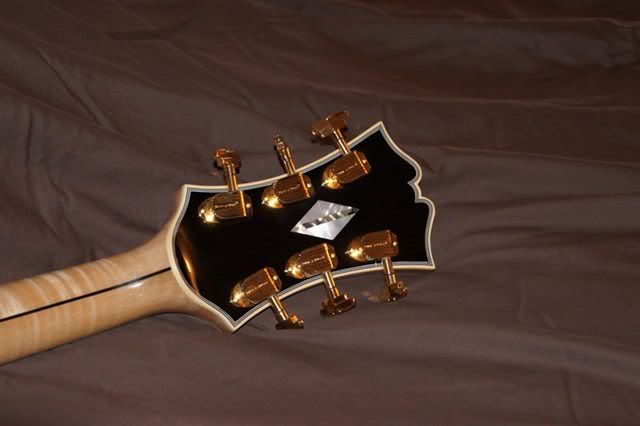
Regarding volutes . . the collector in me rejects them only due to their marking of the change of a model design. As an example, in 1970, when Super 400s went to a volute with *Made In USA* stamped in the back of the head stock . . along with a change from the orange oval label to the rectangular purple, white and black . . the newer variant was immediately perceived as a non vintage tool of the trade. That same sentiment still exists, to a degree, in the world of collectors. Imagin that?? A soon to be 45 year old arch top considered a *used guitar* as opposed to a *vintage arch top*.
Volutes on one of my Unitys;
-
This may not be the right thread for a lengthy discussion regarding the typical wages of Jazz musicians, as there is a substantial contingent present who look disapprovingly on tangential subjects distracting from photo fests. That's perfectly reasonable, but your comments are important and timely ... maybe you'd consider starting a new thread about "jazz fans/ venue owners/ concert promoters" and "It gets tiresome always having to justify prices when they are already stupid low." Originally Posted by jasonc
-
This topic is summed up nicely in step #2 "Use Your Budget As a Standard":
-
I wasn't looking to have a lengthy conversation about musicians wages just using it to make a point. But since the whole point of the thread was about guitar price/ value I'll break it down one more time so people will have a better understanding of the costs involved. Somebody threw out $3000 as being an expensive instrument....let's take a look. I have over $1000 in material costs in an instrument. Here's a quick breakdown for anyone who thinks that's unreasonable: top $200, back $300, fingerboard $40, pickup $100, tuners $70, truss rod (double action) $25, pearl $35 per oz., case $200. That doesn't include the neck stock, headstock veneers, ebony for fittings (ebony is around $90 per board foot), fret wire, pots/ jack/ wire, binding, linings, wood for neck and tail blocks, nut, strap buttons, adjustment wheels, side dots....and that stuff adds up especially when you start factoring shipping. So to keep the math easy that leaves $2000 divided by the 150 hours it takes to make one of these things you end up with $13.33 an hour. That is not all profit. Out of that $13.33 per hour comes the utilities, rent, insurance and machine maintenance. For skilled labor that is "stupid low". I'm not saying you have to get a handmade instrument to sound good because you don't but you have to understand that the luthiers that command big money for their instruments are not making nearly the profit you would think. Originally Posted by SuperFour00
-
I know that was a turn of phrase, but I bolded the last words of your post to comment directly: I'm acquainted with a very famous builder who makes guitars for the highest echelon of famous elite artists, and I'm aware that, while such luthiers are busy and have a waiting list years long, he doesn't earn as much for his countless hours of work as an uninformed observer would suspect. I appreciate that your interest in the wages of your customers is only of minor importance to you in the context of this discussion, and I rescind my suggestion to further explore that subject. Pardon my misinterpretation. Originally Posted by jasonc
-
150 hours?? Really?? Originally Posted by jasonc
-
Could it be that life extracts a toll for making a living at doing what one truly loves to do? Take the above wage and compare it to that of most performing musicians and might it be consistent with the wage/expense scenario you've provided? Originally Posted by jasonc
-
-
What do you know. I actually tend to agree with you here. Originally Posted by fumblefingers

-
You mean like how the machine manufacturing companies are worried about how much I make or how the sawyer is going to charge me less for ebony because I'm not making very much? When was the last time you made less than $10 per hour on a gig? Look man, I am a player also and I wish I got paid more for that too. As a luthier I am a skilled laborer and don't think it's crazy to be paid as such. That's all. Originally Posted by SuperFour00
I've never timed it all myself. I got that number from either Benedetto, Michael Lewis or somebody in an interview I can't remember. But that's about what it seems to me. That's like three weeks and change to build one. Most makers make between 10-20 a year when that's their sole gig...no repair etc. To add some perspective the Gibson Memphis plant can put out something like 300 instruments a day. Benedetto told me they could probably put out 300 a year. For a single man operation, putting out 30 in a year would be Herculean. Originally Posted by Patrick2
Like pro athletes or people who really enjoy buying and selling corporations? I just don't understand not getting paid for work just because you might enjoy said work. I also won't play the music festivals that are put on around here because none of them pay the musicians. The sound guy gets paid. The folks who set up the chairs and stages get paid. The people who do the booking are getting paid. Everybody is getting paid except the people that everyone came to hear. Originally Posted by 2bornot2bop
I joined this forum as a player not as a builder so we are all on the same team. But understand that griping about the price of hand made instruments is not far removed from griping about not getting paid to play jazz. Nobody is getting rich here. This is my last post on this subject...I have to go look for a trim carpenter gig
-
Jason,
Beautiful instruments at your site.....!
reasonable prices...!
-
If a volute can be made like that, I'd want one. What a shame Aaron Cowles is no longer among us. The thought of having him make a guitar for me could be growing on me. But I suppose I'm 10-20 years late for that. Originally Posted by Patrick2
Last edited by oldane; 09-09-2014 at 04:10 PM.
-
Duly noted that you choose to no longer post in this thread. Regarding the bolded question in your quote, the answer is no. I gather that large manufacturers of machinery or lumber suppliers don't fall under any category that would include artists or artisans, so as a rule, I doubt they could be expected to hold similar views to us regarding the work you do, or for that matter, the gigs I do, and the associated wages of same. I'm detecting a note of contentiousness in your response, as though you think somehow I feel that luthiers who hand make guitars, or even you specifically, should charge less for your products than you do. That's incorrect. You should proudly value your instruments at whatever the market will bear, (or whatever you deem appropriate). Whether or not the price you charge and the final profit you realize is a matter with which I should concern myself is purely academic, since I prefer a certain assembly line instrument, so I have no dog in the race. I do wish you the very best in your instrument making and musical careers. Originally Posted by jasonc
-
We all know the drill. Life is about the choices we make. Some us spent 20 years dealing with society's ills because the pay was decent, even though the job was risky. Choices - We all make them voluntarily. Originally Posted by jasonc
-
Re the pay of jazz musicians-
Down here in Tasmania, Australia, jazz musicians are getting the same pay they were getting in the 1980's. I'm 21 so I wasn't around then, but musicians I play with tell me that there were getting $100 for a 3hr gig back then- today I'm lucky to get that. $100 today is worth a lot less than $100 25 years ago. In terms of economy etc. Australia isn't in a great place, especially as far as the arts are concerned.
-
- There is a lot of 'It's my favorite so it must represent a good value' in this thread. I own many things I enjoy and would not replace with an alternative based on cost. That doesn't make these things a good value. It just makes them my preference.
- 'How much you can sell it for' is marketing. 'How good is it for how much is costs' is value.
- Knowing yourself and your requirements may sound easy, but it's quite hard. It takes playing and owning a lot of guitars to zero in on what you really want. It also takes trusting your own eyes and ears. There are a couple of approaches that work for getting to experience several instrument configurations and sizes. Buying brand new high end US factory guitars is not one of them
- Professional musicians have several unique requirements that don't apply to the rest of us. Return on investment, image, durability, maintainability and others. Not to mention the world of endorsement. A good guitar for your favorite guitar player may not be a good guitar for you.
- A custom made instrument is a bargain. They are always ('always' being a statement of statistical approximation) far better than a factory instrument. Not only can you specify the details to achieve the perfect playability for you, but you'll get the very best sound the wood is capable of. And you can call out whatever shiny bits you might enjoy or have it spartan and to the point. They are the logical destination once you know what you want in your primary instrument. This is, of course, assuming that music is what you want it for.
-
i'm not sure who you're referring to. the top players play whatever they want, especially at home and in the studio. Originally Posted by Jim Soloway
amatuers and scufflers? sure, they're another story. they have other bills to pay yada, yada. we all have our burdens, so why should we give a...... hoot.
-
no, not necessarily. what does that even mean "life extracts a toll"? sounds witty and poetic but life doesn't extract anything. Originally Posted by 2bornot2bop



 Reply With Quote


Gibson ES-175 Hollowbody Electric Guitar 2013 w/ Original Hard Case
Today, 06:06 PM in For Sale