


-
Yeah there can be quite a range of big band material. What I find is that if we're doing a fast latin tune or a funk song or something, it doesn't matter what I'm playing. There is so much other stuff happening that it doesn't matter.
But when it does matter is in the nice swing rhythm thing, in the classics, not necessarily just 4-to-the-bar-but along those lines. In those situations, getting that bounce and touch of acoustic air from an electrified archtop is really helpful. I get more control over the swing - there are of course many different ways to swing.
-
03-07-2014 06:00 PM

-
Not cut it as in not being loud enough, or as in would have awkward sound? To me, laminates sounded more than loud, non amplified.
 Originally Posted by D.G.
Since all that you have to consider regardless of guitar type, I don't think it makes any difference in this discussed case.If amplified, then you have an even bigger set of parameters to consider, such as pickups, amplifier, settings on guitar and amp, etc. Even "unamplified" you'll usually have some sort of amplification, even if it's just a mic and then you have to start thinking about mic type, placement, monitors, etc.
Well, meaningless for you, but If I was in the band I'd care about what audience hear, and what their feelings towards the band are.This is a meaningless comparison. What is meaningful is how you, the player, feel about your instrument and how your band mates hear you.
All my feelings toward instrument and what my bandmates hear should be perceived from the audience's supposed position (expectation?). IMO.
-
Vladan, which laminates and solids have you heard?
There's little comparison. I can do a video of a God in kingpin back to back with a Loar.
-
Z - as the guy who specializes solely in "Swing" Guitar - i.e. ~1935-1945 - I think I can actually answer your question the most specifically. Originally Posted by zowno
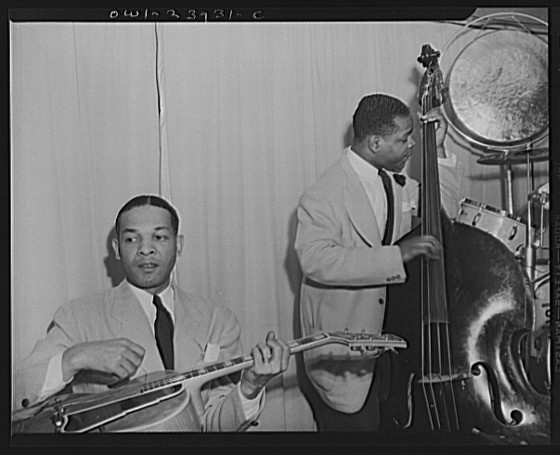
95% of the guitar played in that era and genre is Acoustic Rhythm Guitar - a.k.a "Freddie Green"-style, 4-to-the-bar comping of 3-note chords on an ACOUSTIC archtop.
Maybe 5% was something else, split between Acoustic solos (some chordal - Reuss, Van Eps, Mastren, Cress), some single note (Al Casey, Bernard Addison, Dick McDonough, pre-electric Eddie Durham), and then ELECTRIC single-note solos (Charlie Christian, and the early adopters Slim Gaillard, Al Hendrickson, Irving Ashby, Tiny Grimes, early Barney Kessel, Oscar Moore).
So there's really a small percentage that is electric - unless ELECTRIC is what you're specifically into, go ACOUSTIC.
Get a non-cutaway Loar LH-600 or 700, if you can afford it. If you can afford a non-cutaway Eastman 805 or 810, go with that.
String it with .013 gauge bronze strings, and get a thick, stiff pick. By the Charleton Johnston book.
By the way, here's an entire article I wrote about the gear I'd get if I were starting out again.
http://www.campusfive.com/swingguita...-player-1.html
There's probably a bunch of helpful stuff on the blog, so take a look around.
-
In terms of acoustic volume, here's a good general guide, from quietest to loudest (assuming good quality guitars): Originally Posted by Vladan
1. Laminate archtop guitars, i.e. like ES175's etc. Really, these are electric guitars and always need to be plugged in in practically all situations aside from home practice.
2. Solid wood flattops, like your standard Martins, Gibsons, Taylors, etc.
3. Solid wood archtops, with their midrange emphasis will cut better than a flattop.
4. Solid top, laminate back and side gypsy guitars. These will cut better than practically anything.
5. Resonator guitars. Loudest (and clankiest) being biscuit cones, quietest are spider cones (dobros).
Of these four "families" only 3 and 4 would be usable in a trad style big band, and even then you're going to want to have a bit of amplified support (we're not all Freddie Green!) I've never heard or seen a resonator in a big band, but I suppose you could use one though the tone would probably not fit very well.
It does matter. Frankly, I'm baffled as to why you don't seem to see this. Maybe it's a lack of real world experience? Or maybe we're talking at cross purposes? :shrug: Originally Posted by Vladan
Yes, I agree with this, and should have pointed out that it was the comment about listening to recordings and trying to identify different guitars that is not relevant to the playing situation. I play lots of different kinds of guitars and I'm sure the audience can't tell the difference between my $500 Godin and my $2400 Eastman, but I sure can and so can my bandmates. Originally Posted by Vladan
-
Well, whatever they were, I really do not know except for my Squier, couple Gibsons, couple Ibanezes and some Eastern European oddballs, I don't say they sound the same, I say the difference in sound, for the role as explained in Chirillo clips, makes for no difference at all when heard within whole big band.
By the way, I have no idea which, if any, of those archtops was carved wood?
-
Would you kindly be able to? That would help my search. I didn't realise the debate*I*would set off. Originally Posted by mr. beaumont
I would like something with a pickup and a cutaway, but what I'm hearing is that a non cutaway is more authentic, what is the sonic difference? Since I record other bands, something fairly versitle will be what I gravitate toward, but if I can't get big band and versatile, I'll go for big band.
I get that everyone's playing style is different and that people used heaps of different guitars and I want to be different. I want my playing to be unique, so being strictly traditional doesn't have to be adhered to.
I went to NAMM headquarters last year and went through their museum to look at the history of guitar. As far as I can tell big band was more acoustic than amplified, so better acoustics appeal to me. If it comes at the cost of a pickup however, that should be avoided.
Thanks for all the lively discussion. I've learn more from this thread than the rest of the internet on this topic.
-
Nailed it in one. Thanks heaps for this one. Originally Posted by campusfive
Let the big band battle rage on!
-
Listen to campusfive on this and study his blog religiously Originally Posted by zowno

It's been recommended to me that the best way for what you want is to get a good, loud non-cutaway carved top acoustic archtop (vintage or new) and use a DeArmond pickup like a Rhythm Chief for amplification. I personally have yet to get the right pickup on my Eastman 905 (vintage DeArmond's being quite expensive) so for giging I'm currently using a Godin Kingpin loaded with a p90. It's solely for it's amplified tone, i.e. the acoustic tone is a bit too anemic to use miced.
I have purchased a Kent Armstrong hand wound floating single coil and a finger rest and tone controls for my Eastman, but have yet to take it in for surgery
Keep in mind that there are lots of drawbacks to amplifying a good acoustic archtop such as feedback, finding the right amp, etc. There's a reason laminate and solid body guitars were invented. Still, nothing sounds like a good archtop swing rhythm guitar so it can be worth the hassle.
Again, listen to campusfive on this topic and ignore the rest of us
-
Actually, now I remember, I did a video a few years back.
I don't do any old school rhythm chop...but you'll hear the difference.
-
Mr. B is right that a laminate is not going to give you the tone or volume of a carved top ... the only exception being some Harmony-made instruments have very thin tops with amazing tone and volume, but most are in disrepair and a modern instrument will be a much nicer player.
If you want volume and projection, the Loar is going to give you that. The Eastmans are nice (I owned a noncut) but they sort of crap out the harder you play. They make great solo instruments.
I hate to sound like a broken record but next to the Loar my two Yunzhi guitars are the next loudest and much nicer / bigger sounding, followed by a vintage L7 custom, then a custom American archtop. You could have a L5-spec'd guitar made within your budget: 17" non-cutaway, 25.5" scale, 3.5" deep. That would be a true "orchestra" guitar as well.
I have clips of the L7 and a few of the Yunzhi and will PM them if you are interested. I have a clip of the Yunzhi using a K&K pickup as well.
-
Yes, the difference in loudnes is obvious.
There's one thing I've noticed with my laminated Squier, which I already tried to express in one of previous posts, namely,
there's something like a threshold of applied force vs. loudness, a point where loudnes become unproportionally bigger compared to applied force, point of excitation.
I play soft - soft is the sound, than apply some more force - it follows accordingly, even more force - it follows, but then, at one point ... I add a little bit more force - it really jumps out and becomes really loud, much louder than what I'd expect in regard to previous behaviour.
Playing lines and riffs can never get it that loud. Only forcefull playing of chords, really going for it, can make it do so.
-
So all things considered, my price range be damned, I think I have found a good allround contender. What do people think of the loar lh 350? it has a solid top which I presume will help a lot with the acoustic sound. It has a pickup, which will provide amplification. It has a cutaway, whilst not traditional it helps in the versatility. Mainly it's within budget and looks a treat.
-
I've played with a big band hundreds of times in the last decade, and at this point, I use a tele with my thumb. Acoustic archtop is not an option for the venues and volumes we play, not even for rehearsals. Once you go electric, it's a whole different game.
I don't claim that my way is the only way, and nothing beats the sound of chunking away on a big acoustic archtop, it's actually as much a percussion instrument as a harmony instrument. But, once your sound is coming from an amp instead of the instrument, we've gone into the electric world. If it sounds good, it is good.Last edited by cosmic gumbo; 03-08-2014 at 04:11 AM.
-
I have a 309 and it's pretty good. The acoustic volume is definitely better than my Godin Kingpin, put still not enough to play acoustically in a jam. Plugged in, there's very little difference between the two guitars except that the Kingpin has a MUCH better tone and sustain on the high B and E string up past the 7th fret. It's possible my Loar is a dud though, so be prepared to go through a few of 'em! Also, the necks are HUGE, I mean almost classical width and with a very large V. In other words, vintage with tiny frets. I prefer the Kingpin, though like I said earlier, I have a nice Eastman 905 which does me for acoustic archtop tones Originally Posted by zowno
-
I think you overestimate the utility of a cutaway. I can't think of one time Charlie Christian or anyone else from that era playing past a high G at the 15th fret, and rarely at that. Originally Posted by zowno
Also, it's a significant upgrade from the 300 series to the 600 series.
You can find a used LH-700 (the top of the line) for $850 on ebay right now.
-
In the US perhaps, but in Australia we just don't get deals like that.
-
zowno, are you able to get Guild guitars in your area? They have a new Newark Street collection that is made in Korea, and are based on the vintage USA Guilds of the 50's and 60's. The A-150 lists in the states for $1150 retail, but can be had for less than $1000 USD. They have a solid top and laminate back and sides, and sound fantastic both acoustically and amplified.
-
Originally Posted by mongrel
Actually, I believe it is Fred Guy. Originally Posted by Woody Sound
-
That's just how you hold a big band acoustic archtop rhythm guitar...holding the back against the torso kills the volume.

-
Hi guys!
I play a lot of swing 30's style guitar for money. I own two guitars that are good for this purpose, a Altamira D-Hole Maccaferri and a Loar LH600.
The latter gets my vote for an authentic 30's American swing rhythm sound. It has a really good throaty tone when you play it near the fingerboard, very refined and punchy. The Maccaferri, by comparison is a little louder, but I find it unsubtle.
Eastmans are great too, but feel a little more 'contemporary' to me. I've tried only cutaway electrics though.
The function of the acoustic guitar in an authentic 30s swing band, is to me, to knit the elements together, bass drums and piano. In this sense it almost doesn't matter if the audience hears you or not!
I played the Loar, which has an aftermarket floating pickup attached, in a little 7-piece Basie style band with drums and amplified bass, and it held it's own acoustically - at exactly the level you want for that type of guitar playing. I could then take the volume up and take on the horn players for solos. Perfection!
I've not had any trouble with feedback from the magnetic pickup, as long as you don't camp out in front of a Fender Twin, say.
Now all you need to do is persuade the sound engineer :-)Last edited by christianm77; 03-21-2014 at 06:12 PM.
-
Excellent video. Good explanations and some really nice playing. Originally Posted by mr. beaumont


 Reply With Quote




Got some picking exercises?
Today, 01:17 PM in Guitar Technique