


-
I just unpacked my new TCE BQ500 amp head, plugged it into my RE 10 cab, and played the first tune that came into my head. All EQ is flat and the compressor is off. The guitar is my Eastman Jazz Elite 16" 7 string, with a HW KA 14 pole pickup and TI JS113 strings plus a 75 thou Chrome 7th. The bottom line is that it sounds fantastic, has the balls of a 100W Boogie, and seems to be built extremely well. At $179, this has to be the biggest bargain in the amplifier world (assuming it holds up).
This is absolutely the most powerful amp I've ever had. I run my BAM200 with gain and master volume both at about 11 o'clock, so that's where I started with this rig. It was unbelievably loud at those settings, and I ended up with gain and volume at 8 o'clock for my usual level of practice volume. Gain and volume pots are both smooth and linear in their attenuation, with no surprise volume swells anywhere on the dial. But bumping them up even to noon was unbearably loud. Even at high volume settings, it's dead silent so far. EQ also works very well, with smooth and linear change across a fairly wide range. It has bass, low mid, high mid, and treble pots and they do what they say. As was RonGom in a post in another thread, I'm a bit surprised at how audible the effect of the high pot is, given its center frequency at 10kHz per TC specs.
How does it sound? It's outstanding! The bass is as tight as I've ever heard from an amplifier, with excellent note clarity even in 4 note chords played on the lowest 4 strings. It's clean and smooth across the entire frequency spectrum, and it brings out the best from my archtops. It's the equal of my DV Mark EG250, which has been the best sounding amp head I've ever had since I got it. But the BQ500 is twice as powerful, which means little in terms of absolute maximum SPL but is palpable in the effortless headroom it gives at reasonable gig and general playing levels. The MOSFET preamp does have similar warmth to the real tube in the EG250, although the EG may be a hair sweeter in the mids and highs. I'll run some comparisons with the BAM200, since it doesn't make sense that they'd use a different preamp in each of these at this price level. The BAM also has a MOSFET front end according to a lot of web posts. Curiously, TC does not mention this on their website or in their literature. so I'll have to do some direct comparison to see if they sound similar.
I recorded one short clip for illustration. The amp has no reverb, so the sound is dry in this clip -
I aded a little TAL reverb to the file for this one. I just love the tone -
-
03-05-2026 05:39 PM

-
Sounds fantastic. I've always thought that a clean guitar sounds great through a bass amp. I have a TC Electronic BG 250 combo, through which the guitar sounds great. I of course love the sound of my 7 strings through my Fender 59 Bassman LTD.
-
My problem with most bass amps is that they make the low strings on a guitar sound sort of like a bass (yet not really). The low notes are flabby and fat, when they should sound like the rest of the guitar strings - just lower in pitch. I used to think that the thump was good - but I've grown out of that. When the low strings sound like the car stereo next to you at a stoplight ("thump, thump, thump" with no pitch or definition), it's not musical.
 Originally Posted by Zigracer
At least today's good bass amps have full range frequency response to capture the attack of string popping and snapping. This is great for guitar players who use bass amps, because it's also more true to the sound of the guitar. When I was starting out, I had a Magnatone 4x10 and then an Ampeg B15N - and I thought they were the greatest for jazz (especially solo). When I listen to them now, I realize that I was missing most of the true character of a good guitar's sound.
-
You got me psyched, mine should be here in a few days.
-
Never, the recordings sound very nice! How does a solid body sound with that setup? What exactly does the active/passive peak switch, the thresh switch and the thrust knob do? Is there an out usable for recording? Are the functions named above the kind of thing every bass player and most guitarists know and can explain in their sleep?
-
Looks like jazz guitarists are a market force after all. Thomann has sold out both BAM200 and BQ500, expecting replenishment in September.
-
That depends on the solid body and what you'e playing. Like the EG250, the BQ500 is a clean and neutral platform that will amplify whatever you put into it. Amps like this let a solid body be what it is - so what you get depends on the build, pickups, strings, etc. Ignoring my Kubicki Express (which is a 22" scale mini LP 6 string with a Duncan Quarter Pounder at the bridge), I only have 2 solid bodies I can use for this comparison. The first is an early '90s ESP 7 hardtail. It has a bolt on maple neck, mahogany body, arched maple cap, and the original plain vanilla SD 'buckers. This one has medium Chromes on it and IMO comes very close to the sound of a laminated archhtop through a decent amp & speaker. It was my first 7 string, and I still love it - but it's not a Strat and it won't scream like a demon. It's actually a very capable jazz guitar. Originally Posted by 0zoro
After this thread, I may not play Stella for a long, long time time. But I figured I'd use the same thing for all of the demos and comparisons of this amp. Here's the ESP straight into the BQ driving the RE 10 cab, with no effects or processing at all -
And here's the same track with reverb added in post -
My other solid is an Epi LP 7 also from the '90s. It's my Frankenpaul - it now has a single pickup (EMG active at the neck) and medium Chromes. It's been my dive bar blues beater for almost 30 years. So if you asked about solids because you want funk, blues, etc, here's a little fun with funk. This is through my Zen clone pedal, and I set the "Thrust" (which is an ordinary compressor that works great) at 1 o'clock. It's just some noodling over a backing track. The first one has reverb on the guitar (added in post), which is probably the way most would play this -
And here's the same track with no effects or processing on the guitar -
As for your other questions:
The active/passive switch changes the input sensitivity. Active pickups generally have higher output voltage than passive ones, so the switch reduces input sensitivity when set to active.The LED next to it is a peak indicator - it lights up when the input signal reaches the threshold of clipping. I haven't tested it because I kinda don't care about it. But the same LED on the BAM lights green when a signal is present a signal and (IIRC) turns red when the signal reaches the clipping point. I don't know yet if the one on the BQ is the same. But it doesn't light up at the levels at which I'm playing, while the one on the BAM does. That may be because the BQ is so much more powerful than the BAM that the very low gain I'm using is too low even to trigger the light. Don't know, don't care.
The Thrust pot controls the threshold of compression. The LED next to the switch that turns ithe compressor on and off is yellow when the compressor is on. Many of us do know what these are, but (especially with the odd labeling) it's not intuitive. Their attempt at humor and cute names falls flat. Don't feel left out!
It has a true balanced XLR DI output that can be used for recording or feeding a board for sound reinforcement.
The only speaker output jack is a rotary locking connector, which is generally known as a Speakon - but I strongly doubt that this one is the actual Speakon jack from Neutrik. A Neutrik Speakon is the Cadillac of rotary speaker connecters, but there are many clones (some of which are quite good, many of which are junk). The one in the BQ feels OK when inserting the plug, and I'm pretty careful with my stuff. I hope (and actually believe, based on the overall quality of the amp) that it'll last as long as the real thing with some care in use. You can't kill a Neutrik Speakon with a stick.
-
Thank you never, nice playing and recording btw, and a special thanks for taking the time and energy for answering a technical dinosaur out of the paleolithic era! I do appreciate it!
-
If this little sucker holds up, it's the biggest bargain in the history of musical instruments. It sounds fantastic, and it looks and feels like it's made very, very well. All the controls work perfectly - EQ is versatile and easy to adjust, and the compressor is actually the best one I've ever used. The control pot is linear in action, and there's no added noise (probably because the amp itself is so quiet that there's little noise to be brought out). There's no pumping or other telltale sonic sign that it's in use, at least to the levels at which I've tried it. Originally Posted by Gitterbug
I have mixed feelings about the Speakon connector as the only speaker level output jack. If some careless person trips over a standard cable with a 1/4" plug, the sudden tug will pull the plug out at least as often as it will drag the amp along. But with a Speakon, the amp will be on the floor - a Speakon type connector will not come out unless you release the locking tab. If the head is Velcro'ed to a Toob, it's a toss-up as to whether the Toob will roll over and let the amp hit the ground. I suspect that a Metro will roll right over on its metal leg, because of the rounded corners on which it sits. But the wooden leg on the larger models will probably not let it tip over. So it'll be dragged along the ground with the amp still on top, and anything can happen. I carry duct tape with me in my gear bag, so I'll tape the speaker cable to the floor. If I'm using a Metro, I'll also tape the Metro's legs to the floor (which is easy because of the design). More than one sideman has done in a cord (usually someone elses's...) on a gig.
Rest easy, GB - I won't unleash the full power of the BQ (or even the BAM) on a Toob. I'll probably use the BQ with my 10S, which IIRC has a Tornado in it. I promise to be careful
-
Do you think it's flat enough to use as a power amp for a modeler to a small passive cab?
-
Maybe bass players are doing the buying? Originally Posted by Gitterbug
-
Absolutely! But the speaker(s) in that cabinet also have to be full range. Just keep in mind that this is one of the most powerful amps on the market (for guitars - bass players are used to an honest 200+ Watts). Even though you have a wonderfully light touch, Jim, an accidental transient through it will damage a speaker that can’t survive that much power. Originally Posted by Jim Soloway
A loose cable or a switch contact with a little oxidation on it can cause a “pop” that will launch the voice coil of a speaker with a low power handling limit into orbit. Even accidentally plugging in or pulling out the cable from your guitar while it’s powered up can blow a speaker when there’s that much power. So if you decide to try one, be verrrry careful.
-
If you don't like Speakon connectors, there is the:
Speakon to Jack adapter.
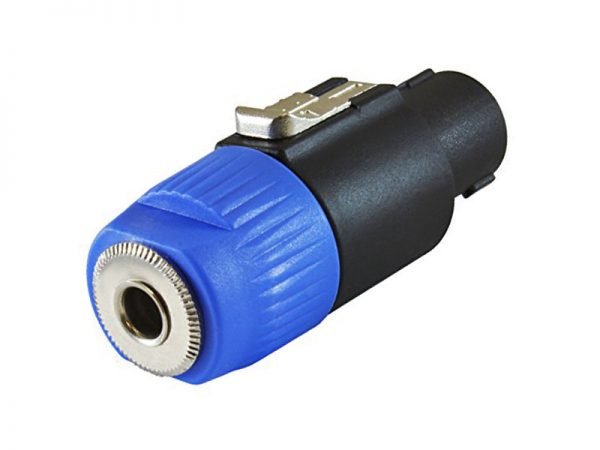
Personally, I've used Speakon connectors for over 20 years with no problems.
-
…as have I. I ordered them on my RE and RevSound cabinets years ago. But you need to be careful not to yank the cables because there’s no “quick release” to prevent or minimize damage. A 1/4” plug will usually just come out of the jack - but Speakons won’t come apart. If you walk into the cable hard enough, you’ll either pull one or both of the items into which it’s plugged or loosen / break a conductor at the plug(s). Originally Posted by GuyBoden
Breakage is much less likely, especially if the terminals are well tightened and the wire strands are intact. But you can very easily knock a small head to the floor and damage it. These are lessons learned (sometimes painfully) over thousands of gigs. I check the connections on my cable plugs every year or two, secure my amps / speakers / cables in place, and take great care with and around all equipment.
Nothing will harsh your mellow faster and more painfully than not being able to finish a gig (or even a tune) because you stupidly broke or failed to check and maintain your own equipment. About 3 years ago, a dumbass guitarist in another band put his beer on our B3 and knocked the glass over during their show. It took out the top dozen keys and the repair cost about $2k because there was beer all over the inside at the treble end.
-
I find these right angle dongles to be a little less obtrusive sticking out the back.
-
Although not sold as such, these do serve as breakaways in the event of a cable grab. If pulled apart during a tune or unknowingly separated so that the next tune is begun with no load on the amp’s output, the result with a tube or most early style SS amps would be a blown output stage component (tube, transformer, etc). But most class D amps can safely tolerate an open output (i.e. infinite resistance) - so this would be a useful safeguard for these little heads. The 1/4" jack in most speaker cabs serves as a breakaway, but adding a second one doubles the protection. Originally Posted by Woody Sound
Of course, you’d need two of these adapters with a standard speaker cable between them, if both amp & speaker cab use Speakons (eg the BQ500 and one of my good cabs). I’m happy just being careful. But this is a great safeguard for crowded stages and gigs with multiple people walking through your equipment area.
I do love the right angle Speakons and use them behind my speaker cabs.Last edited by nevershouldhavesoldit; 03-07-2026 at 12:52 PM. Reason: clarification
-
Hey nevershouldhavesoldit, nice review, and nice playing! Originally Posted by nevershouldhavesoldit
The recording quality is good, too. When I played your tracks, I recognized the sound of that amp immediately. Yes, that's the sound. It *is* kind of 'warm.' I like it too.
FYI - I think the power output specification is 500 watts *peak* into a 4 ohm load. That means it's about 350 watts RMS into that same 4 ohm load, and about half that into an 8 ohm load (175W RMS). I figure I can count on about 150 *honest* and clean, continuous watts into an 8 ohm speaker. That is plenty.
At some point, I would like to try it with two cabs on either side of the bandstand (4 ohm load). 300 watts! But this was supposed to be a portable solution...
I've been bringing this amp and an open-back 1-12" speaker cab to a jam session in a loud room (brick walls) in which the band sets up at the back wall of a long, narrow rectangle. The clientele is loud, the room is loud, the band is loud. The BQ500 provides all the clean headroom I need, with room to spare. It gets loud and clean without sounding like a hard, sterile PA amp—or a mushy, farting out 20W tube amp. I agree that (if it holds up) it's a great budget option for a simple, functional and good-sounding amp for playing jazz gigs. Too bad about the extra $50 we Americans have to pay to get it. If we could get it at the regular price of $129, it would be a complete no-brainer of a purchase.
Also, thanks for the discussion on the Speakon-copy connector. Adding that seemed to me to be a bit excessive, but hey, it works. I use a Speakon to 1/4" female pigtail adapter. So far, so good. I'm putting the amp right on top of the speaker so that there's no cable hanging out, waiting for someone to trip over.
Thanks for the review and for the nice tracks. Nice playing!
-
You're right in concept about the power rating. But the long time rule of thumb (based on sinusoidal math, since sine waves are the standard test signal) has been that "peak" power is 1.414 (the square root of 2) x WRMS. That's true for most tube amps with big transformers and caps in the power supply. But for class D amps, most of which lack oversized power supplies, there's no standard % or generally applicable formula. Manufacturers now inflate peak power ratings wildly, so "peak" power may be anywhere from 1.414 to 4+ times WRMS. Originally Posted by RonGon
TC put out a power chart for a few of their class D heads, but the BAM and BQ500 are not on it. It does give you an idea of how their peak ratings compare to actual measured wattage. For example, the BH500 is rated by TC as being a 500 Watt amplifier with a peak power rating of 1000W. It actually put out 250 steady state WRMS into 4 Ohms and 225 into 8. It hit 980 W for an instantaneous peak into 2 Ohms, but the thermal cutoff probably triggered immediately at that level (assuming the amp even survived the test).
If the BQ500 is similarly designed and built, it's probably very close to the same.



 Reply With Quote


What is it?!? Why am I still at it?!?
Today, 04:53 AM in Everything Else