

Take Five was composed by Paul Desmond and first recorded by The Dave Brubeck Quartet for the 1959 album Time Out. It was one of the first jazz compositions with a time signature other than 4/4 or 3/4 and went on to become the best-selling jazz single of all time.
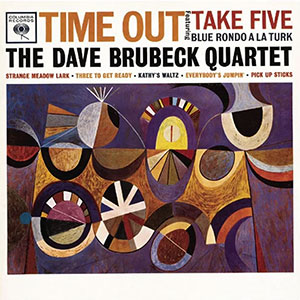
The idea came from drummer Joe Morello, who was interested in unusual time signatures. Morello had been playing around with 5/4 in his solos and asked Desmond to write a tune in that meter. That challenge led to Take Five.
Even though the tune became the best-selling jazz single ever, Desmond reportedly saw it as just a simple studio piece to complete the album rather than become a major success.
In this lesson, you will learn how to play the chords of Take Five and how to approach its famous 5/4 groove.
You will also learn two ways to play the chords of the bridge. One version follows Dave Brubeck’s original diatonic chords. The other, inspired by George Benson’s version, adds passing chords and turns the bridge into a circle of fifths progression.
Download PDF, backing track, and bonus content with JGO+ (Click here to join / Member log in)

Recommended listening:
- The Dave Brubeck Quartet – Time Out (1959)
- The Dave Brubeck Quartet – At Carnegie Hall (1963)
- George Benson – Bad Benson (1974)
- Al Jarreau – Look to the Rainbow (1977)
- Joe Morello – Morello Standard Time (1994)
- Toots Thielemans (with Robben Ford) – East Coast West Coast (1994)
Playing 5/4 Time – 3+2 Rhythm
One of the things that makes Take Five instantly recognizable and where the song gets its name from is the 5/4 time signature. Although 5/4 might seem unusual at first, the groove feels natural once you hear how the beat is divided.
Instead of counting 1-2-3-4-5, the rhythm is grouped as 1-2-3 | 1-2
This way of dividing the beat gives the song its relaxed, flowing feel. In the original recording, the piano, drums, and bass all highlight this grouping, which keeps the groove smooth without making it sound stiff or technical.
When playing the chord vamp, try to feel the bigger 3 + 2 pulse instead of counting each beat on its own.
Take Five Chords & Groove
Form: ABA (24 bars)
Key: Eb minor
Take Five has a simple harmony, but it’s the mix of the vamp, 5/4 groove, and phrasing what makes the song stand out.
The groove might sound simple on the original recording, but making it feel relaxed and natural on guitar can be tricky.
The rhythm flows naturally on piano, while on guitar there is a risk of making the groove sound stiff or too heavily accented.
In this section, you’ll learn how to play through the chords while keeping the light, floating feel of the original recording as much as possible.
A Section
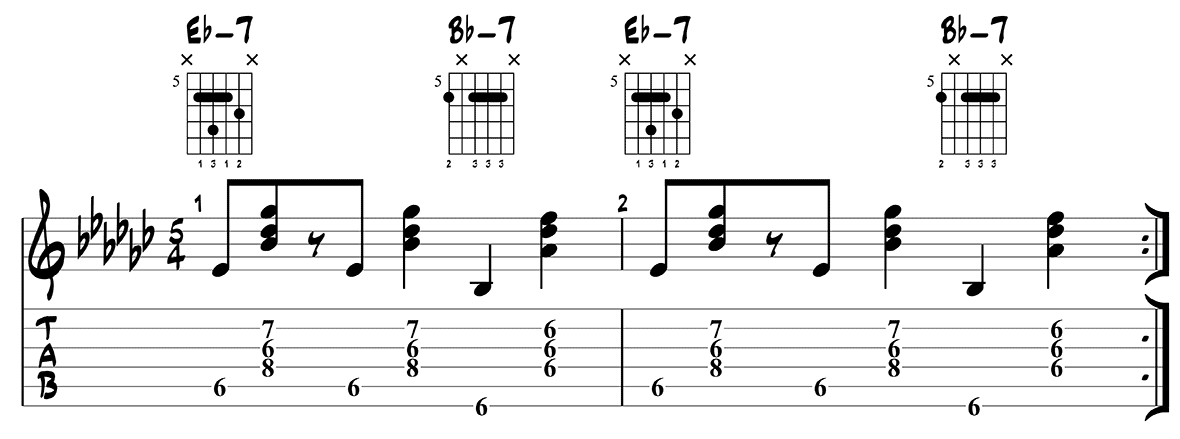
The A section is built around a two-chord vamp alternating between Ebm and Bbm7.
The comping pattern follows the 3 + 2 subdivision of the bar. Try to keep the rhythm relaxed and consistent.
Start by practicing the groove slowly by itself until the subdivision feels comfortable. When the rhythm feels natural, try playing along with a metronome or backing track.
Bridge
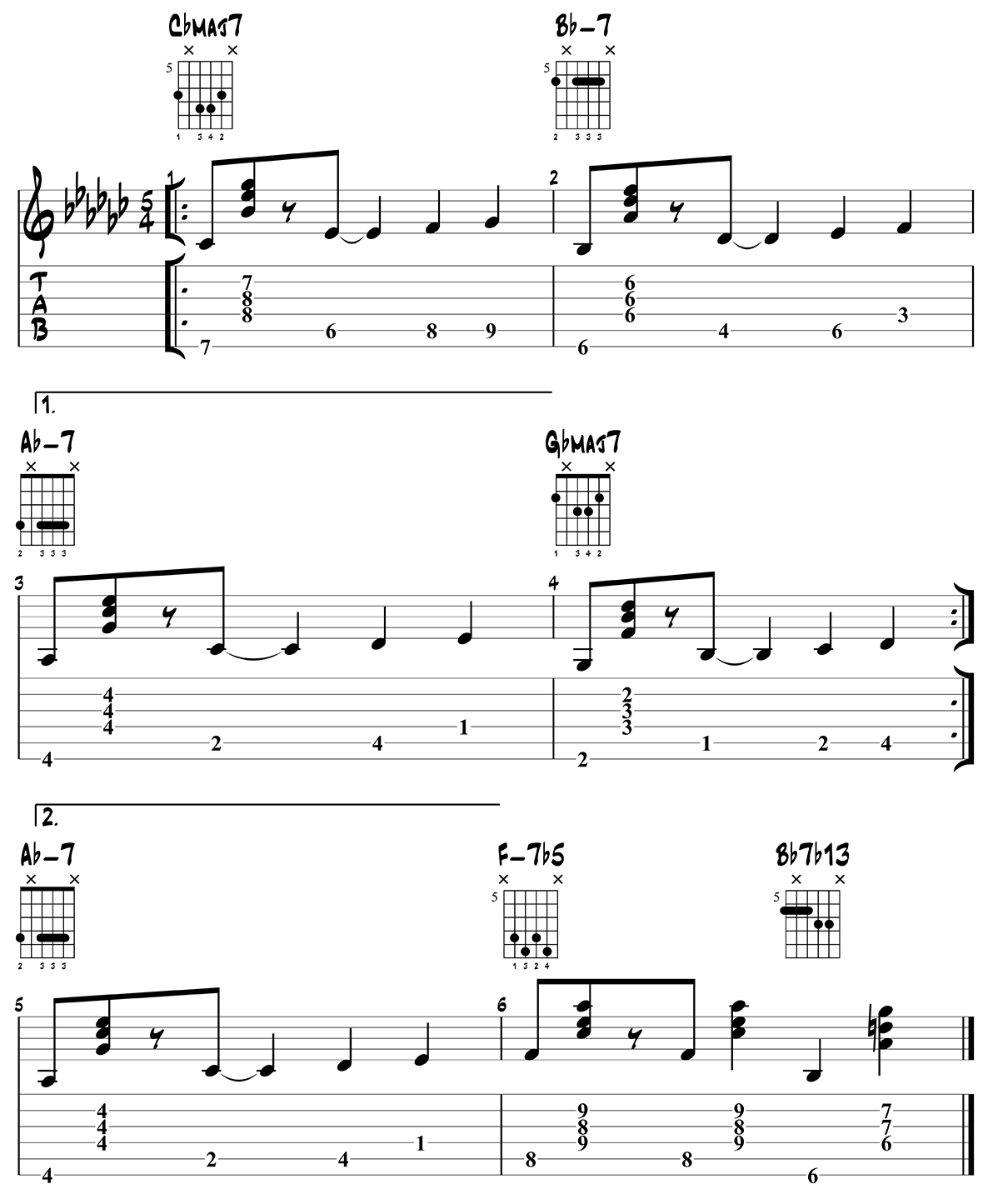
The bridge modulates to Gb major and follows Dave Brubeck’s original chord movement, which is a descending diatonic progression:
Cbmaj7 → Bbm7 → Abm7 → Gbmaj7
Each chord is followed by a short voice-leading line, originally played on piano, that connects the harmony smoothly from one chord to the next.
Alternative Bridge
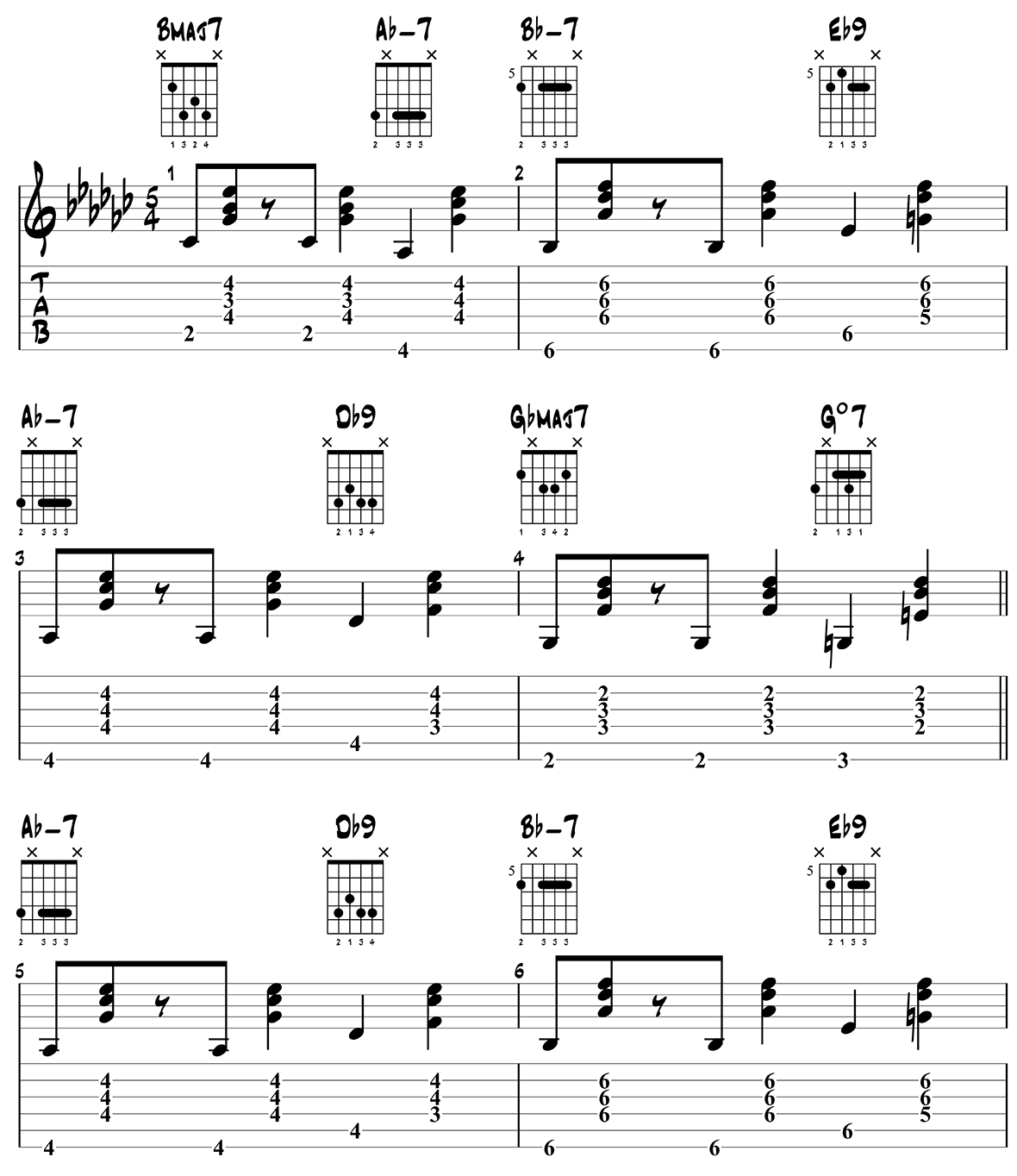
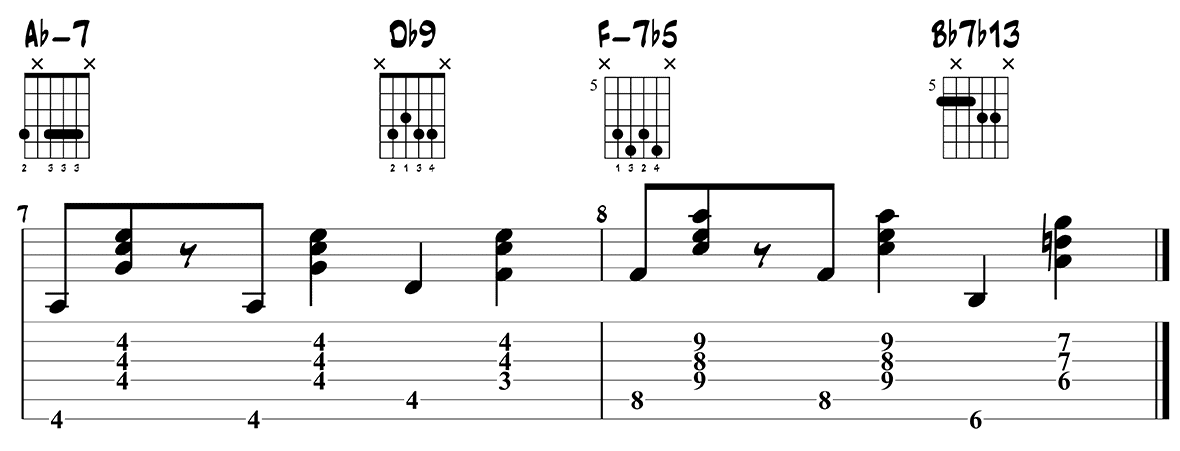
This alternative bridge adds ii-V movement and non-diatonic chords to the original Brubeck changes.
Now, each bar has two chords instead of one, which adds more harmonic movement and makes the circle-of-fifths sound stronger.
This version combines the Real Book chords with George Benson’s arrangement. The extra ii-V progressions make the bridge sound more like a classic jazz standard.
Take Five Melody & Paul Desmond Solo
If you’re a JGO+ member, you can access the extra content for this lesson, including:
- A guitar arrangement of the melody of Take Five
- Paul Desmond’s original solo on Take Five, divided into 5 phrases
Members can also download a printable PDF, Guitar Pro file, audio examples, and backing track for this lesson, along with downloads for 65+ other lessons.
Click Here to Join / Member Log In
There’s a thing I don’t understand: in measure 6 of bridge section, the first chord is noted as a F-7b5 ( the chord diagram is a drop 2 F-7b5 with root on 5th string). But the notes are F-A(natural)-Eb-Gb, and so are the notes indicated on the Tablature. To me it seems a F7b9. What is the right chord? Thank you!
I’m asking about measure 6 of bridge section. The first chord is written as F-7b5, and the fingering diagram Is correct (drop2 voi ing with root in 5th string). However the notes are F-A(Natural)-Eb-Gb, as in the TAB. Shoulnd’t It be a F7b9 chord? Thank you.
Thanks for letting me know Benna, that’s a typo, fixed it.
I watched an interview with Brubeck where-in he stated that he asked Desmond to come up with a 5/4 figure, Desmond came back advising he had nothing. DB went to a study room and came back 25 minutes later with the head. I know it’s odd that PD is credited as composer. But then, Bill Evans wrote ‘Blue in Green.’ and had a dig at Miles Davis about credits on Kind of Blue, MD is reported to have thrown $40 at him. On the album it’s a Davis credit.
Could you arrange this yourself based on the provided content? That would really cement this song conceptually and theoretically for you.
Auriez-vous oublié “Take Five” by Elek Baczik ?
Rhythm: Dizzy is reputed to have told his band members to repeat the phrase “Who parked the car, I did” to get the feel of the rhythm. To this day, I hear that phrase while playing, and counting becomes unnecessary!
Signature A section riff: on on guitar, try alternating between a low Eb at 11 (use little finger) and a piece of the Eb min chord formed by strings 5,4,3 at frets 9,8,8. I barre across position 8 – its very comfortable. Let up on the 9,8,8 notes between bass stabs to get that signature bounce. Then slide down to position 6 and play the Bb min as written.
Who parked the car, I did – brilliant!!
Ma perché non la fate in dm7 am7. Etc prima posizione ,facile fingerpicking. con bassi. Liberi Valerio.
Why do I hear a add11 in the Bm7 chord?
Agradeço pela ótima lição! Tudo de forma simples e pedagógica. Forneceu meio de vencer às dificuldades costumeiras deste clássico do jazz, porém a técnica adquirida poderá ser utilizada em outras performances.
*AGRADEÇO*( ao invés de ” Obter”)
Thank you for all these free resources. Absolutely fantastic.
Very good lesson that simplifies a complicated song
It’s a wonderful lesson but hell on earth on a nylon string classical guitar! Perhaps this is my excuse to go get yet another axe? Oh, the wife will be thrilled!
I’ve played this tune on (?)piano when I was a kid, on guitar as a teenie and now I spend time playing a 5/4 rhythm on the drums. I’ve heard Dave Brubeck the last time he was in Stuttgart/Germany – an old man until he sat down in front of the piano.
Paul Desmond covers it all: a real hook melody, rhythm and feel. This is jazz – not noodling.
Dirk – you’re great.
Dirk you’re the man!!!! For people like me who’s intrigued by jazz music I gotta give to you!! Fantastic job!! You’re a jazz guitarist’s lifesaver!!! Keep the jazz guitar going!!!!
Thanks for breaking this down. I don’t plan on doing the syncopated version anytime soon.
I still haven’t figured out how to start the lead lines (count 4 & 5 first..? or ?)
Thanks for your very persistent and use-able email lessons,
S E
Here’s a way to count in the three notes that kick off the melody:
First, count off the 5/4 tempo by thinking “(1-2-3)(1-2)” rather than “1-2-3-4-5,” as suggested by Dirk.
Next, give it a swing feel by thinking “(1-and-2-and-3-and) (4-ee-and-a).”
The three notes that kick of the melody coincide with “ee-and-a.” They fall on the last three eighth notes of the 4-bar intro.
Now all you need to do is figure out “Blue Rondo a la Turk”… 😛
Hi, only to say thanks … is great your job… and thanks for sharing it… I think the majority of us need improvisation tips… perhaps Ebm melodic minor or pentatonics sacles… arpegios… etc… well thanks again… –
Pls i need help in soloing …combining major pentatonic with blues.can someone help?pls
Try the forums on this website.
First, listen to the many improvisors who do that. I’ve found it helps to occasionally add a flat 3 or flat 7 to the major pentatonic. It eases the transition from the major pentatonic to the blues scale with the same root.
This was excellent…thanks!
Fantastic tutoria.. What I am looking for.. Tks
thank you very much. Wonderful.
Amazing Lesson thanks
Thanks for this 5/4 piece Dirk, it’s probably the most troublesome tune i have encountered, along with Straight No Chaser!
I will study this great example I take my hat off to the players who can render this with ease.
Very good tutorial. Thanks!
Or forget Chet Atkins awesome solo arrangement on his “Alone” album
Let’s not forget Joe Morello’s immaculate drumpart
Take Five was a hit of the Dave Brubeck Quartet in the 1959 LP Time Out. Although the piano groove in 5/4 may well be the offspring of Dave Brubeck’s mind, the tune was actually written by the alto-saxophonist and member of group Paul Desmond.
I’ve Paul Desmond’s solo written out! George Benson also did a version, but that’s an interpretation.