


-
I'm not sure if this is the right place for this, but here it goes anyways..
I was hoping that some of the more experienced players could help me differentiate between the various Latin styles. I obviously know bossa, but aren't sambas very similar? And if a fake sheet says "Latin" at the top left, how do I comp that? What would the bassist be doing? The drummer? How would that be different from a Mambo, cha-cha, rumba, afro-Latin, salsa, tango, bolero? Which styles use a montuno? Also, how does the 3/2 clave rhythm come in?
Sorry for the ignorance, but that's what the forum's for, right?
Thank you
-
05-30-2011 12:51 PM

-
The best path to any real level of understanding of the massively large question you are asking is through detailed listening first.
From that vantage point, the info found in books will have greater meaning.
Bossa
Samba
Mambo
Cha Cha
Rumba
So good to see a young Celia Cruz
Afro Latin generally refers to various Afro Cuban 6/8 rhythms
More modern, great tune and arrangement by Hector Martignon
Salsa
Bolero
Couldn’t resist, a great version of the same song from Jose Feliciano
Tango (from Argentina)
This is compiled from what I could quickly pull up from You Tube.
Enjoy.
-
Interesting compilation Bako ... My wife manages a dance studio and from that exposure, I can easily recognize the different rhythms, which can be subtle in some cases. For example the Salsa and Mambo are similar but the mambo accents the second beat while the Salsa hits the first. Its easy to get the difference when you hear the music and watch how dancers move.
The difficulty I find is reproducing the subtle differences in the rhythms on the guitar, either finger-style or with a pick. I think this is the question.
I would also be interested in any tips on how to capture the different feels with simple rhythmic patterns on the guitar. It would be a good way to treat a tune in different ways.
-
Jazzaluk has a good point about the differences in comping. That was part of the question. I used to be a bassist so I know that, like Jazzaluk says, in Mambos, as well as several other Latin styles, the bass avoids the one completely. So the real question (Bako, thank you for the many listening examples, it helped a lot... the only question I have is about afro-latin: in The Real Book, Caravan is written as afro-latin and that's just in cut time, not 6/8 or 3/4... Why?) is what comping patterns, rhythms, shapes, etc to use and how does that communicate with the bass and drums?
-
At the back of the Shur latin books are examples of different feels notated out... more for a visual... to play... all need to be felt, not counted... as bako mentioned. The basic start of all latin music is the "Clave", generally we use two types of clave patterns, "son clave" and "rumba clave". There are others, but start with the basics.
The "3-2" means ... a bar of three accents followed by a bar of two accents... the "2-3", two accents followed by bar of 3 accents. Generally the 1st bar is considered the strong measure, followed by a weak bar. (You really need to pick up Rebecca's Salsa Guidebook if you want to get into the feels)... Reg
-
Without wishing to disagree with anyone, that usually dates from the time when 'Latin' really meant 'straight eights,' i.e. it was an antonym of Swing (and back then, it was unacceptable to put 'Rock'). The rhythmic pattern of the melody often tells you how to comp it, otherwise comp along the lines of one (and) TWO (and) three (and) Four (and), or something like that - whatever groove the rest of the band settles into.
 Originally Posted by mtierney
-
Hey Jon.... yea good point about the straight 8ths thing. And yea... year's ago, a lot of years ago that might have worked, but most of the time in recent years...there are pre-set grooves from traditional latin dance or listening styles that are implied or verbally agreed upon before tune starts... not to say that may not develop into something else, but it's usually not that loose... there are at least two bar rhythmic patterns that set the feel or groove, or longer etc... Reg
-
I'm not disagreeing with you, Reg, but in those cases, I would have expected the rhythm description at the top of the fake sheet to be more precise, 'Salsa' or 'Rumba' or whatever (maybe I'm just optimistic). Whereas that very vague 'Latin' is illustrated in things like the ABAC of On Green Dolphin Street, A being (nondescript) Latin and B/C Swing. Originally Posted by Reg
-
Hey John... my charts do or I verbally say what style before we start. I'm optimistic with you... but most of the time it's simply called out... your expected to know. I'm basically on west coast of states... I did live on east coast during 70's, which was more in the direction of that vague use of term latin... usually not implying dance styles. The term Songo is somewhat the default style for "Latin Jazz Style"... somewhat loose, not so dance oriented and more from Cuban or Puerto Rico styles. Or the many jazz versions of the Samba based... Bossa...
We as guitarist and in the "rhythm" section should be aware and able to cover latin styles and able to blend or fuse different styles together.... I cover Salsa gigs... most of the time there are not charts... you need to know the basic tunes and montunos.
Like Bako and I said you need to play, not verbally learn the styles. There are used copies of Rebeca's "Salsa Guide Book", her "101 montunos" and The "Brazilian Music Workshop"by Antonio Adolfo all available on Amazon used for cheap....That's what I mainly used... and still do...
John I'm talking to OP and anyone else who's trying to get their latin thing together, please don't take my comments...personal , sorry if they come off that way... your posts are always extremely knowledgeable and you always express yourself... as I would like to ..Reg
-
I think the question is being side-stepped here. There is in fact a difference between the various latin rhythms that make them distinct, albeit subtly in some cases.
The fact that in jazz you can create patterns that resemble these rhythms and call them bossa and "songo (?)" does not address the question.
I believe the question is, how can you manifest the different distinct rhythmic elements of rhumba, salsa, samba, meringue, bachata and tango on the guitar.
Perhaps the question would be better addressed by a Brazilian guitarist. These rhythms are probably best interpreted in a finger-style technique.
-
Hey Jazzaluk... if the question is being side-stepped it's only because it was answered... get the needed resources and practice. I can easily make videos of basic Brazilian styles which are very easy and fit guitar great and the try and cover montunos and play basic Cuban and Puerto Rican dance music. But it's as you said like having a Brazilian guitarist try and cover Jazz harmony and feel... not perfect.
I'm guessing that since Mtiemey was making reference to jazz tunes with the Latin label... we're talking about Latin Jazz listening music as compared to dance music... not the typical Salsa gig.
The only basic difference between a 3/2 son clave and a 3/2 rumba clave is the location of attack of 3rd beat... on 4 or off 4. And then you simply change order of two bar phrase for 2/3 versions. There all basically two bar figures except when the harmony needs more space and then they become a four bar pattern. And in the end it's very similar to the difficulty of notating or verbally explaining swing... You need to feel not count. The actual technical aspect is not difficult, as long as one has the chops... most of the time the tempos are up and felt in two.
But Hey, Mtiemey... if you would like pick a few tunes and styles and I'll gladly make video of how a jazz guitarist covers... or if you want montunos , I play them all the time. Or just salsa... And then maybe a true Brazilian guitarist... well actually bako gave more than enough examples... Listen to the second Samba example, Desde Que O Samba... probable what your looking for. Or could be Gilbert's fairly simple but beautiful style. Many of the examples are old and while great examples.... are not really used much anymore.
If you want samples of latin/jazz feels that are a little hipper and is more about the feel as compared to simple accent patterns check out;
Ryan Cohan
Danilo Perez
Ruben Gonzalez
Paquito D'Rivera
older standard style;
Mongo Santamaria
Pancho Sanchez
Hope this helps motivate... Reg
-
Well, excuse us, we were answering your original question in a jazz context, on account of how this is a jazz forum, and that's what we are used to talking about. Originally Posted by Jazzaluk
Why not? Authenticity is all very well, but as far as I'm concerned, if it sounds like mambo, I'll call it mambo, but if you want to say it's pachanga, that's OK as well. (And what's the point of the question mark after 'songo', is there something wrong with the word?)The fact that in jazz you can create patterns that resemble these rhythms and call them bossa and "songo (?)" does not address the question.
These are not just single rhythms - there are different tango patterns, for example, the important thing is that they be danceable. Rumba covers all sorts of different styles, from Cuban to Catalan passing through ballroom. Even reggaeton has variations (not a lot, admittedly). And of course it isn't always the guitarist's job to mark the the rhythm, for example in bachata. Quite often, what's expected of the guitar is a counterpart, filling in the holes, it may be silent on the beats. Upstrokes help.I believe the question is, how can you manifest the different distinct rhythmic elements of rhumba, salsa, samba, meringue, bachata and tango on the guitar.
-
I play allot of tunes with bossa rhythm, which as you know is a jazz adaptation of Latin pulse, but I wouldn't call them salsa, samba, mambo or any other definitive latin count. I understand the clave and how it underlies the pulse of Latin music, and like most (amateur) players, I manipulate the feel to fit what's going on in the music, which in most jazz combos situations I have played in and listened to, the feel always seems to morph into this generic bossa rhythm. Unfortunately, most dancers at the ballroom / latin dance studio my wife manages, will interpret this bossa feel as a rhumba.
With respect to this question, I was merely hoping to get some input as to some guitar rhythmic figures that would capture the different accents that distinguish each type of dance. This would be useful info to adapt some bossa tunes to different feels.
If you don't have an answer or if the question is not clear, then that's fine ... you are free to ignore it. I will look for other sources. I certainly don't want to step on any pro-toes.
BTW, never heard of songo before. Will check it out.
Edit:
I just found this video which should clarify my question. It provides a great answer for the Samba.
Last edited by Jazzaluk; 06-05-2011 at 06:35 PM.
-
I posted the video samples because I think listening in context is more meaningful in the beginning than learning a collection of 2 bar figures.
In samba, the instrumental style emerged out of the percussion, voice and dance music. There are guitar styles that mix simplified bass rhythms (surdo) and chordal patterns tied into the higher pitched percussion instruments (agogo, tamborin, etc.) There is a high pitched string instrument called the cavaquinho that often plays rhythmic patterns with solid chords.
Guitarists can emulate this sound effectively. In older samba and also choro, a 7 string guitar plays these amazing contrapuntal bass lines combined often with simplified chordal comping. There are amazing solo guitar styles that have emerged.
What does this mean to someone trying to play a chart marked Latin?
That depends on the individual and the individual band and the instrumentation.
Reg raises the important point about how people play today.
Sometimes a band will play referentially to an old style. Buena Vista Social Club brought more attention to earlier Cuban styles.
Other bands are aware of the most recent developments. Bands play both solidly in a dance groove as well as highly abstracted approaches.
The internet has provided access to study both historical and present moment elements of a style. How jazz musicians have interpreted these rhythms is another piece of the story.
-
No, bossa nova is not jazz. Jazz adopted bossa, not the other way round. First there was bossa nova (which did use jazz chords and harmonies, but hey, discovering major sevenths and the flat fifth in the second half of the twentieth century wasn't exactly pioneering), then people like Stan Getz used bossa in jazz and got rich. Bossa came first. Originally Posted by Jazzaluk
So you know exactly what I mean about that vague 'Latin' rhythm: 1 and 2 and 3 and 4 and, for example, probably extended over two bars, as Reg says about the clave....but I wouldn't call them salsa, samba, mambo or any other definitive latin count.
I expect that's just because that's what they know the movements for. I know lots of girls here who dance everything as reggaeton or salsa, they move from the hips, it's what they understand. Ricky Martin, Shakira - they move from the hips. U2 or something dirge-like - they move from the hips anyway.Unfortunately, most dancers at the ballroom / latin dance studio my wife manages, will interpret this bossa feel as a rhumba.
There's no need to be touchy, we have given you answers, there is no such thing as 'an' answer. Reg, particularly, has given you a lot of great pointers.If you don't have an answer or if the question is not clear, then that's fine ... you are free to ignore it.
I've only heard of it myself, I've never actually heard it, so I have no idea whether it is interesting. Except that all forms of music are of at least some interest.BTW, never heard of songo before.
-
Relax JR ... I found my answers from another source.
-
Hey Jazzaluk... could you share, I'm sure the OP would appreciate. Again I'll gladly post older or more contemporary versions of any tunes you want in any Brazilian or Cuban etc... style. I'm not worried about getting my toes stepped on, really... I don't mind...I'm not giving out info. or making offers to make me a better player. Glad to hear you found some answers... Best Reg
-
For a book of samples of playing Brazilian chord patterns and examples of the basic Rhythms... which are different from latin or salsa montuno or style... Nelson Faria's "The Brazililian Guitar Book" is probable the best source of examples from a Brazilian guitarist. As usual... it's published by Shur. Has good CD to go along with. New is $26 and are around used. Sorry I forgot I even had... What is great is there are samples of accompany for many of the standards...Reg
-
yes, this is an outstanding work. Originally Posted by Reg
for a more foundational approach to understanding and getting inside the samba groove (which underlies much of brazilian music, especially bossa nova), this is an excellent resource:
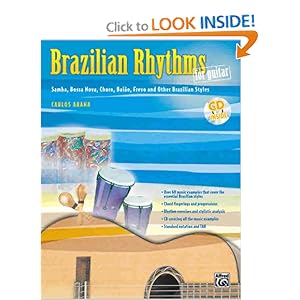
Amazon.com: Brazilian Rhythms For Guitar (Book & CD) (Guitar Masters Series) (9780757940798): Carlos Arana: Books
if you are lucky enough to live in sunny CA, there is a brazilian music camp every summer...



 Reply With Quote


Andy Bartosh plays "Dolphin Dance"
Yesterday, 04:20 PM in The Players